
What does the battery really cost?
A pack is the most expensive part to replace. We turn cycles and your real usage into a cost per km and a replacement year - so there are no surprises.
Showing 0 of 595. Type to find a bike.
How this is calculated
Lifetime km = rated cycles × km per charge. Cost per km = replacement price ÷ lifetime km. Replacement year = lifetime km ÷ your annual km.
| Battery capacity | 1680 Wh |
|---|---|
| Replacement price | $2,177 |
| Rated charge cycles | 800 |
| Range per charge | 70 mi |
| Lifetime | 55,675 mi |
| Cost of one full charge | $0.29 |
| Battery cost per distance | $0.039/mi |
E-bike battery calculator: frequently asked questions
How long an e-bike battery lasts, how we calculate cost per kilometre and replacement year, and how to make your pack last as long as possible.
What is the e-bike battery calculator?
It is a tool that turns a battery's specifications and your usage into the numbers that matter: how many kilometres the pack will cover in its life, what each kilometre costs in battery terms, and roughly which year you will need a replacement. It helps you judge whether a battery is good value before you buy.
How long does an e-bike battery last?
Most e-bike batteries last several years and several hundred to over a thousand charge cycles before capacity falls to around 70 to 80 percent of new. In distance terms that is often 15,000 to 40,000 kilometres depending on capacity. Your real figure depends on how far you ride each year and how well you treat the pack.
How is battery lifespan calculated?
Lifetime kilometres equals the battery's rated charge cycles multiplied by the kilometres you get per charge. For example, 800 cycles at 40 kilometres per charge is 32,000 lifetime kilometres. Dividing that by your annual distance gives the likely replacement year.
What is a charge cycle?
A charge cycle is one full discharge and recharge of the battery, equivalent to using 100 percent of its capacity. Two half discharges count as one cycle. Manufacturers rate batteries for a number of cycles before meaningful capacity loss, which is the figure we use to estimate lifespan.
How do you calculate battery cost per km?
Cost per kilometre is the replacement price of the battery divided by its lifetime kilometres. A 600 euro battery rated for 30,000 kilometres works out to about 0.02 euros per kilometre. This lets you compare a cheap battery with a short life against a pricier one that lasts much longer.
When will I need to replace my e-bike battery?
When capacity drops far enough that the bike no longer covers your needs, usually around the 70 percent mark. The calculator estimates the replacement year by dividing the battery's lifetime kilometres by your annual distance, so a low-mileage rider may keep a pack for many years while a daily long-distance commuter replaces sooner.
What does battery degradation mean?
Degradation is the gradual, normal loss of capacity as a lithium-ion battery ages and is cycled. It is not a fault. A pack slowly holds less charge, so range shrinks over time. Our degradation curve assumes capacity falls toward a 70 percent end-of-life threshold, the point most riders notice meaningfully shorter range.
How much does an e-bike battery cost to replace?
Replacement batteries typically cost roughly one to one-and-a-half euros per watt-hour, so a 500 Wh pack is often in the region of 500 to 750 euros. Because it is the most expensive part to replace, battery economics should be part of your buying decision, not an afterthought.
How can I make my e-bike battery last longer?
Avoid leaving the pack at 100 percent or fully empty for long periods, keep it out of extreme heat and cold, store it around half charge if you are not riding for weeks, and charge it indoors in winter. Gentle, partial charging and moderate temperatures are the biggest factors in slowing degradation.
What does end-of-life at 70 percent mean?
Battery life is usually defined as the point where capacity has dropped to about 70 percent of when it was new. The battery still works below that, but range is noticeably reduced and most riders choose to replace it. We mark this threshold on the degradation chart so you can see when it is likely to arrive.
Guides related to this calculator
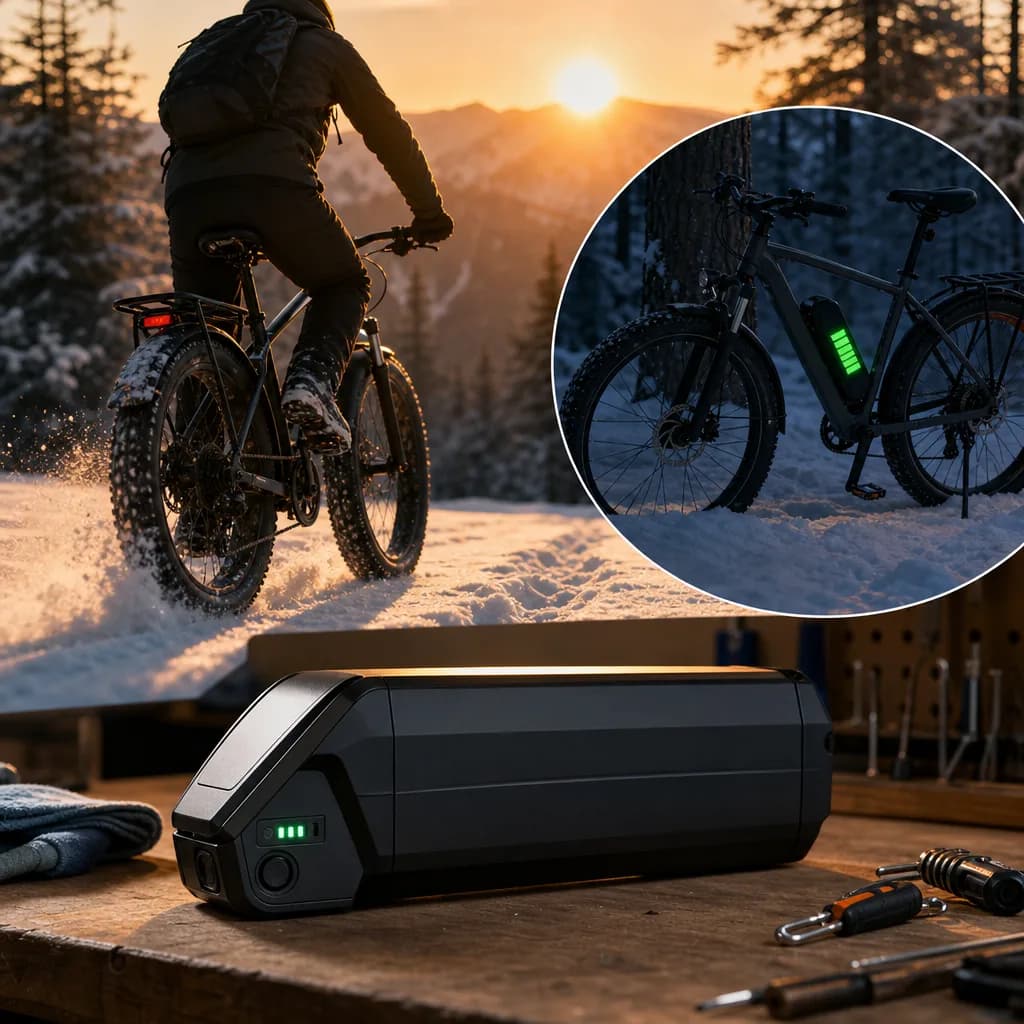 Batteries
How Cold Weather Drains Your E-Bike Battery (and What to Do)
Cold weather can cut your e-bike range by 40 percent. Learn why lithium batteries struggle in winter and get simple tips to get more miles from each charge.
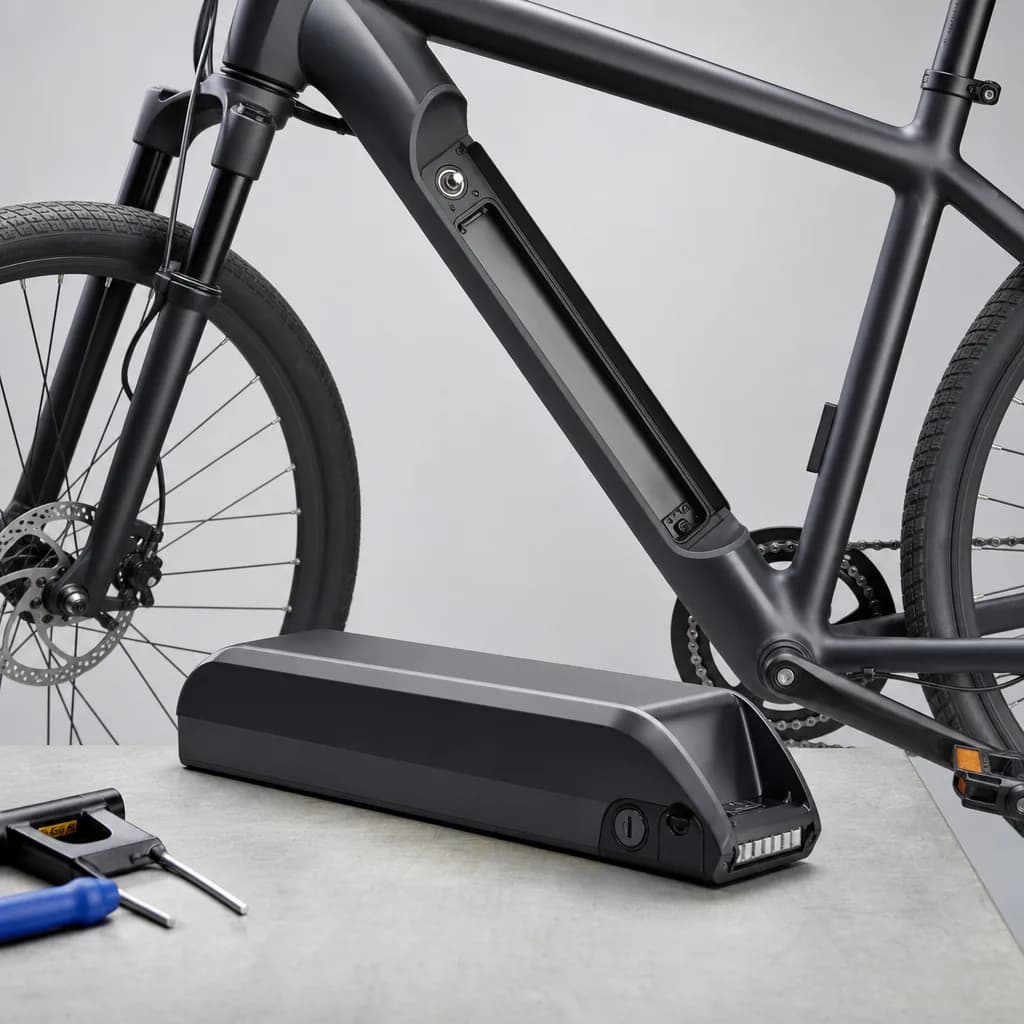 Batteries
How Long Do E-Bike Batteries Last? The Honest Answer
E-bike batteries last 3-5 years or 500-1000 full charges. Learn what affects lifespan and how to get the most from your battery.
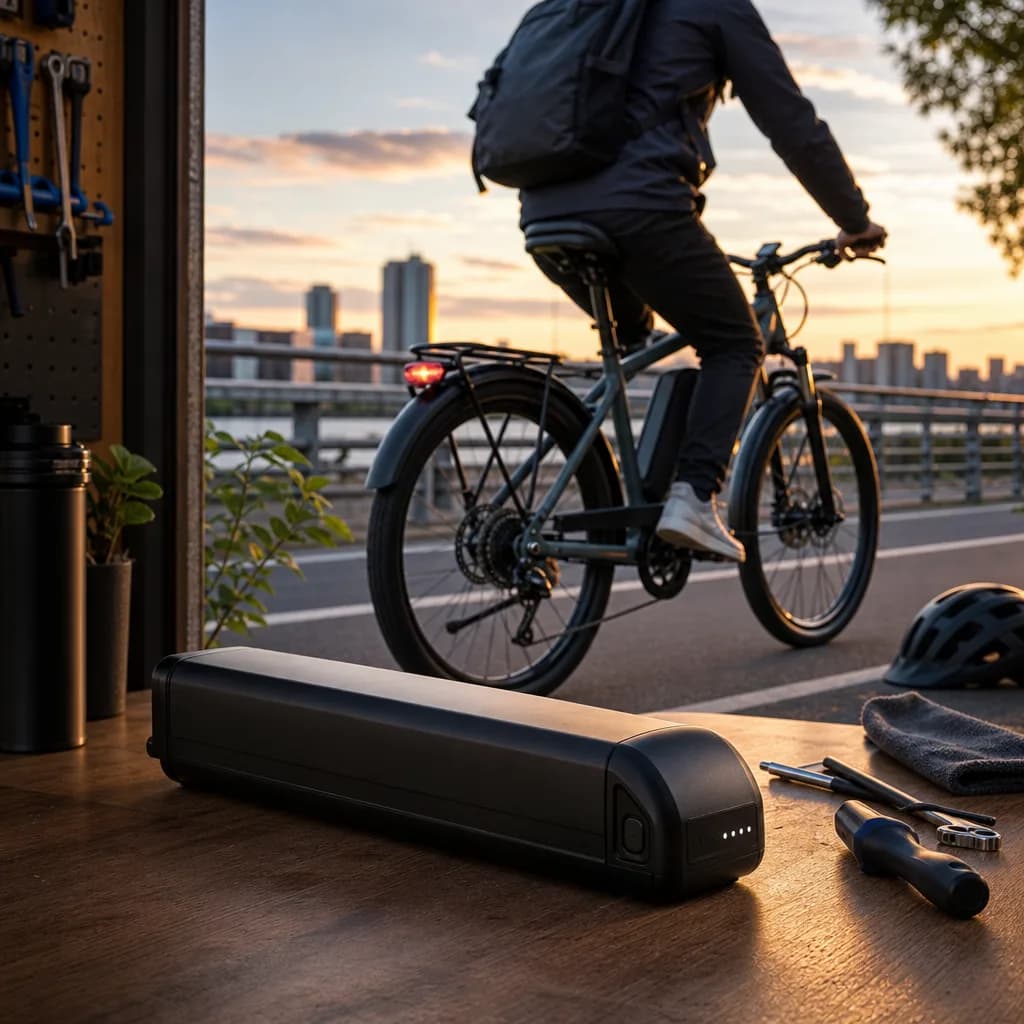 Batteries
What Battery Size Do You Actually Need for Your Commute?
Not sure what battery size you need for your commute? We break down how range, weight, and terrain affect your choice. Use our calculators to find the perfect fit.
How this is calculated
Every figure this tool produces comes from the formula below and the constants beside it. They are the same values the code runs, not a description of them, so what you see here is what the calculator did.
usable range = Wh / consumption, and Wh = amp hours x volts
| Input | Value used |
|---|---|
| Watt hours | amp hours multiplied by nominal voltage |
| Charge cost | Wh divided by 1000, multiplied by your electricity price (starts at your market's average, below), with no charger loss |
| Cycles | a cycle is one full charge, not one plug-in |
Electricity price by market
| Market | Price | Covers | Source |
|---|---|---|---|
| United States | $0.173 per kWh | average residential retail price in the United States, taxes and fees included (17.30 cents per kWh); 2025, annual average. | U.S. Energy Information Administration (Electric Power Monthly, Table 5.3), U.S. Energy Information Administration (what the price includes) (read 9 October 2026) |
| Europe | €0.2896 per kWh | EU-27 average household price, band DC (2,500 to 4,999 kWh a year), all taxes and levies included; second half of 2025. | Eurostat (dataset nrg_pc_204, band DC) (read 9 October 2026) |
| United Kingdom | £0.2632 per kWh | Ofgem price cap unit rate for electricity, Direct Debit, Great Britain average, no VAT on electricity in this period (26.32 pence per kWh, standing charge not included); 1 October to 31 December 2026, price cap period. | Ofgem (price cap rates) (read 9 October 2026) |
| Canada | None. Calculators start at 0.30 EUR, converted. | Canada has no national tariff. The Canada Energy Regulator publishes provincial prices only as a chart, without taxes, and states no national average. We found no official city or national figure we could read, so we show none. | Canada Energy Regulator (provincial prices) (read 9 October 2026) |
| Australia | None. Calculators start at 0.30 EUR, converted. | Australian prices differ by state and network. The AEMC's price report is a projection drawn in charts without a figure, and we found no national average on an official source we could read, so we show none. | Australian Energy Market Commission (price outlook) (read 9 October 2026) |
Where these constants come from, and what the model cannot tell you: read the methodology