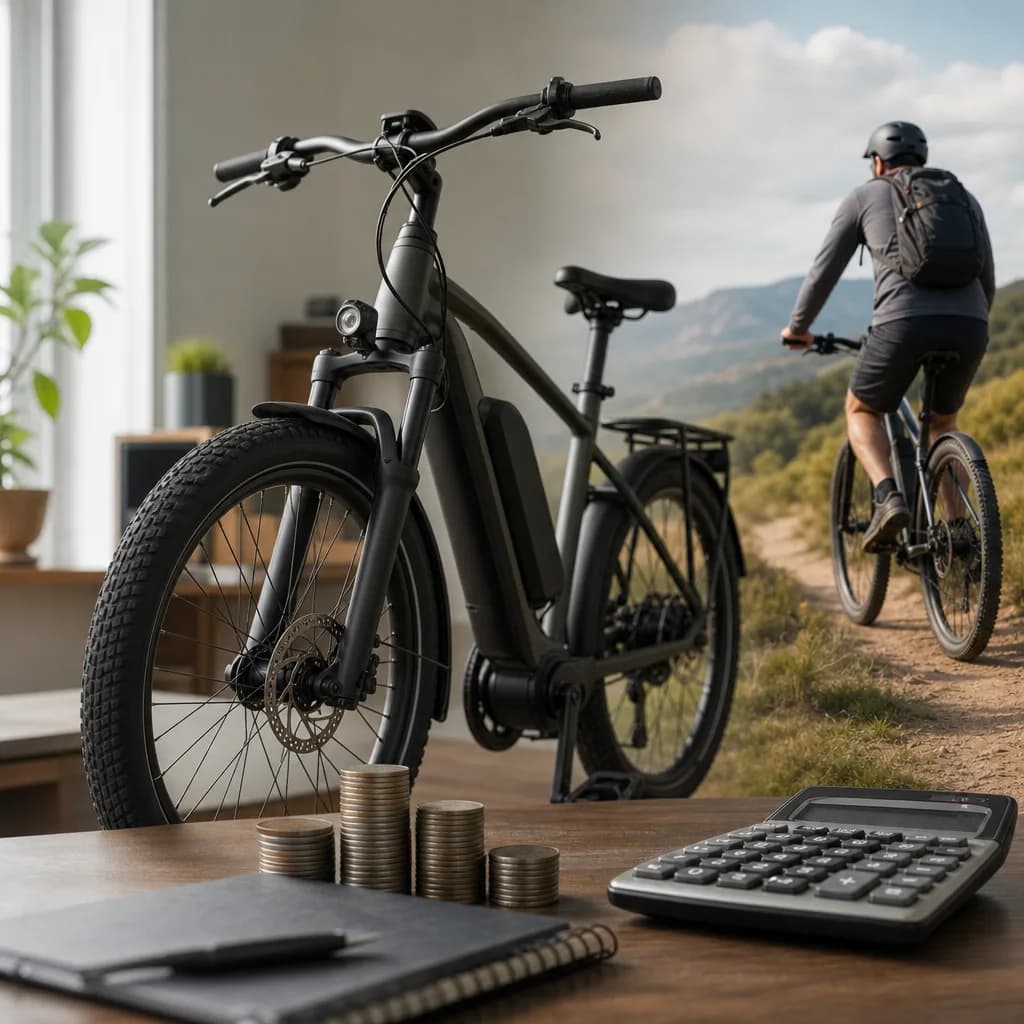
Which is cheaper to own?
Sticker price is just the start. Pick two bikes and we'll project the full cost over your ownership - charging, service, battery replacement and resale value included.
Pick two bikes above to see the comparison.
E-bike cost of ownership calculator: frequently asked questions
How total cost of ownership works, what we include beyond the sticker price, and how to compare two e-bikes fairly over several years.
What is total cost of ownership for an e-bike?
Total cost of ownership, or TCO, is the full cost of owning an e-bike over time, not just its purchase price. It adds up charging, maintenance and battery replacement, then subtracts the bike's resale value, to show what the bike really costs you across the years you own it.
How is e-bike TCO calculated?
We add the purchase price, total charging cost, total maintenance and any battery replacement needed over your ownership period, then subtract estimated resale value. Dividing the result by total kilometres gives a cost per kilometre, which is the fairest way to compare two bikes with different prices and efficiencies.
What is included beyond the purchase price?
Charging (based on your annual distance, the motor's consumption and your electricity price), maintenance (higher for mid-drive motors than hub motors because they wear the chain and gears), battery replacement if you exceed the pack's lifetime, and resale value as a credit. Together these can change which of two bikes is actually cheaper.
How do you estimate battery replacement cost?
We work out the battery's lifetime kilometres from its rated charge cycles and kilometres per charge. If your total distance over the ownership period exceeds that lifetime, we add a replacement at roughly 1.20 euros per watt-hour. A bigger or longer-lived battery may avoid a replacement entirely within your ownership window.
How is resale value calculated?
Resale value is estimated as a percentage of the purchase price that decays over time. We start from around 60 percent and apply a steady annual decline with a sensible floor, so a bike sold after a few years still returns some value. A higher resale credit lowers the effective cost of owning the bike.
Why does motor type affect maintenance cost?
A mid-drive motor pushes its power through the chain, cassette and chainring, so those parts wear faster and cost more to replace over time. A hub motor drives the wheel directly and leaves the drivetrain alone, so it is usually cheaper to maintain. We assume around 120 euros a year for hub bikes and 180 euros for mid-drives.
How do I compare two e-bikes' cost?
Pick a bike for slot A and another for slot B, set your ownership years, annual distance and electricity price, and the calculator shows each bike's total cost side by side with a cost breakdown and a clear verdict on which is cheaper to own. It is the best way to see past the sticker price.
Over how many years should I calculate TCO?
Five years is a sensible default that captures at least one likely battery question and meaningful depreciation, but you can set anything from one to ten years. A longer window favours efficient, durable bikes that hold their value, while a short window weights the purchase price more heavily.
Does a cheaper e-bike always cost less to own?
No. A bike with a low sticker price but an expensive, short-lived battery and high maintenance can cost more over five years than a pricier bike that sips power and holds its value. Comparing total cost of ownership rather than purchase price is the only way to know which is genuinely cheaper.
What is a good cost per km for an e-bike?
It depends on price and usage, but many quality e-bikes land somewhere around 0.20 to 0.40 euros per kilometre once everything is included, which is still far below the true cost of car travel. The calculator shows cost per kilometre for both bikes so you can judge value on a like-for-like basis.