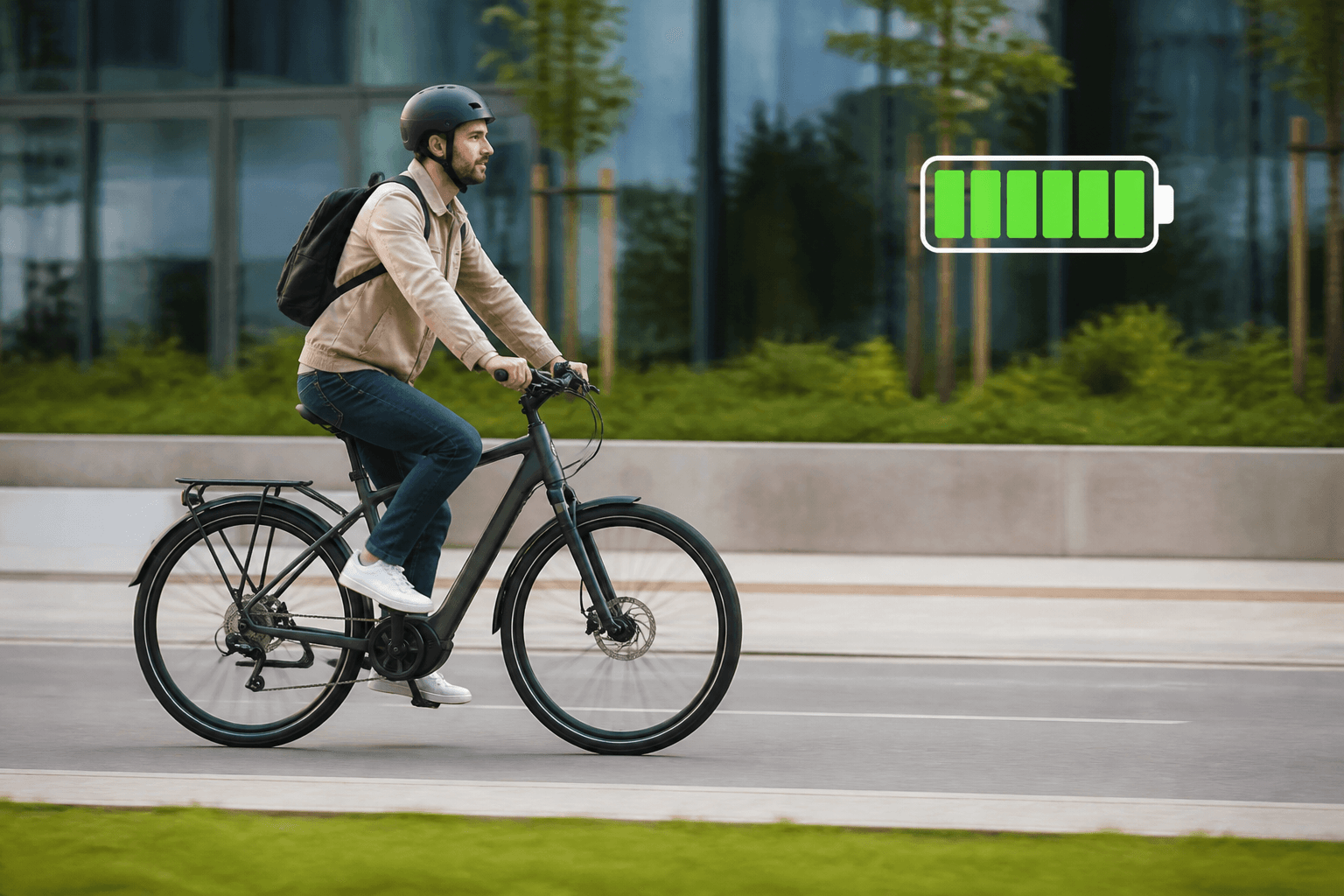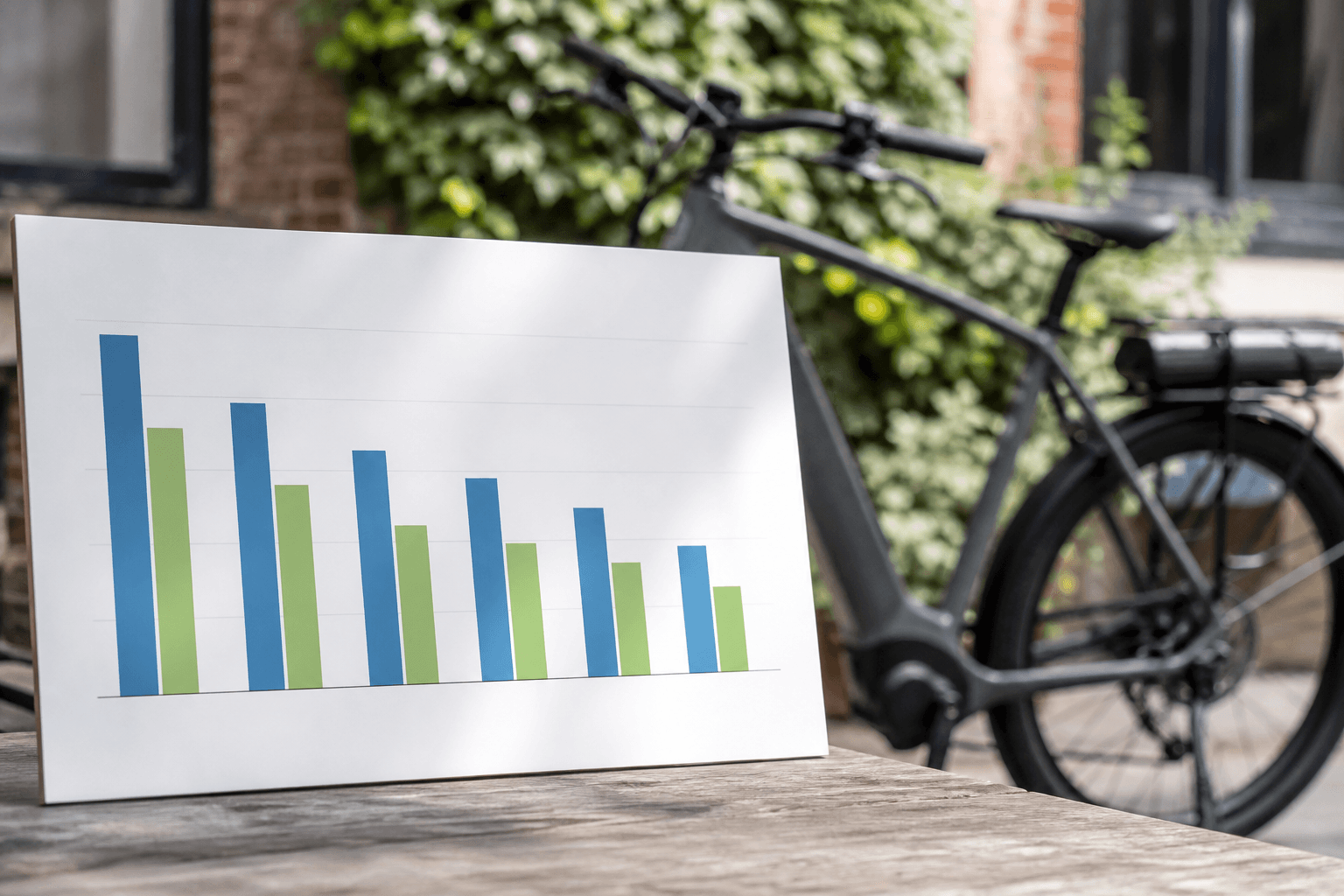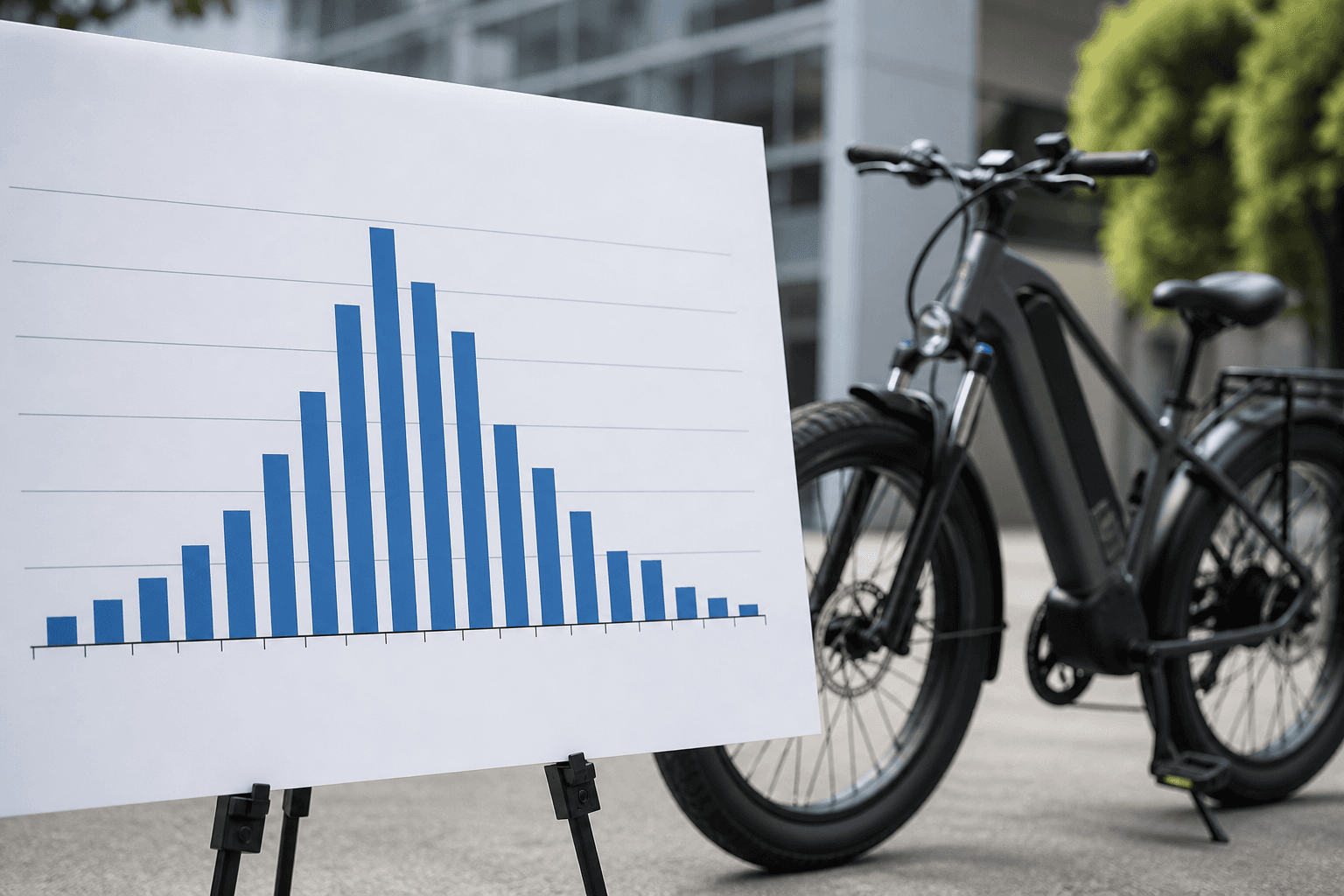

An e-bike's real range on one charge is usually about half of what the manufacturer claims. In our catalogue of 275 bikes, the median claimed range is 97 km, but the median estimated range is 48 km. That is a 50 percent overclaim on average. Of the 275 bikes with a claim, 271 claim more than our estimate. So when you see a range figure on a spec sheet, expect to get roughly half of it in real-world riding.
What Is E-Bike Range?
E-bike range is the distance you can travel on a single full battery charge. It depends on how much energy the battery stores and how quickly the motor uses it. Battery capacity is measured in watt hours (Wh). The median battery in our catalogue is 720 Wh. The motor's energy consumption depends on how much assistance you use and the conditions you ride in.
Manufacturers often quote a range from a test that uses the lowest assist level, a light rider, flat ground, and warm weather. That is the best case, not the typical case. Our estimates use a more realistic set of assumptions, based on published formulas and constants. We do not test bikes; we calculate from specifications.
Key Factors That Affect Range
Several factors determine how far you can go. The most important is your assist level. Eco mode uses 7 Wh per km, Tour uses 11, Sport uses 15, and Turbo uses 20. That means Turbo consumes nearly three times as much energy as Eco. If you ride mostly in Turbo, your range will be much shorter.
Terrain is the second big factor. Flat ground has a multiplier of 1, rolling hills 1.25, and steep hills 1.6. A route with steep climbs can cut your range by more than a third. Tyres also matter: road tyres have a multiplier of 1, hybrid 1.1, and knobby 1.25. Knobby tyres, common on mountain bikes, increase rolling resistance and reduce range.
Temperature and pace also play a role. Cold weather increases consumption by 20 percent. Riding at a relaxed pace reduces consumption by 10 percent, while a fast pace increases it by 30 percent. Your weight matters too: for every 5 kg above or below 80 kg, range changes by 1 percent. A heavier rider will see shorter range.
| Factor | Effect on Range |
|---|---|
| Assist level | Eco: 7 Wh/km, Tour: 11, Sport: 15, Turbo: 20 |
| Terrain | Flat: 1, Rolling: 1.25, Steep: 1.6 |
| Tyres | Road: 1, Hybrid: 1.1, Knobby: 1.25 |
| Temperature | Mild: 1, Cold: 1.2 |
| Pace | Relaxed: 0.9, Brisk: 1, Fast: 1.3 |
| Rider weight | 1% per 5 kg from 80 kg |
How to Estimate Your Real-World Range
To estimate your range, start with your battery capacity in watt hours. Then divide by the energy consumption per km for your riding style. For example, a 720 Wh battery in ordinary riding (Tour, rolling) uses 11 Wh per km times 1.25, which is about 13.75 Wh per km. That gives a range of about 48 km. Our worked examples show a range of 48 km, in a band of 42 to 53 km.
The range band of plus or minus 12 percent accounts for variations in conditions. In easy riding (Eco, flat), the same battery goes 94 km, with a band of 82 to 105 km. In hard riding (Turbo, steep), it drops to 20 km, with a band of 18 to 23 km. Cold weather reduces the ordinary range to 40 km.
You can use our range calculator to get a personalized estimate. It asks for your battery size, assist level, terrain, tyre type, temperature, and rider weight. It then shows the estimated range and the band. This is more accurate than relying on the manufacturer's claim.
Range by Battery Size: Examples
Battery size is the biggest determinant of range. Larger batteries store more energy, so they go further. But the relationship is not linear because consumption depends on riding style. Here are examples of ordinary range (Tour, rolling) for different battery sizes, from our worked examples.
| Battery (Wh) | Ordinary Range (km) | Replacement Pack (EUR) |
|---|---|---|
| 192 | 13 | 230 |
| 346 | 23 | 415 |
| 450 | 30 | 540 |
| 518 | 34 | 622 |
| 600 | 40 | 720 |
| 672 | 44 | 806 |
| 720 | 48 | 864 |
| 768 | 51 | 922 |
| 816 | 54 | 979 |
| 884 | 58 | 1061 |
| 1056 | 70 | 1267 |
| 1200 | 79 | 1440 |
| 1440 | 95 | 1728 |
The median battery in our catalogue is 720 Wh, which gives an ordinary range of 48 km. The largest battery we have is 1440 Wh, on the Troxus Trax Plus, which gives 95 km. The smallest is 192 Wh, on the Ridel Cruzzer, which gives only 13 km. Consider your typical ride distance when choosing a battery.
Tips to Extend Your E-Bike Range
You can stretch your range by adjusting how you ride. Use a lower assist level when possible. Eco uses 7 Wh per km, while Turbo uses 20. If you can ride in Eco or Tour, you will go much further. Shift gears to keep a steady cadence, especially on hills. Avoid sudden accelerations and high speeds, as fast pace increases consumption by 30 percent.
Maintain your tyres at the recommended pressure. Under-inflated tyres increase rolling resistance, which reduces range. Choose road or hybrid tyres if you ride mostly on pavement; knobby tyres are for off-road and cost range. Remove unnecessary weight from the bike, as extra weight increases consumption.
Plan your route to avoid steep hills if range is a concern. A steep hill multiplier of 1.6 can cut your range by more than a third. If you must climb, use a lower assist level and pedal more. Also, consider the temperature: cold weather increases consumption by 20 percent, so expect less range in winter.
Battery Health and Range Over Time
Batteries degrade with use. A typical battery lasts about 800 full charge cycles before its capacity drops significantly. For a median battery of 720 Wh, that is 38400 km of riding. After that, you may need to replace the pack. Replacement costs vary: a 720 Wh pack costs about 864 EUR at 1.2 EUR per Wh.
To extend battery life, avoid fully discharging it regularly. Charge it to about 80 percent for daily use, and only charge to 100 percent before a long ride. Store the battery in a cool, dry place, especially in winter. Extreme heat and cold can damage the cells.
Our cost of ownership calculator includes battery replacement over five years. For a median bike, five years of ownership costs 1642 EUR total, including charging (63 EUR), servicing (600 EUR), and what the bike is worth at the end (316 EUR). That works out to 0.11 EUR per km.
E-Bike Range vs. Other Transport Costs
E-bikes are cheap to run. Electricity to ride 100 km costs about 0.42 EUR. Over a year of riding 1000 km, electricity costs just 4 EUR. Even adding servicing on a hub motor, that is 124 EUR per 1000 km. Compare that to driving a car, which costs about 0.06 EUR per km in maintenance, 0.12 in depreciation, and 0.02 in parking, totaling 0.20 EUR per km before fuel.
Riding an e-bike instead of driving can save a lot. If you ride 50 km a week instead of driving, you save 486 EUR a year. At 100 km a week, you save 1072 EUR a year. At 200 km a week, you save 2245 EUR a year. A 1295 EUR bike pays for itself in 32 months at 50 km a week, 14 months at 100 km, and 7 months at 200 km.
| Weekly Riding | Annual Saving (EUR) | Months to Pay Back a 1295 EUR Bike |
|---|---|---|
| 50 km | 486 | 32 |
| 100 km | 1072 | 14 |
| 200 km | 2245 | 7 |
E-bikes also have a much lower carbon footprint. A car emits 170 g of CO2 per km, while an e-bike emits 5 g. Over a year of 1000 km, that is a difference of 165 kg of CO2. A single tree absorbs about 22 kg per year, so riding an e-bike is like planting several trees.
Choosing the Right E-Bike for Your Range Needs
When choosing an e-bike, think about your typical ride distance. If you commute less than 20 km round trip, a smaller battery may suffice. If you plan longer rides or have a hilly route, opt for a larger battery. The median price in our catalogue is 1399 USD, but prices range from 399 to 4499 USD.
Consider the bike's weight and type. A lighter bike, like the Fiido Air Carbon at 13.6 kg, is easier to pedal without assistance and may use less energy. Heavier bikes, like the Hiboy C1 at 56.7 kg, are more demanding. Also, think about the motor type: mid-drive motors are more efficient but cost more to service (180 EUR per year) than hub motors (120 EUR per year).
Use our find-my-ebike tool to narrow down options based on your needs. You can also browse the full catalogue and filter by battery size, price, and type. Look for bikes with realistic range estimates, not just the claimed figure.
Where to Find Deals on E-Bikes
E-bikes are available from many online retailers and local bike shops. Prices vary widely. The cheapest bike in our catalogue is the Fiido D3 Pro at 399 USD, while the most expensive is the Cyrusher Trident at 4499 USD. A quarter of bikes cost under 999 USD, half under 1399 USD, and three quarters under 1899 USD. Only a tenth cost above 2299 USD.
Look for sales during holidays or end-of-season clearances. Some brands offer discounts on last year's models. Also consider refurbished or demo bikes, but check the battery condition. A replacement battery can cost a significant portion of the bike's price.
When comparing prices, factor in the total cost of ownership. A cheap bike with a small battery may not meet your range needs, and you might end up replacing it sooner. Use our cost of ownership calculator to compare models over five years.
Financing Your E-Bike
If you cannot pay upfront, many retailers offer financing. A 1295 EUR bike over 24 months at 0 percent APR costs 54 EUR per month, with no interest. At 9.9 percent APR, the monthly payment is 60 EUR, and you pay 138 EUR in interest. Always check the APR and total cost before signing.
Consider whether the savings from riding an e-bike can cover the monthly payment. If you ride 100 km a week, you save 1072 EUR a year, which is about 89 EUR a month. That can cover a 0 percent APR payment and more. Use our finance calculator to see what you can afford.
What to Do Next
Start by estimating your real-world range needs. Think about your daily commute, errands, and weekend rides. Use our range calculator to see what battery size you need. Then set a budget and use our find-my-ebike tool to narrow down options. Compare total cost of ownership, not just the purchase price.
Once you have a shortlist, check the estimated range for each bike and read reviews from other owners. Remember that the claimed range is often inflated, so rely on our estimates. And if you plan to finance, use the finance calculator to understand the monthly cost.
Finally, consider the long-term savings. Riding an e-bike instead of driving can save you thousands of euros a year, and it is better for the environment. With the right bike, you can enjoy the freedom of two wheels without worrying about running out of power.
Frequently asked questions
Why is the claimed range often higher than the real range?
Manufacturers often test in ideal conditions: low assist, flat ground, light rider, warm weather. In our catalogue, the median claimed range is 97 km, but the median estimated range is 48 km. That is a 50 percent overclaim on average.
How much does battery size affect range?
Battery size is the main factor. A 720 Wh battery can go 94 km in easy riding (Eco, flat) but only 20 km in hard riding (Turbo, steep). Larger batteries like 1440 Wh can reach 95 km in ordinary riding, while smaller ones like 192 Wh manage only 13 km.
Does riding style really change range that much?
Yes. Assist level and terrain have a huge impact. Eco uses 7 Wh per km, Tour 11, Sport 15, and Turbo 20. Rolling hills multiply consumption by 1.25, steep hills by 1.6. A relaxed pace reduces consumption by 10 percent, a fast pace increases it by 30 percent.
How can I estimate my own e-bike range?
Use our range calculator. It takes your battery size, assist level, terrain, tyre type, temperature, and rider weight. It also shows a range band of plus or minus 12 percent, because real-world conditions vary.
Does cold weather reduce range?
Yes, cold weather increases energy consumption by 20 percent. For example, a 720 Wh battery that gives 48 km in ordinary riding at mild temperatures drops to 40 km in the cold.