
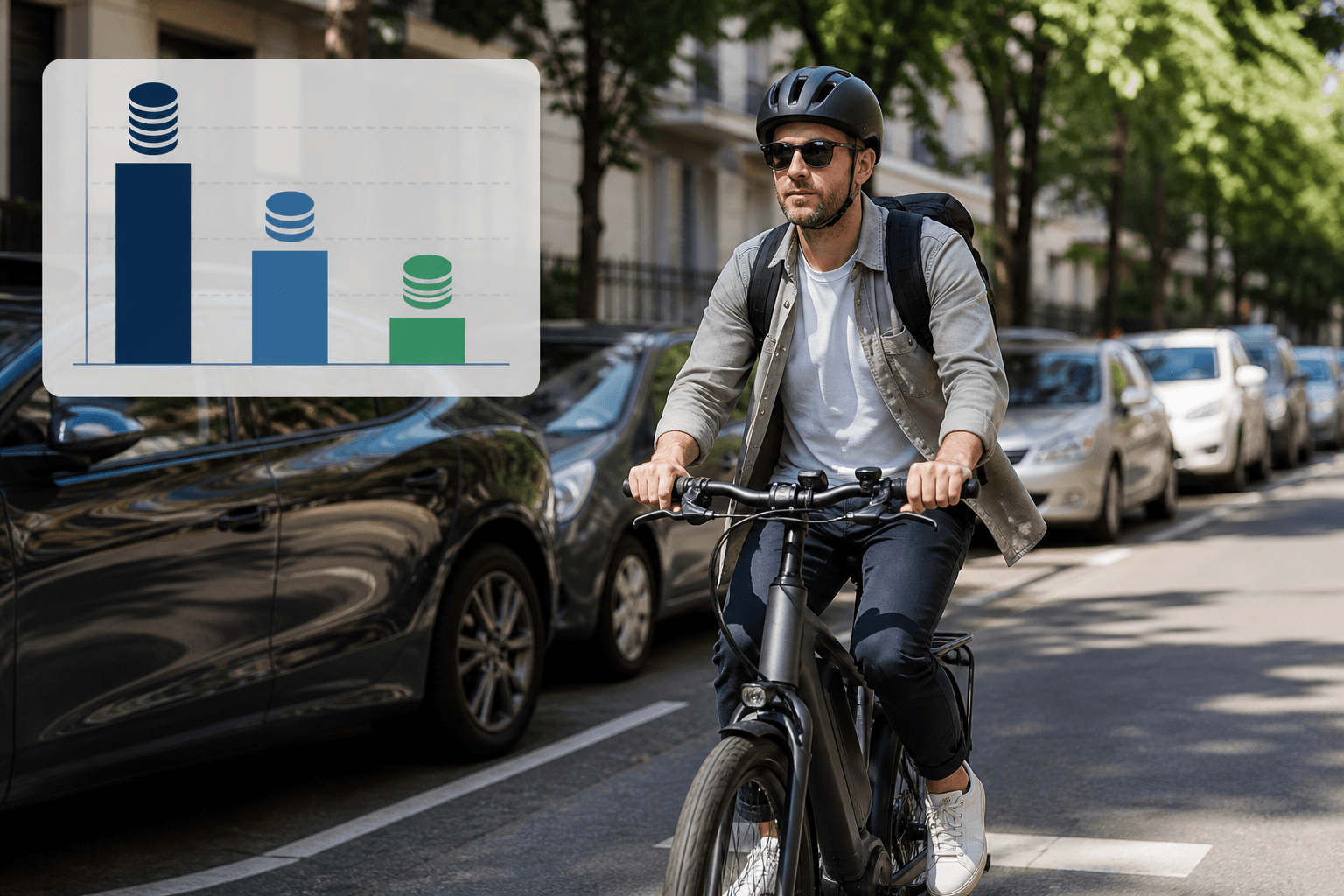
If you ride a city e-bike to work instead of driving, the bike often pays for itself. The median city e-bike costs 0.10 EUR per km over five years. Driving costs about 0.20 EUR per km in maintenance, depreciation, and parking alone. Over a 10 km commute, that is a saving of 1 EUR each way. The question is which bike gives you the lowest cost per commute without sacrificing what you need.
This guide ranks the 144 city e-bikes in our catalogue by their five-year cost per km. We use published specifications and open formulas. No one here has ridden any bike. Everything comes from the numbers you see on the spec sheet. The total cost depends on your mileage, your electricity tariff, and how long you keep the bike. Our savings calculator does that arithmetic for you.
What Goes Into Cost Per Commute
Five things drive the cost of owning a city e-bike: the purchase price, charging, servicing, battery replacement, and resale value. The purchase price is the biggest. The median price in our catalogue is 1299 USD. A quarter of bikes cost under 960 USD, half under 1299 USD, and three quarters under 1781 USD. The cheapest city bike is 500 USD. The most expensive city bike is 3335 USD.
Charging is small. Electricity to ride 100 km costs 0.42 EUR at 0.28 EUR per kWh. Riding 1000 km a year costs 4 EUR in electricity. Riding 3000 km a year costs 13 EUR. Riding 5000 km a year costs 21 EUR. Servicing is larger. We count 100 EUR a year for any e-bike, plus extra for mid-drive motors. A bike with 60 Nm or more torque counts as a mid-drive. Servicing a hub motor costs 120 EUR a year. A mid-drive costs 180 EUR a year.
Battery replacement matters over five years. A battery lasts 800 full cycles. The median battery is 720 Wh. Replacing a 720 Wh pack at 1.2 EUR per Wh costs 864 EUR. That is more than many bikes cost new. Resale value helps. After five years, a bike retains about 0.6 times e to the power of minus 0.18 times 5, floored at 0.15. For a 1203 EUR bike, that is 293 EUR in our worked example.
The Range Problem: Claims vs Reality
Every city e-bike lists a claimed range. Most are optimistic. In our catalogue, the median overclaim is 50 percent. The widest overclaim is 84 percent. Of 505 bikes with a claim, 483 exceed our estimate. Only 22 come in at or under it. The Hidoes C5 comes closest. Its claimed range is 27 km and our estimate is 27 km. The Aventon Ramblas eMTB has the widest gap. It claims 20 km but we estimate 20 km, a 0 percent difference? No, the widest gap is 84 percent.
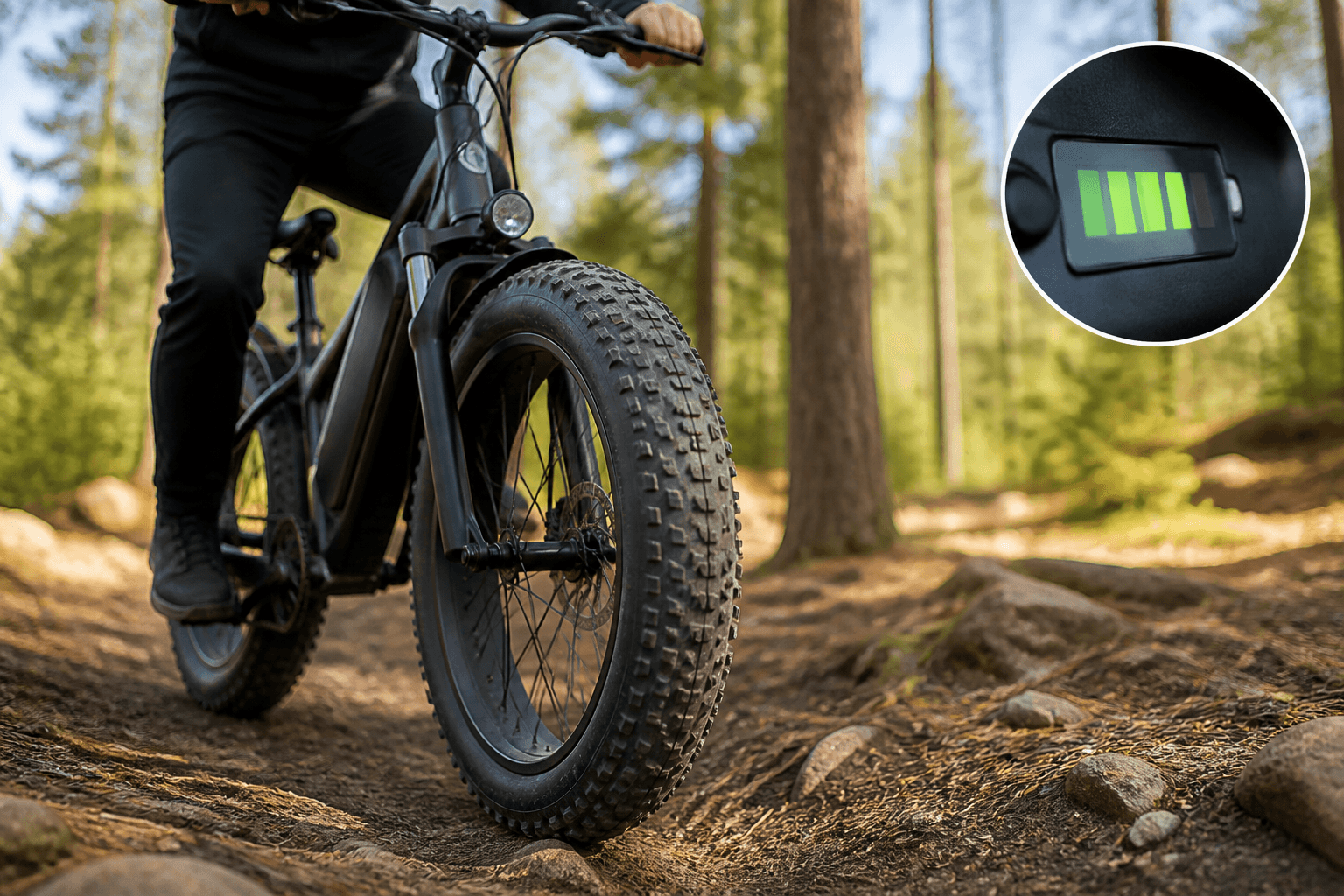
Our range estimate uses assist consumption per km. Eco mode uses 7 Wh per km. Tour uses 11 Wh per km. Sport uses 15 Wh per km. Turbo uses 20 Wh per km. Terrain, tyres, temperature, and pace adjust that. A 720 Wh battery in easy riding gives 94 km, with a band of 82 to 105 km. Ordinary riding gives 48 km, band 42 to 53 km. Hard riding gives 20 km, band 18 to 23 km. Cold weather cuts it to 40 km. Knobby tyres cut it to 42 km. Road tyres give 52 km.
For a city commute, you rarely need a huge battery. The median battery is 720 Wh. That gives you about 48 km in ordinary riding. Most commutes are shorter. A 374 Wh battery, like the VIVI C26UL, gives 25 km. That is enough for a 10 km round trip. A 614 Wh battery, like the Fiido Air Carbon, gives 41 km. A 1040 Wh battery, like the Cyrusher Trident, gives 58 km. The extra battery weight and cost may not be worth it.
| Battery size | Ordinary range | Replacement cost |
|---|---|---|
| 374 Wh | 25 km | 449 EUR |
| 504 Wh | 33 km | 605 EUR |
| 614 Wh | 41 km | 737 EUR |
| 720 Wh | 48 km | 864 EUR |
| 1040 Wh | 69 km | 1248 EUR |
How We Rank: Five-Year Cost Per Km
To rank city e-bikes by cost per commute, we take the five-year total cost and divide by the kilometres ridden. The five-year total includes purchase price, charging, servicing, and battery replacement, minus resale value. Charging uses 15 Wh per km and 0.04 EUR per km for maintenance. Servicing is 100 EUR a year plus the motor type extra. Battery replacement assumes 800 cycles and a new pack at 1.2 EUR per Wh. Resale after five years uses the formula 0.6 times e to the power of minus 0.18 times 5, floored at 0.15.
The result is a cost per km that you can compare across bikes. For a median bike, that cost is 0.10 EUR per km. A cheaper bike with a smaller battery might cost less per km if you ride enough. A more expensive bike with a bigger battery might cost more, but it could save you time if you cannot charge at work. The ranking depends on your annual distance. We show worked examples for 50, 100, and 200 km per week.
| Weekly distance | Annual saving vs driving | Months to pay back a 1203 EUR bike |
|---|---|---|
| 50 km | 486 EUR | 30 months |
| 100 km | 1072 EUR | 13 months |
| 200 km | 2245 EUR | 6 months |
The Cheapest City Bikes to Own
If you want the lowest purchase price, the VIVI C26UL is the cheapest city bike in our catalogue at 500 USD. It has a 374 Wh battery and an estimated range of 27 km. That is enough for a short commute. But the cheapest to own over five years may not be the cheapest to buy. A slightly more expensive bike with a bigger battery could last longer and cost less per km if you ride a lot.
The Fafrees Hailong One is typical of the under 800 USD band. It costs 699 USD and has a 522 Wh battery. Its estimated range is 38 km. The Fiido E Gravel C22 is typical of the 800 to 1200 USD band. It costs 999 USD and has a 614 Wh battery. Its estimated range is 45 km. The HIMIWAY D3 is typical of the mid-priced city bikes. It costs 1299 USD and has a 720 Wh battery. Its estimated range is 52 km.
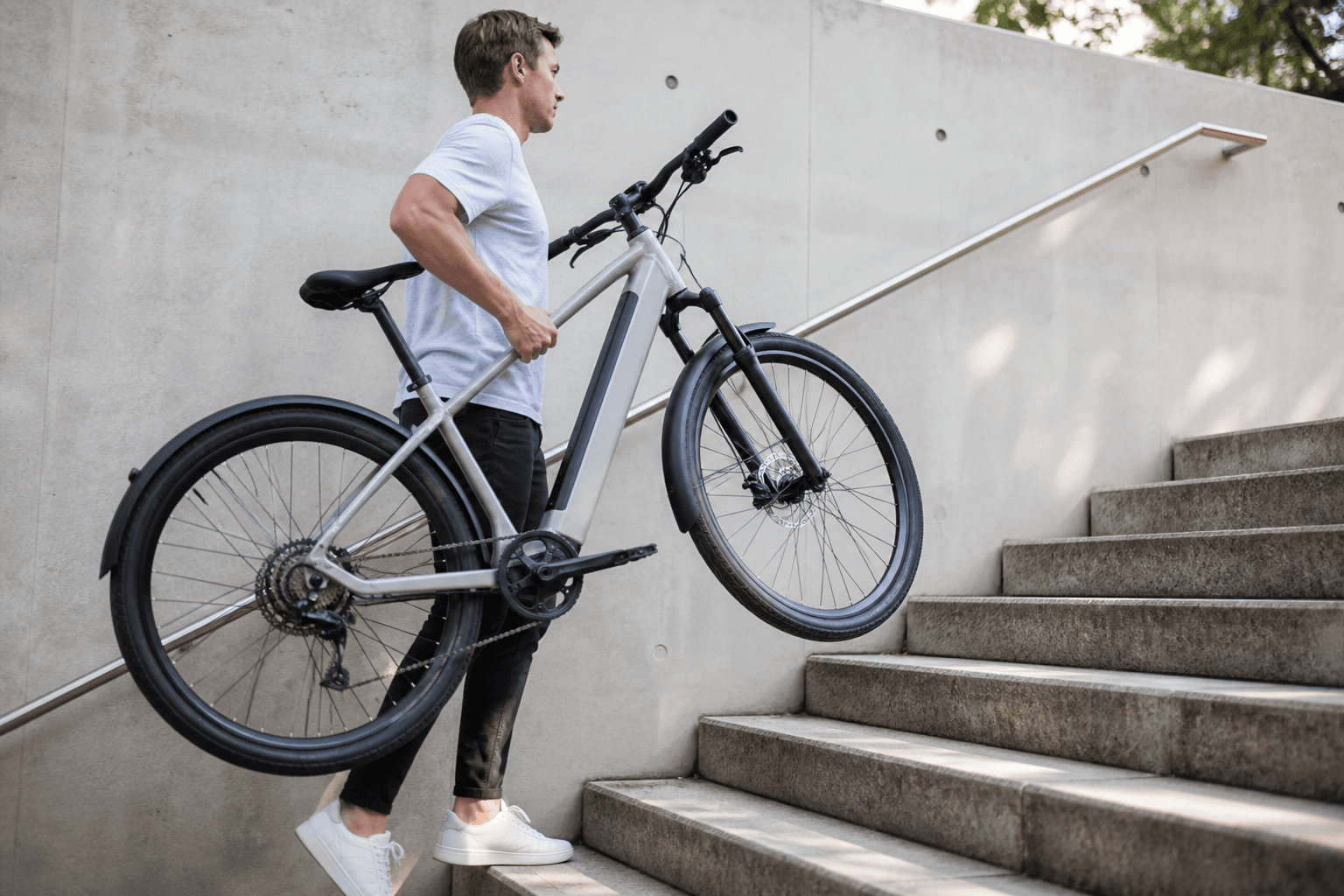
The most expensive city bike is the ADO AIR 30 PRO at 3335 USD. It has a 370 Wh battery and an estimated range of 27 km. That is a lot of money for a short range. But it is light at 20.4 kg. If you carry your bike up stairs, weight matters. The Fiido Air Carbon is the lightest city bike at 13.6 kg, with a 614 Wh battery and 46 km range. It costs 1799 USD.
Weight and Payload: What You Carry Matters
City e-bikes vary widely in weight. The median is 29.5 kg. The lightest city bike is the Fiido Air Carbon at 13.6 kg. The heaviest in the whole catalogue is the Hiboy C1 at 56.7 kg, but that is a folding bike. For city use, a lighter bike is easier to park and carry. But lighter often means a smaller battery and shorter range. The Fiido Air Carbon has a 614 Wh battery, which is decent. The ADO AIR Carbon is a folding bike at 15.9 kg, but it costs 4199 USD.
Payload rating tells you how much weight the bike can carry. Most bikes state a payload rating. The highest in our catalogue is 250 kg on the Riding Time GT53. That is a cargo bike. For city commuting, you might carry a laptop and a change of clothes. A typical payload of 100 kg is enough. Heavier riders should check the payload rating. Our range estimate adjusts for rider weight by 1 percent per 5 kg either side of 80 kg.
Battery Size vs Cost: Finding the Sweet Spot
Battery size drives both range and cost. The median battery is 720 Wh. Replacement costs 864 EUR. A smaller battery costs less to replace but gives less range. A 374 Wh battery costs 449 EUR to replace. A 504 Wh battery costs 605 EUR. A 614 Wh battery costs 737 EUR. A 1040 Wh battery costs 1248 EUR. For a city commute, you rarely need more than 720 Wh. The extra cost and weight are not worth it unless you have a long ride without charging.
The smallest battery in our catalogue is 187 Wh on the Onesport OT02 PRO. Its estimated range is 14 km. That is fine for a very short hop. The largest battery is 1920 Wh on the Coswheel GT20 PRO. Its estimated range is 107 km. That is overkill for most commutes. The median claimed range is 97 km, but our median estimate is 47 km. The gap shows why you should ignore claimed range and use our estimate.
| Battery | Example bike | Estimated range | Replacement cost |
|---|---|---|---|
| 374 Wh | VIVI C26UL | 27 km | 449 EUR |
| 522 Wh | Hiboy C1 | 36 km | 626 EUR |
| 720 Wh | HIMIWAY D3 | 52 km | 864 EUR |
| 1040 Wh | Cyrusher Trident | 58 km | 1248 EUR |
| 1920 Wh | Coswheel GT20 PRO | 107 km | 2304 EUR |
Financing a City E-Bike: What It Really Costs
If you finance your e-bike, the interest adds to the cost. A 1203 EUR bike over 24 months at 0 percent APR costs 50 EUR per month with 0 EUR interest. At 9.9 percent APR, the monthly payment is 55 EUR and the interest is 128 EUR. That is 128 EUR extra over two years. It might be worth it if you need the bike now, but it raises your cost per km.
Some places offer subsidies or tax breaks for e-bikes. These vary by country and city. Check locally to see what applies to you. Our finance calculator shows the monthly payment and total interest for any loan amount and APR.
The Best City E-Bike for Your Commute
The best city e-bike is the one that fits your commute distance, your budget, and your need for speed or cargo. For a short commute under 10 km, a cheap bike like the VIVI C26UL at 500 USD is hard to beat. For a longer commute of 20 km each way, you need a battery of at least 500 Wh. The HIMIWAY D3 at 1299 USD gives you 52 km of estimated range. For a hilly commute, look for a motor with more torque. The highest torque in our catalogue is 180 Nm on the Coswheel R6000.
If you carry a lot of gear, consider a cargo bike. The cheapest cargo bike is the Fiido M1 Pro at 799 USD. It has a 614 Wh battery and 41 km range. The Mukkpet Breeze is a mid-priced cargo bike at 1499 USD with a 720 Wh battery and 46 km range. The most expensive cargo bike is the HIMIWAY Big Dog at 3599 USD, also with a 720 Wh battery and 46 km range. Cargo bikes are heavier, so check the weight if you need to carry it up stairs.
What to Do Next
Start with your commute distance. Measure it in kilometres. Then use the savings calculator to see how much you would save by riding instead of driving. That tells you what a bike is worth to you. Then narrow the catalogue with find-my-ebike or browse the full list on bikes. Compare a few models on price, battery, and weight. Use the cost of ownership calculator to see the five-year total. Finally, check the finance calculator if you plan to borrow.
Remember that the cheapest bike is not always the cheapest to own. A bike with a smaller battery may need replacement sooner if you ride a lot. A bike with a mid-drive motor costs more to service. But for most city commutes, a simple hub motor and a battery around 500 to 700 Wh gives the best balance. The median city e-bike costs 0.10 EUR per km. That is a fraction of driving. The sooner you start riding, the sooner it pays off.
Frequently asked questions
How is cost per commute calculated?
Cost per km adds the bike's price, charging, servicing, and battery replacement over five years, then subtracts resale value. That total is divided by the kilometres you ride. Our [savings calculator](/calculators/savings) does this for you with your own mileage and local costs.
What is the median cost per km for a city e-bike?
For a median-priced bike, the five-year cost per km is 0.10 EUR. That figure comes from our [cost of ownership calculator](/calculators/cost-of-ownership) using the catalogue's median price of 1299 USD and a 720 Wh battery.
Do e-bikes really cost less than driving?
Yes, if you ride enough. Riding 50 km a week instead of driving saves 486 EUR a year. At 100 km a week, the saving is 1072 EUR a year. At 200 km a week, it is 2245 EUR a year. The [savings calculator](/calculators/savings) lets you compare your own commute.
Why do claimed ranges differ so much from real ones?
Most bikes overstate range. In our catalogue, the median overclaim is 50 percent. For a 720 Wh battery, the median claimed range is 97 km, but our estimate for ordinary riding is 48 km. Use the [range calculator](/calculators/range) to get a realistic figure for your conditions.
What is the cheapest city e-bike to run?
The cheapest city e-bike in our catalogue is the VIVI C26UL at 500 USD. But the cheapest to run over five years depends on your mileage and local electricity prices. The [savings calculator](/calculators/savings) shows the total cost for any bike.