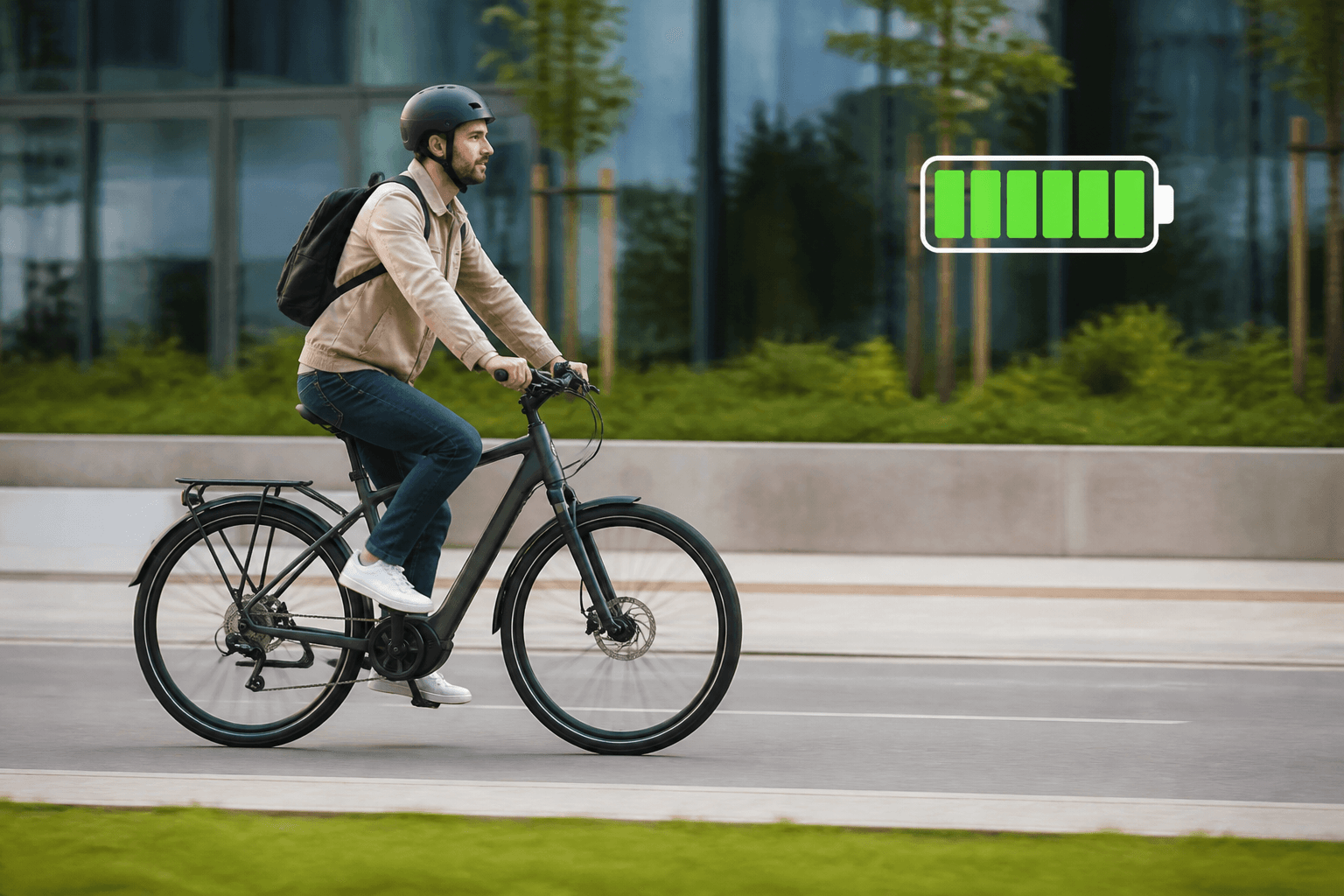

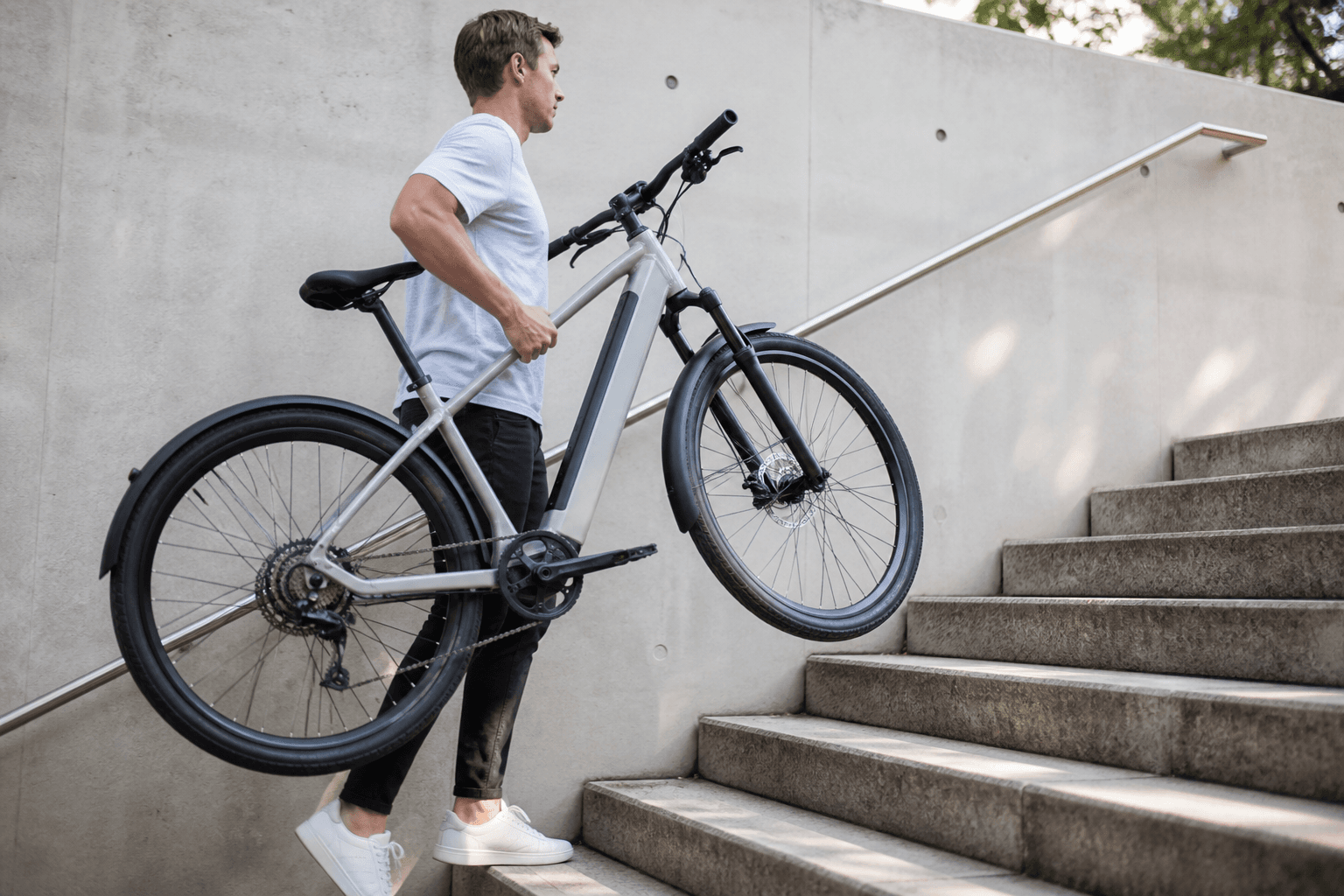
The lightest e-bike you can actually buy from our catalogue is the Fiido Air Carbon at 13.6 kg. That is about 30 pounds. It is a city bike with a 614 Wh battery and an estimated range of 46 km. It costs 1799 USD. But lightness is not the whole story. Weight decides how easily you carry the bike up stairs, onto a train, or into a flat. It also affects how far the battery takes you, because the motor has to move less mass. This guide looks at the light end of the catalogue, what it costs, and what you give up.
Why weight matters
Weight is the first thing you feel when you lift a bike. The median e-bike in our catalogue weighs 29.5 kg, about 65 pounds. That is heavy for stairs. The lightest, the Fiido Air Carbon, is 13.6 kg, less than half the median. The heaviest, the Hiboy C1, is 56.7 kg, more than four times the lightest.
Weight also changes range. A lighter bike needs less energy to accelerate and climb. Our range formula does not include bike weight directly, but rider weight matters. The formula adjusts range by 1 percent for every 5 kg the rider is away from 80 kg. A lighter bike often has a smaller battery, which can reduce range. The Fiido Air Carbon has a 614 Wh battery and an estimated range of 46 km. That is close to the median estimated range of 47 km for all bikes, despite the smaller battery.
The lightest bikes in our catalogue
We have 505 bikes in our catalogue. The lightest is the Fiido Air Carbon at 13.6 kg. It is a city bike with a 614 Wh battery, an estimated range of 46 km, and a price of 1799 USD. The next lightest we can name is the ADO AIR Carbon at 15.9 kg. That is a folding bike with a 346 Wh battery, an estimated range of 26 km, and a price of 4199 USD. The ADO AIR 30 PRO is 20.4 kg, a city bike with a 370 Wh battery, 27 km estimated range, and 3335 USD.
Among folding bikes, the Fiido D3 Pro is 17.7 kg, has a 374 Wh battery, an estimated range of 28 km, and costs 399 USD, the cheapest in the catalogue. The Onesport OT02 PRO is 17.2 kg, has a 187 Wh battery, an estimated range of 14 km, and costs 755 USD. The Fiido E Gravel C22 is 17.7 kg, a city bike with a 614 Wh battery, 45 km estimated range, and 999 USD.
| Bike | Type | Weight (kg) | Battery (Wh) | Est. range (km) | Price (USD) |
|---|---|---|---|---|---|
| Fiido Air Carbon | City | 13.6 | 614 | 46 | 1799 |
| ADO AIR Carbon | Folding | 15.9 | 346 | 26 | 4199 |
| Onesport OT02 PRO | Folding | 17.2 | 187 | 14 | 755 |
| Fiido D3 Pro | Folding | 17.7 | 374 | 28 | 399 |
| Fiido E Gravel C22 | City | 17.7 | 614 | 45 | 999 |
| ADO AIR 30 PRO | City | 20.4 | 370 | 27 | 3335 |
The lightest bikes tend to be city or folding models. Mountain bikes and cargo bikes are heavier. The lightest mountain bike we can name is the AAIRSK Q7 at 23.1 kg, with a 360 Wh battery and 21 km estimated range, for 647 USD. The lightest cargo bike is the Fiido M1 Pro at 24.9 kg, with a 614 Wh battery and 41 km estimated range, for 799 USD.
What lightness costs
Lightness often comes with a higher price. The Fiido Air Carbon costs 1799 USD. The ADO AIR Carbon costs 4199 USD. But you can get a light bike for less. The Fiido D3 Pro at 17.7 kg costs 399 USD. The Onesport OT02 PRO at 17.2 kg costs 755 USD. The Fiido E Gravel C22 at 17.7 kg costs 999 USD.
The price spread in our catalogue is wide. A quarter of bikes are under 960 USD, half under 1299 USD, three quarters under 1781 USD. The median price is 1299 USD. The cheapest is 399 USD, the most expensive 5799 USD. Light bikes appear across this range, but the very lightest often sit above the median.
Battery size and range trade-offs
Light bikes often have smaller batteries. The Fiido Air Carbon has a 614 Wh battery. The ADO AIR Carbon has 346 Wh. The Onesport OT02 PRO has 187 Wh, the smallest in the catalogue. Smaller batteries mean shorter range. The Onesport OT02 PRO has an estimated range of 14 km. That is enough for a short commute, but not much more.
The median battery in our catalogue is 720 Wh. That gives 48 km of ordinary riding. A 614 Wh battery gives 41 km, according to our worked example. The Fiido Air Carbon's estimate is 46 km, which is higher because the bike is light and the riding conditions are easy. Our range calculator lets you adjust for terrain, tyres, temperature, pace and rider weight.
If you need long range, a light bike may not be the best choice. The Emoko C94, a cargo bike, has the longest estimated range at 109 km, with a 1680 Wh battery. It weighs 35.8 kg. The Coswheel GT20 PRO has the largest battery at 1920 Wh and an estimated range of 107 km, but weighs 45 kg. You have to decide what matters more: carrying the bike or riding it far.
| Battery (Wh) | Ordinary range (km) | Replacement pack (EUR) |
|---|---|---|
| 187 | 12 | 224 |
| 346 | 23 | 415 |
| 370 | 24 | 444 |
| 374 | 25 | 449 |
| 614 | 41 | 737 |
| 720 | 48 | 864 |
Real range versus claimed range
Manufacturers often overstate range. In our catalogue, the median claimed range is 97 km, but the median estimated range is 47 km. The median overclaim is 50 percent. The widest overclaim is 84 percent, on the Aventon Ramblas eMTB. Its claimed range is not in the brief, but its estimated range is 20 km. The Hidoes C5 comes closest, with a claimed range that is close to its estimated 27 km.
Of the 505 bikes with a claim, 483 have a claim that exceeds our estimate. That is 96 percent. So you should treat any claimed range with suspicion. Use our range calculator instead. It uses assist consumption per km, terrain, tyres, temperature and pace. For a 720 Wh battery, easy riding gives 94 km, ordinary riding gives 48 km, and hard riding gives 20 km. The range band shown is plus or minus 12 percent.
Cost of ownership for light bikes
The price tag is only the start. You pay for charging, servicing, and eventually a new battery. For a median bike, five years total 1573 EUR. That includes 63 EUR for charging, 600 EUR for servicing, and 293 EUR resale value. The cost per km is 0.10 EUR.
Charging is cheap. Charging a median battery once costs 0.20 EUR at 0.28 EUR per kWh. Electricity to ride 100 km costs 0.42 EUR. Riding 5000 km a year costs 21 EUR in electricity. Servicing is more. Hub motors cost 120 EUR a year, mid-drives 180 EUR a year. A bike is counted as a mid-drive from 60 Nm of torque.
Battery replacement is the big cost. A 720 Wh pack costs 864 EUR to replace. A 614 Wh pack costs 737 EUR. A 187 Wh pack costs 224 EUR. The battery lasts about 800 full cycles. For a median battery, that is 38400 km. If you ride 50 km a week, you will not need a new battery for many years.
If you finance a bike, the interest adds up. A 1203 EUR bike over 24 months at 0 percent APR costs 50 EUR a month with no interest. At 9.9 percent APR, it costs 55 EUR a month and 128 EUR in interest. Always check the APR.
How to choose a light e-bike
Start with where you will carry the bike. If you need to take it up stairs every day, look for something under 20 kg. The Fiido Air Carbon at 13.6 kg is the lightest. The Fiido D3 Pro at 17.7 kg is cheaper. The ADO AIR Carbon at 15.9 kg is lighter but costs more.
Next, think about range. A small battery like 187 Wh gives only 14 km. A 374 Wh battery gives 25 km. A 614 Wh battery gives 41 km. If your commute is longer, you need a bigger battery, which usually adds weight. The Fiido Air Carbon balances both at 13.6 kg and 614 Wh.
Consider the type of bike. Folding bikes are easy to store and carry, but they often have smaller wheels and may feel less stable. City bikes are comfortable for commuting. Mountain bikes are heavier but can handle rough terrain. Cargo bikes are the heaviest, but they carry loads.
- Set a weight limit that works for your stairs or train.
- Check the battery size and estimate range with our calculator.
- Compare prices across the catalogue, not just the lightest.
- Read the fine print on claimed range and servicing costs.
Examples from the catalogue
What you give up for lightness
Light bikes often have smaller batteries and shorter range. The Onesport OT02 PRO at 17.2 kg has a 187 Wh battery and 14 km range. That is fine for a very short trip, but not for a commute. The ADO AIR Carbon has 346 Wh and 26 km range. The Fiido Air Carbon has 614 Wh and 46 km, which is close to the median estimated range of 47 km.
Light bikes may also have less powerful motors. Torque figures are not always stated, but 433 bikes have a stated torque. The highest torque is 180 Nm on the Coswheel R6000, which weighs 55 kg. Light bikes often have lower torque, which means less assistance on steep hills. Check the torque figure if you ride hills.
Payload capacity is another trade-off. The highest payload rating is 250 kg on the Riding Time GT53, a cargo bike that weighs 53 kg. Light bikes may have lower payload limits. If you carry a child or shopping, check the payload rating. 493 bikes have a stated payload rating.
Finally, consider the battery replacement cost. A small battery is cheaper to replace, but it may not last as long in terms of range. A 187 Wh battery costs 224 EUR to replace, but it gives only 12 km of ordinary range. A 720 Wh battery costs 864 EUR but gives 48 km. The cost per km is similar over the battery's life.
Next steps
Decide what matters most: weight, range, or price. Write down your maximum weight and minimum range. Then use the range calculator to estimate real range for the bikes you like. Compare prices and servicing costs. Finally, check the battery replacement cost, because that is a long-term expense.
The lightest e-bike you can buy is the Fiido Air Carbon at 13.6 kg. It is not the cheapest, but it offers a good balance of weight and range. If you are on a tight budget, the Fiido D3 Pro at 399 USD is a remarkable deal at 17.7 kg. If you need the absolute lightest and money is no object, the ADO AIR Carbon at 15.9 kg is an option, but you pay a premium.
Remember that every number in this guide comes from the catalogue or our published formulas. Your own range depends on your riding style, terrain, and conditions. Use the calculators to get numbers for your situation. Then make a choice you can live with for years.
Frequently asked questions
What is the lightest e-bike you can buy?
The lightest in our catalogue is the Fiido Air Carbon at 13.6 kg. It is a city bike with a 614 Wh battery and an estimated range of 46 km. It costs 1799 USD.
How much does the average e-bike weigh?
The median weight across all 505 bikes in our catalogue is 29.5 kg. That is about 65 pounds. The lightest is 13.6 kg and the heaviest is 56.7 kg.
Does a lighter e-bike have less range?
Not necessarily. The Fiido Air Carbon weighs 13.6 kg and has an estimated range of 46 km. Some heavier bikes have longer range, but weight is only one factor. Battery size and riding conditions matter more.
Are light e-bikes more expensive?
Often yes. The Fiido Air Carbon costs 1799 USD. But the Fiido D3 Pro, a folding bike at 17.7 kg, costs 399 USD. Lightness alone does not set the price.
How do I estimate the real range of a light e-bike?
Use our range calculator. It takes battery size, assist level, terrain, tyres, temperature, pace and rider weight. The median battery in our catalogue is 720 Wh, which gives 48 km of ordinary riding.