
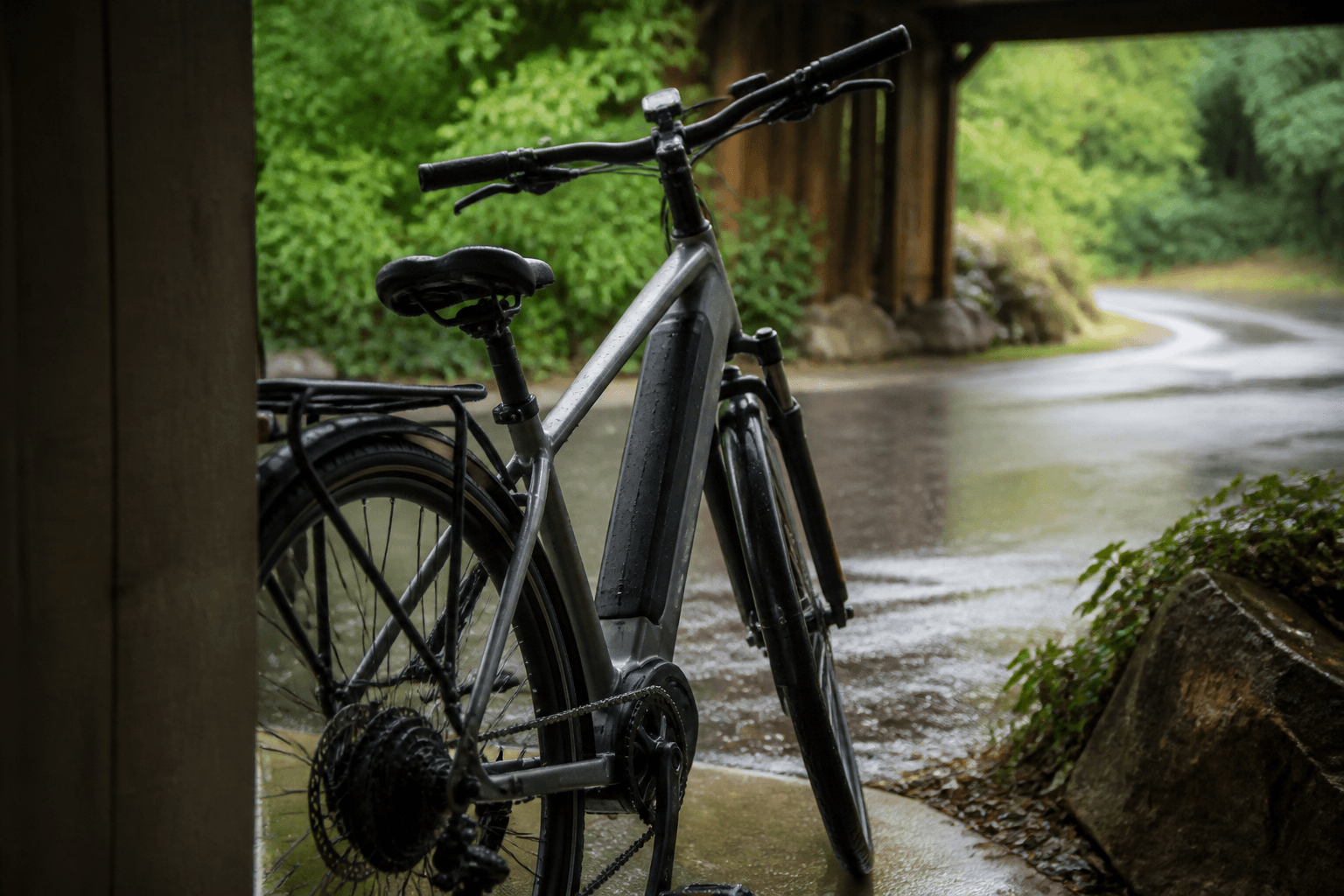
Rain doesn't kill e-bikes, neglect does. Water gets into connectors, chains and brakes before it gets into the motor. The motor is usually sealed, but the rest of the bike is not. A wet ride can lead to corrosion, rust, and electrical failures if you don't dry things off. Here's what breaks first and what to do about it.
What Actually Gets Wet
An e-bike has three vulnerable areas: the electrical system, the drivetrain, and the brakes. The electrical system includes the battery, motor, display, and all the cables connecting them. Water can seep into connectors and cause short circuits or corrosion. The drivetrain, meaning the chain, cassette, and derailleur, is exposed to spray from the rear wheel. Water washes away lubricant and leaves grit that grinds metal parts. Brakes, whether rim or disc, lose stopping power when wet and wear faster.
The motor itself is usually well sealed, but not always. Some budget bikes have poor sealing around the motor casing. The battery mount is another entry point. If water gets into the battery connector, it can cause intermittent power loss or even damage the battery management system. The display is also vulnerable, especially if it's not rated for heavy rain.
The Chain and Drivetrain
The chain is the first thing to rust. Water gets into the links and washes away the factory grease. A dry chain squeaks and wears quickly. After a wet ride, wipe the chain with a rag to remove water and grit. Then apply a wet lubricant, which is designed to stay on in the rain. Let it soak in for a few minutes, then wipe off the excess. This keeps the chain from rusting and reduces wear on the cassette and chainrings.
The cassette and derailleur also need attention. Grit from the road can get into the derailleur pulleys and cause them to wear. Check the derailleur for smooth shifting after a wet ride. If it feels gritty, clean it with a degreaser and re-lubricate the pivot points. The chain is the most important, though. A new chain costs less than a new cassette, so keep the chain clean to make the whole drivetrain last longer.
| Part | What rain does | How to protect |
|---|---|---|
| Chain | Rusts and wears | Dry and lube with wet lube |
| Cassette | Wears faster | Keep chain clean, replace chain regularly |
| Derailleur | Pulleys wear | Clean and lube pivots |
| Brake rotors | Corrode | Dry with cloth, avoid touching with fingers |
| Brake pads | Wear faster | Check thickness, replace if low |
Brakes in the Wet
Brakes are critical. Water on the rims or rotors reduces friction, so you need more lever travel to stop. This is normal, but it means you should brake earlier and with more force. After a wet ride, dry the rims or rotors with a clean cloth. This also removes any oily residue that can cause brake fade.
Brake pads wear faster in wet conditions because water washes away the braking surface. Check the pad thickness regularly. If the pads are worn down to the wear indicator, replace them. For disc brakes, also check the rotors for corrosion. Surface rust is common but can be cleaned with fine sandpaper. If the rotors are deeply scored, they may need replacing.
Some e-bikes have regenerative braking, which uses the motor to slow down. This is less affected by water, but it doesn't replace the mechanical brakes. Always maintain the mechanical brakes as the primary stopping system.
Electrical Connections and the Battery
The electrical system is the heart of an e-bike. Water in the connectors can cause shorts, corrosion, and intermittent failures. Most connectors are not waterproof, even if they are covered by rubber boots. After a wet ride, inspect all visible connectors. Look for water droplets or signs of corrosion. If you find moisture, dry it with a cloth and let it air out. You can use dielectric grease on the connectors to repel water, but apply it sparingly.
The battery is the most expensive component. A median battery is 720 Wh, and replacing one costs 864 EUR at 1.2 EUR per Wh. Water can damage the battery if it gets into the case or the connector. Always dry the battery contacts before reconnecting. If the battery has been submerged, do not use it. Let it dry completely and have it checked by a professional.
The display is also vulnerable. Many displays are not fully sealed. If water gets inside, the screen may fog up or stop working. Dry the display with a soft cloth and avoid pressing buttons while it's wet. If the display has a removable cover, take it off and dry the inside.
What About the Motor?
The motor is the most sealed part of an e-bike. Hub motors are enclosed in a casing that keeps water out. Mid-drive motors are also sealed, but they are mounted low and can be submerged if you ride through deep water. In general, the motor is not the first thing to break in the rain. It's the connectors and the battery that fail first.
However, if water does get into the motor, it can cause serious damage. The motor windings can short out, and the bearings can rust. If you hear grinding or see water dripping from the motor, stop riding and let it dry. Do not open the motor yourself unless you know what you're doing. Take it to a shop.
Some motors have a vent that allows pressure equalization. These vents can let water in if the motor is submerged. If you ride through a deep puddle, check the vent for water afterward. Most modern motors have a one-way vent that keeps water out, but it's worth checking.
After the Ride: A Simple Routine
You don't need to spend an hour drying your bike after every wet ride. A few minutes of care can prevent most problems. Here's a routine:
- Wipe down the frame, fork, and any exposed metal parts with a dry cloth.
- Dry the display, battery, and all connectors. Pay attention to the battery mount.
- Wipe the chain with a rag to remove water and grit.
- Apply wet lubricant to the chain. Let it sit for a few minutes, then wipe off excess.
- Dry the brake rotors or rims. Check the brake pads for wear.
- If the bike is very wet, let it dry indoors before storing. This prevents rust.
If you ride in the rain often, consider adding fenders. Fenders keep a lot of water off the drivetrain and your back. They are a cheap investment that reduces maintenance. Also, check your tire tread. Worn tires have less grip in the wet, which is dangerous.
Does Rain Affect Range?
Rain itself doesn't directly affect battery range, but the conditions that come with rain do. Cold weather reduces battery efficiency. The temperature multiplier in our range calculator is 1.2 for cold, meaning range drops by about 20 percent. A 720 Wh battery that gives 48 km in ordinary riding might give only 40 km in the cold. Wet roads also increase rolling resistance, especially if you use knobby tires. The terrain and tire multipliers show that knobby tires reduce range by 10 percent compared to road tires.
If you plan a long ride in the rain, use our range calculator to estimate how far you can go. It accounts for temperature, tire type, and riding style. Remember that the estimate is a range, not a single number. The range band is plus or minus 12 percent. So a 48 km estimate could be as low as 42 km or as high as 53 km.
Also, rain can affect your speed. You might ride slower to stay safe, which uses less power per kilometer. But if you use a higher assist level to compensate for the extra effort, you'll use more. The assist consumption constants show that Turbo uses 20 Wh per km, while Eco uses only 7 Wh per km. So choose your assist level wisely.
Long-Term Costs of Riding in the Rain
Riding in the rain doesn't have to cost more if you maintain your bike. But neglect can lead to expensive repairs. A new chain might cost 30 EUR, but a new cassette and chainrings can cost over 100 EUR. Corroded connectors might require replacing the wiring harness, which is labor-intensive. The battery is the biggest cost. A replacement pack for a 720 Wh battery is 864 EUR. That's more than half the price of a median bike, which costs 1299 USD. So protecting the battery is crucial.
The cost of ownership calculator can help you plan for these expenses. It includes five years of servicing, charging, and battery replacement. For a median bike, five years of ownership totals 1573 EUR, including 600 EUR for servicing and 63 EUR for charging. If you ride in the rain often, you might need to service the drivetrain more frequently, which increases the annual servicing cost. The calculator assumes a servicing cost of 100 EUR per year for hub motors and 180 EUR for mid-drive motors. But if you ride in harsh conditions, you might need to budget more.
The good news is that e-bikes are cheaper to run than cars. Riding 50 km a week instead of driving saves 486 EUR a year. Over five years, that's over 2400 EUR, which covers the cost of a new bike. So even with extra maintenance, riding in the rain is still economical.
Which Bikes Handle Rain Best?
Some e-bikes are better suited to wet weather than others. Look for bikes with fully enclosed cables, sealed bearings, and a high IP rating for the motor and battery. Fenders are a plus. Mountain bikes and commuter bikes often have better sealing than folding bikes, but it varies.
In our catalogue of 505 bikes, there are 190 mountain bikes, 144 city bikes, and 142 folding bikes. The type doesn't determine waterproofing, but mountain bikes are often built for rougher conditions. For example, the Cyrusher Trident Full Suspension is a 5799 USD mountain bike with a 1040 Wh battery. It's designed for off-road use, so it likely has better sealing than a budget folding bike. On the other end, the Fiido D3 Pro is the cheapest at 399 USD. It has a 374 Wh battery and is a folding bike. It may not have the same level of waterproofing.
When comparing bikes, check the specifications for IP ratings. Many manufacturers don't list them, so you may need to contact them. Also, look at the placement of the battery and connectors. Batteries mounted on the downtube are less exposed than those on the rear rack. Connectors that are angled downward are less likely to collect water.
If you live in a rainy area, consider spending a bit more for a bike with better components. The median price is 1299 USD, but you can find good options in the 1200 to 1600 USD band, which has 131 bikes. The G-Force ZM is typical of that band at 1399 USD. It has a 960 Wh battery and is a mountain bike. It likely has decent sealing.
The Bottom Line: Ride, But Maintain
Rain shouldn't stop you from riding your e-bike. It's a machine built for the outdoors. But it needs care after a wet ride. The chain, brakes, and electrical connectors are the first to suffer. A few minutes of drying and lubricating can prevent costly repairs. The motor is usually fine, but the battery and connectors are not.
If you're in the market for an e-bike, consider how you'll use it in the rain. Look for bikes with good sealing and fenders. Use our find-my-ebike tool to narrow down options based on your needs. And remember, the cost of ownership includes maintenance. Use the calculator to budget for it.
So go ahead, ride in the rain. Just dry it off afterward. Your e-bike will thank you.
Frequently asked questions
Can I ride my e-bike in heavy rain?
Yes, most e-bikes handle rain, but the degree of waterproofing varies. Connectors, displays, and battery mounts are the weak points. Check your bike's IP rating and avoid submerging the motor or battery. After a wet ride, dry all exposed electrical contacts.
What should I do immediately after riding in the rain?
Dry the bike with a cloth, especially around the display, battery, and motor connectors. Wipe the chain and apply wet lubricant. Let the bike dry indoors if possible, then check for water in the connectors before the next ride.
How often should I lubricate the chain after wet rides?
After every wet ride, the chain should be wiped and re-lubricated. Water washes away the factory grease and can cause rust. Use a wet-specific lubricant that resists washing off. If the chain squeaks or looks dry, apply more.
Will rain damage the motor or battery?
Motors and batteries are usually sealed, but not always. Water can enter through seals if they are damaged or if the bike is pressure-washed. The battery connector is a common entry point. Dry the contacts and ensure the battery is fully seated to keep moisture out.
Do brake pads wear faster in the rain?
Yes, wet conditions accelerate brake pad wear because water washes away braking surface and increases friction. After a wet ride, check pad thickness and clean the rims or rotors. Replace pads if they are below the wear indicator.