
Torque is what reaches the ground. Watts is an input, torque is what reaches the ground. When you climb, the motor must overcome gravity. That requires force, and torque is that force. Watts tells you how much electrical power the motor draws, but gearing and motor design decide how much becomes turning force at the wheel. So torque is the number to watch.
Our catalogue holds 505 bikes from 62 brands. Of those, 433 state a torque figure. That is a large enough set to compare. The highest torque we have is 180 Nm, on the Coswheel R6000. The median bike, the Heybike Ranger S at 1299 USD, does not state its torque in our database, but many others do.
Why torque beats watts for climbing
Think of watts as the size of the engine. Torque is the pulling power at the wheels. A small engine can produce high torque through gearing, just as a large engine can produce low torque if geared poorly. E-bike motors are rated in watts, but that rating is often the peak electrical input, not the mechanical output at the wheel.
For climbing, what matters is the force pushing you up the slope. That force comes from torque at the rear wheel. The motor's torque, multiplied by the gear ratio, gives you that force. A motor with high torque can maintain speed on a steep grade without you having to downshift and spin slowly. Watts alone does not tell you that.
How torque is measured and what the numbers mean
Torque is measured in newton-metres (Nm). It is the rotational force the motor produces at its output shaft. For hub motors, that shaft is the wheel axle, so the torque is directly at the wheel. For mid-drives, the motor's torque goes through the crankset and then the bike's gears, so the effective torque at the wheel can be much higher in low gears.
A figure of 40 Nm is typical for a light city hub motor. That is enough for gentle hills if you pedal along. A figure of 60 Nm is our threshold for a mid-drive. That is enough for most commuters with moderate hills. A figure of 80 Nm or more is strong, suitable for steep hills and heavier riders. The highest we have is 180 Nm, on the Coswheel R6000, a heavy mountain bike.
| Torque range | What it means | Example bikes |
|---|---|---|
| Under 40 Nm | Light city use, flat terrain | Fiido D3 Pro (not stated), Hiboy C1 (not stated) |
| 40 to 59 Nm | Moderate hills, hub motors | Many folding and city bikes |
| 60 to 79 Nm | Mid-drive territory, good for hills | Aventon Ramblas eMTB (not stated), Himiway D3 (not stated) |
| 80 Nm and above | Strong climbing, heavy loads | Coswheel R6000 (180 Nm) |
But torque alone is not the whole story. The bike's weight matters. A heavy bike needs more torque to accelerate and climb. Our median bike weighs 29.5 kg. The lightest is 13.6 kg, the Fiido Air Carbon. The heaviest is 56.7 kg, the Hiboy C1. A 50 Nm motor on a 13.6 kg bike will climb better than a 50 Nm motor on a 56.7 kg bike.
How to use the torque figure when comparing bikes
Start with the type of riding you do. If you live on flat ground, torque is less critical. If you have steep hills, set a minimum torque. For most riders, 60 Nm is a good target because it usually means a mid-drive. But some hub motors also exceed 60 Nm, so check the motor type as well.
Look at the bike's weight. A lighter bike with the same torque will climb more easily. For example, the Fiido Air Carbon weighs 13.6 kg and has a 614 Wh battery. The Coswheel R6000 weighs 55 kg and has 180 Nm. Even with three times the torque, the R6000 may not climb much better because it is four times heavier.
Real bikes that show the range of torque
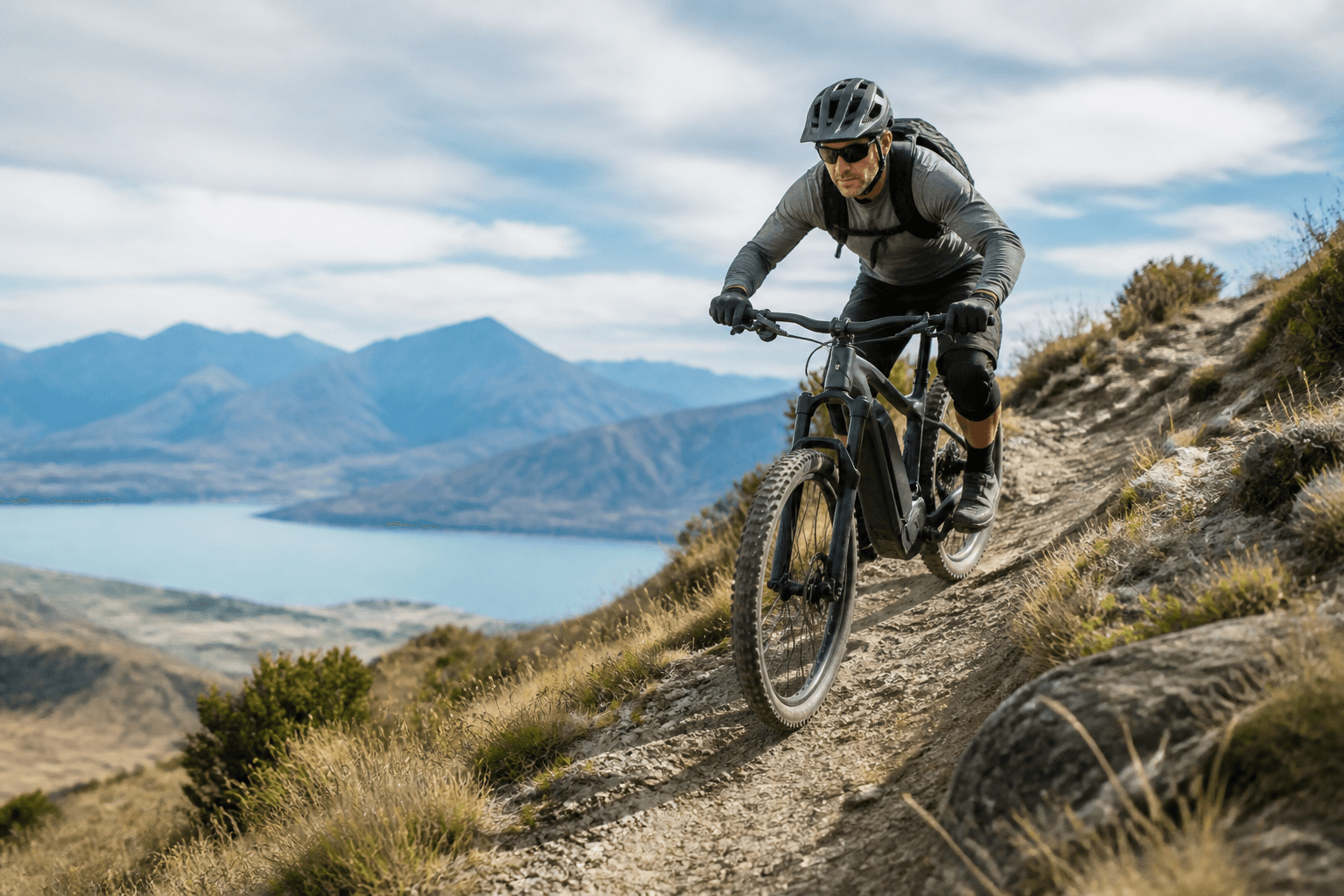
The Coswheel R6000 is a mountain bike with a 1800 Wh battery and 180 Nm of torque. It is built for heavy off-road use and steep climbs. But it weighs 55 kg, so that torque is needed just to move its own mass. Its estimated range is 99 km, but that is on flat ground. On steep hills, the range will drop significantly.
The Fiido Air Carbon is the lightest bike in our catalogue at 13.6 kg. It has a 614 Wh battery and an estimated range of 46 km. Its torque is not stated, but because it is so light, even a modest torque motor will climb well. This shows that weight is as important as torque.
The Aventon Ramblas eMTB is a mid-drive mountain bike. It has a 346 Wh battery and an estimated range of 20 km, the widest gap between claim and estimate in our catalogue. Its torque is not stated, but as a mid-drive, it likely exceeds 60 Nm. This bike shows that a small battery can limit your climbing range.
The role of battery size in climbing
Climbing consumes more energy. Our range calculator uses assist consumption figures: Eco 7 Wh per km, Tour 11, Sport 15, Turbo 20. On a steep hill, you will likely use a higher assist mode, so your range will be shorter. The terrain multiplier for steep is 1.6, meaning a steep ride uses 1.6 times the energy of a flat ride.
The median battery in our catalogue is 720 Wh. With a 720 Wh battery, easy riding gives a range of 94 km (band 82 to 105). Ordinary riding gives 48 km (band 42 to 53). Hard riding gives 20 km (band 18 to 23). Climbing is hard riding, so expect around 20 km of range if you are climbing steep hills continuously.
If you have a smaller battery, like the 346 Wh on the Aventon Ramblas, your range will be even shorter. The range calculator can estimate your specific range based on your battery and riding conditions. Use it before you buy if you plan to climb.
Torque and motor type: mid-drive vs hub
Mid-drive motors are mounted at the bottom bracket, where the pedals are. They drive the chain, which then drives the rear wheel through the bike's gears. This means you can shift to a low gear to multiply torque. That is why mid-drives are often recommended for hills. Our threshold for counting a motor as a mid-drive is 60 Nm.
Hub motors are in the center of the wheel. They drive the wheel directly, without gears. This is simpler and cheaper, but it means the motor's torque is fixed. A hub motor with 50 Nm will always have 50 Nm at the wheel, regardless of gear. On a steep hill, you may have to pedal harder to help the motor.
Some hub motors have high torque, like the Coswheel R6000 at 180 Nm, but that is rare. Most hub motors are below 60 Nm. If you live in a hilly area, a mid-drive is usually a better choice. But mid-drives are more expensive to service. Our servicing cost for a mid-drive is 180 EUR per year, compared to 120 EUR for a hub motor.
| Motor type | Typical torque | Climbing ability | Servicing cost per year |
|---|---|---|---|
| Hub motor | Below 60 Nm | Moderate, limited by gearing | 120 EUR |
| Mid-drive | 60 Nm and above | Good, uses gears to multiply torque | 180 EUR |
How to find a bike that climbs well
Use our catalogue filter to narrow down bikes by type, price, and other specs. Look for bikes that state a torque figure. If a bike does not state torque, it is often a low-cost hub motor. Check the motor type and the bike's weight. A lighter bike with a mid-drive motor and a torque above 60 Nm is a safe bet for climbing.
Consider your budget. Our price bands show that most bikes are under 1600 USD. The median price is 1299 USD. At that price, you can find mid-drive bikes, but they may have smaller batteries. For example, the Aventon Ramblas eMTB costs 2899 USD, which is above the median, but it has only a 346 Wh battery. You may need to spend more for a bike with both a strong motor and a large battery.
Do not rely on claimed range. In our catalogue, 483 of 505 bikes have a claim that exceeds our estimate. The median overclaim is 50 percent. The widest overclaim is 84 percent, on the Aventon Ramblas. Use our estimated range, which is based on real-world riding conditions.
The cost of climbing: battery and range
Climbing uses more battery, so you may need a larger battery or a second one. The median battery is 720 Wh. Replacing a 720 Wh pack costs 864 EUR at our replacement rate of 1.2 EUR per Wh. A larger battery, like the 1920 Wh on the Coswheel GT20 PRO, costs 2304 EUR to replace. That is a significant cost to consider.
If you ride 50 km a week instead of driving, you save 486 EUR a year. That saving can pay for a bike over time. A 1203 EUR bike would pay back in 30 months at that rate. If you ride 100 km a week, you save 1072 EUR a year and pay back in 13 months. The cost of electricity is tiny: 0.20 EUR to charge a median battery once.
But climbing reduces your range, so you may need to charge more often. Use the range calculator to see how far you can go on your typical hilly route. Then decide if the battery size is adequate. If not, look for a bike with a larger battery, but remember that larger batteries add weight, which affects climbing.
What to do next
Decide what kind of hills you will ride. If they are steep and long, prioritize torque and a mid-drive motor. Set a minimum torque of 60 Nm. Then look at the bike's weight and battery. Use the range calculator to estimate how far you can go on your typical ride. Finally, use the cost of ownership calculator to see the total cost over five years.
Remember, torque is the number that predicts climbing. Watts is just the input. Use our catalogue to compare torque figures across bikes. And if you are unsure, take the find-my-ebike quiz to narrow down your options.
Frequently asked questions
What is the difference between torque and watts?
Watts is the motor's power input, a measure of how much electrical energy it consumes. Torque is the rotational force the motor produces, which is what actually turns the wheel and propels you up a hill. Higher torque at the wheel means better climbing ability, especially at low speeds.
Why is torque more important for climbing than watts?
Climbing requires force to overcome gravity. Torque is that force. Watts tells you how much energy the motor uses, but gearing and motor design determine how much of that becomes torque at the wheel. Two motors with the same watts can have very different torque outputs, so torque is the better predictor of climbing.
What is the mid-drive threshold?
We count a motor as a mid-drive from 60 Nm. Mid-drive motors are mounted at the bottom bracket and can use the bike's gears to multiply torque, giving them an advantage on steep hills. Hub motors, which are in the wheel, typically have lower torque and cannot use gearing as effectively.
How do I compare torque figures across bikes?
Look at the torque rating in newton-metres (Nm). A higher number means more twisting force. For climbing, aim for at least 60 Nm if you want a mid-drive. But remember, the bike's total weight and your own weight also affect how steep a hill you can climb, so a lighter bike with the same torque will climb better.
What else affects climbing performance besides motor torque?
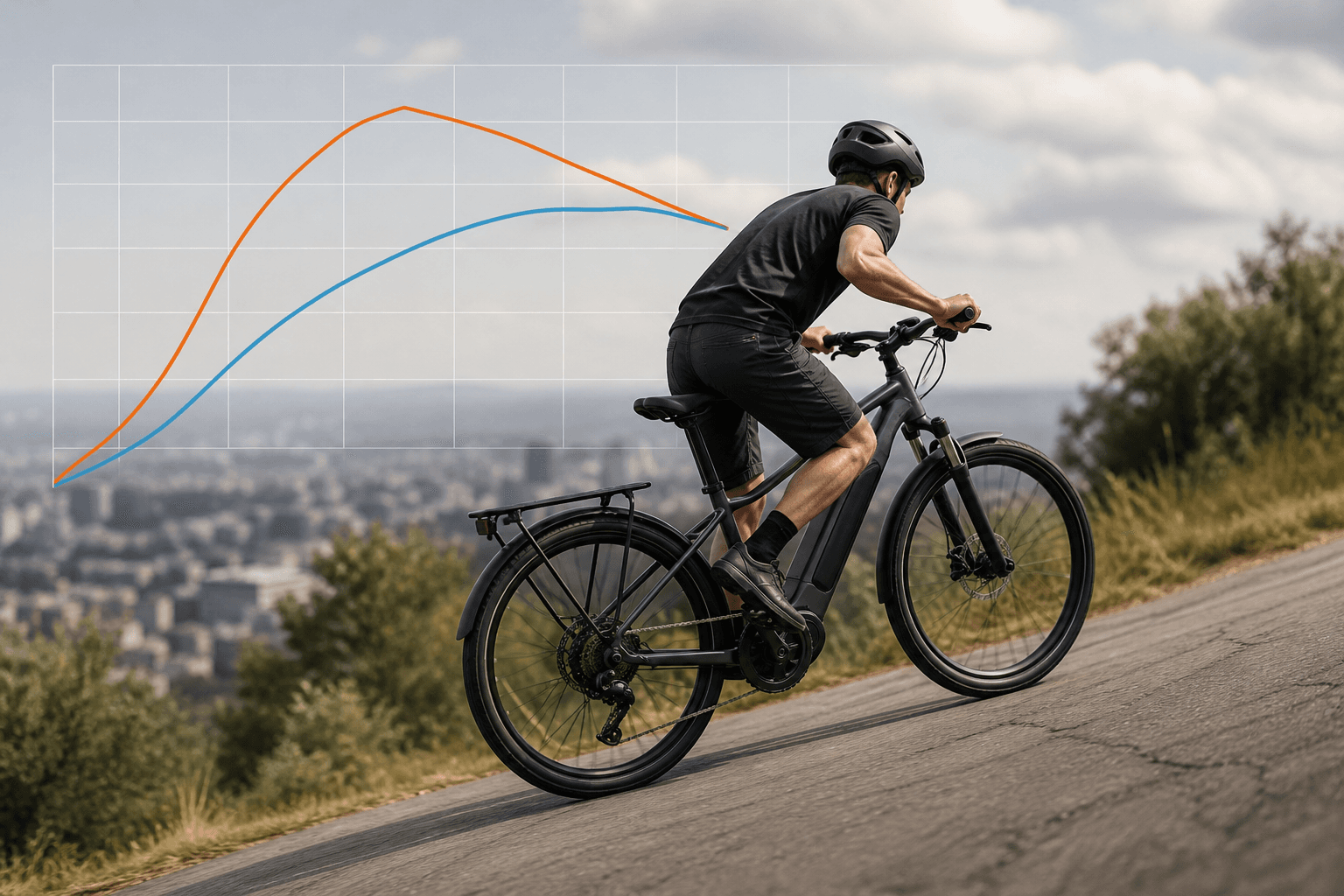
Bike weight, rider weight, and gearing all matter. A heavier bike needs more torque to accelerate and climb. The motor's torque curve, how it delivers power across speeds, also matters. And your own pedaling input adds to the total force. The range calculator can help you estimate how battery size affects your ability to sustain climbing.