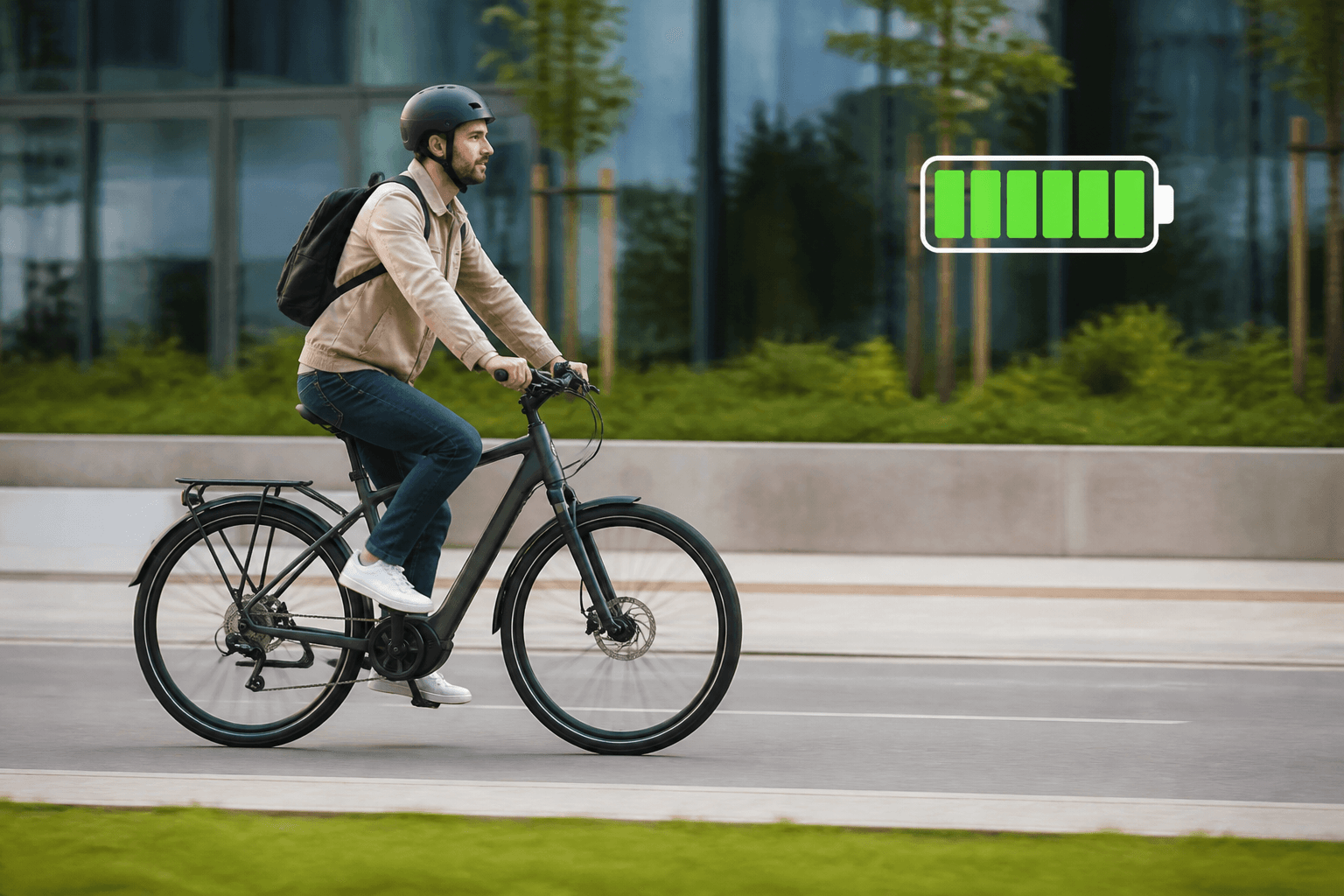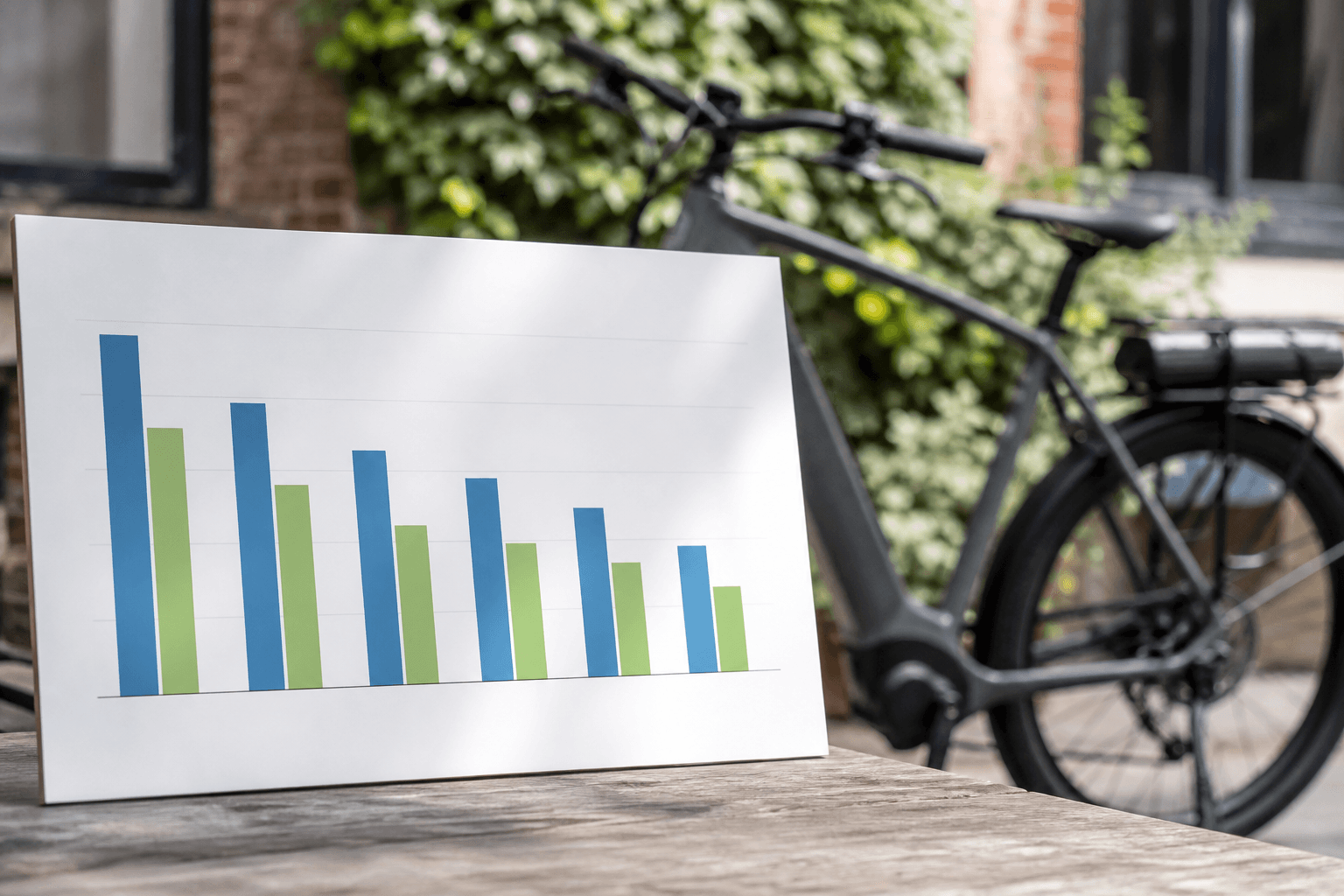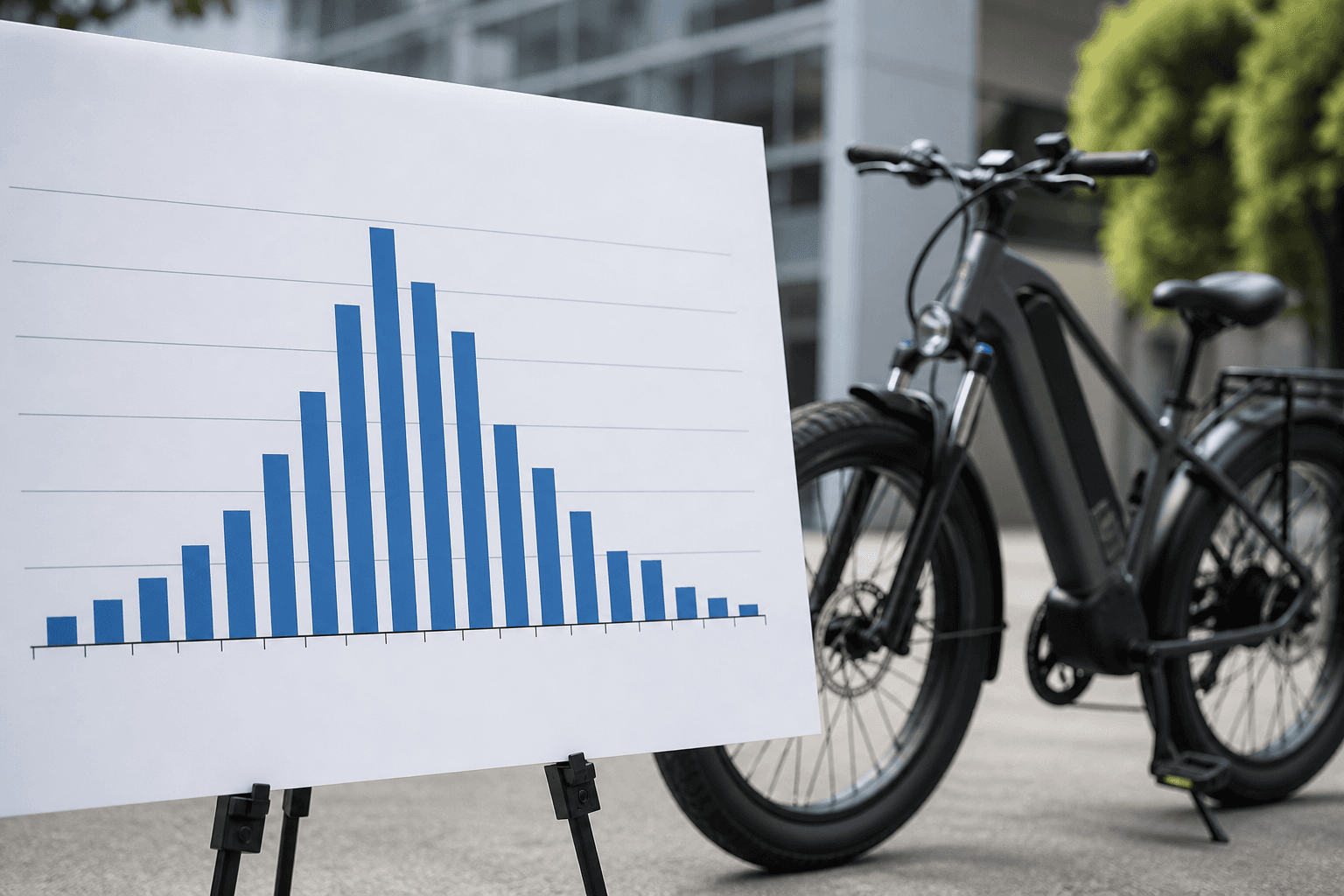

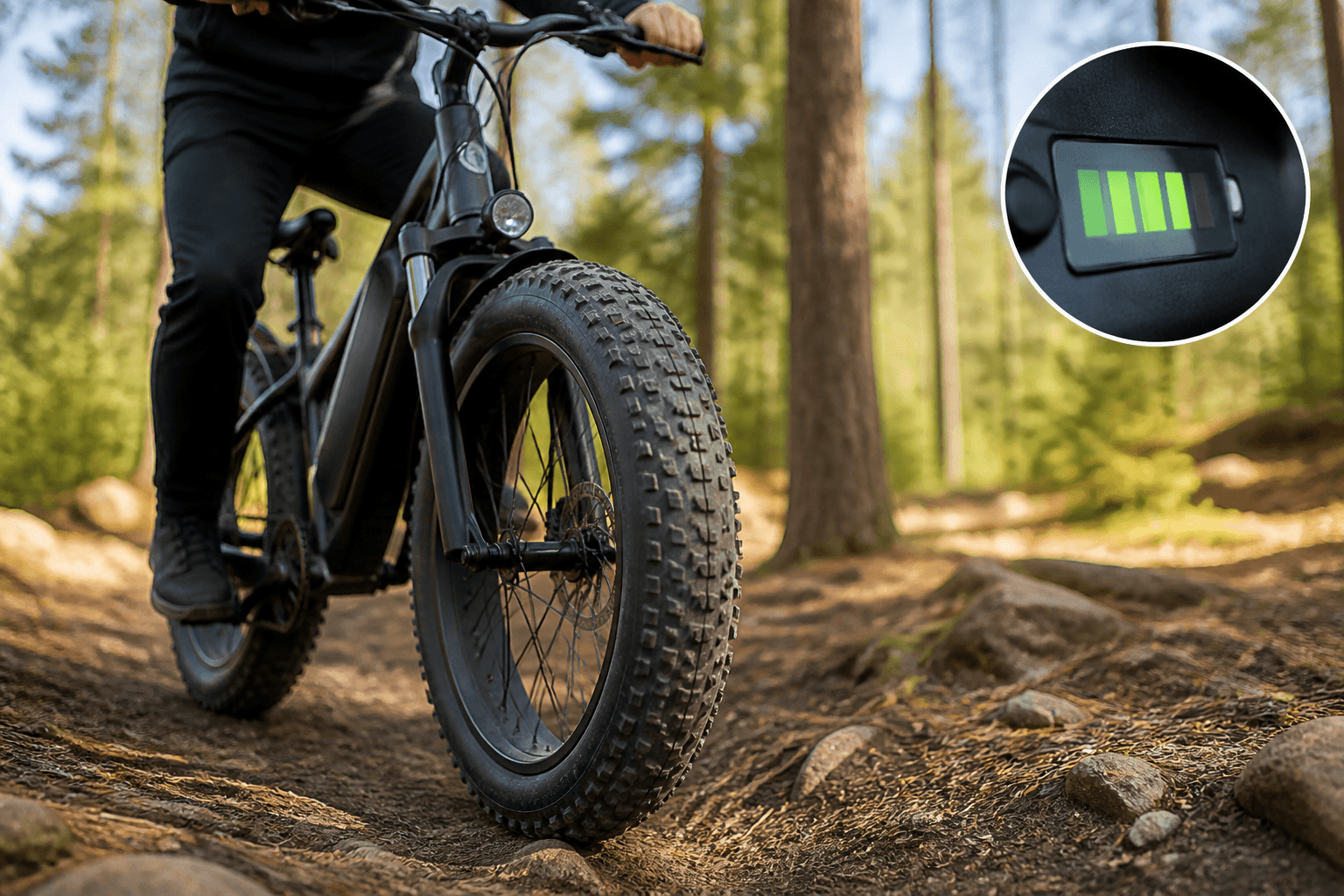
Fat tyres cost you range. In our published formula, knobby tyres carry a multiplier of 1.25 against 1 for road tyres. That means a bike with knobby tyres uses 25 percent more energy per kilometre than the same bike on road tyres, all else equal. For a 720 Wh battery in ordinary riding, that is 42 km on knobby tyres versus 52 km on road tyres. You give up 10 km for the fat look.
The formula and the tyre multiplier
Our range formula starts with the battery's watt hours. Then it divides by the assist consumption, which varies from 7 Wh per km in Eco to 20 Wh per km in Turbo. Then it multiplies by terrain, tyre, temperature, and pace multipliers. The tyre multiplier is 1 for road, 1.1 for hybrid, and 1.25 for knobby. That 1.25 is the same as a 25 percent increase in energy use.
To see the impact, take a 720 Wh battery. In easy riding, the range is 94 km with a band of 82 to 105 km. In ordinary riding, it is 48 km with a band of 42 to 53 km. In hard riding, it drops to 20 km with a band of 18 to 23 km. Now add the tyre multiplier. The same battery on knobby tyres gives 42 km in ordinary riding, while road tyres give 52 km. That is a 10 km difference, about 19 percent less range.
The catalogue and fat tyre prevalence
Our catalogue has 505 bikes from 62 brands. By type, there are 190 mountain bikes, 144 city bikes, 142 folding bikes, 26 cargo bikes, 2 touring bikes, and 1 commuter. Fat tyres are most common on mountain bikes and some cargo models. The median price is 1299 USD, with a quarter under 960 USD, half under 1299 USD, and three quarters under 1781 USD. The cheapest bike is 399 USD, the most expensive is 5799 USD.
The median battery is 720 Wh, and the median weight is 29.5 kg. The lightest bike is 13.6 kg, the heaviest is 56.7 kg. Median claimed range is 97 km, but median estimated range is 47 km. That is a median overclaim of 50 percent. In fact, 483 of 505 bikes have claims that exceed our estimate. The widest overclaim is 84 percent. Only a few bikes come close to their claims.
| Battery (Wh) | Ordinary range on knobby (km) | Ordinary range on road (km) | Difference (km) |
|---|---|---|---|
| 374 | 25 | 31 | 6 |
| 504 | 33 | 41 | 8 |
| 720 | 42 | 52 | 10 |
| 1040 | 58 | 72 | 14 |
| 1920 | 107 | 133 | 26 |
The table shows how the gap grows with battery size. A 374 Wh battery loses 6 km, but a 1920 Wh battery loses 26 km. That is because the multiplier applies to the whole range. If you ride far, the cost of fat tyres compounds.
Real bikes and their tyre trade-offs
Consider the HIMIWAY D3, a city bike at 1299 USD. It has a 720 Wh battery and an estimated range of 52 km. That estimate assumes road tyres. If you fit knobby tyres, the range drops to 42 km. For a city bike, that is a significant loss. The HIMIWAY D3 weighs 30.8 kg, which is close to the median.
The G-FORCE ZM is a mountain bike at 1399 USD, typical of the 1200 to 1600 USD band. It has a 960 Wh battery and an estimated range of 55 km. That estimate likely uses road or hybrid tyres. With knobby tyres, the range would be 44 km. That is a 11 km difference, which could be the difference between reaching home and walking.
The Coswheel GT20 PRO has the largest battery in the catalogue at 1920 Wh. Its estimated range is 107 km. With knobby tyres, that drops to 86 km. That is still a long range, but the bike weighs 45 kg and costs 2094 USD. You are buying a lot of battery to compensate for the tyres.
Why claims are so far off
Manufacturer claims are often optimistic. In our catalogue, the median claimed range is 97 km, but the median estimated range is 47 km. That is a median overclaim of 50 percent. Some bikes overclaim by 84 percent. Only 22 bikes have claims that are close to our estimates. The Hidoes C5 has a claim that is closest, with an estimated range of 27 km and a claim that is only slightly higher.
Why the gap? Claims often assume the lowest assist level, flat terrain, road tyres, and a light rider. Our formula uses realistic multipliers. For example, the assist consumption in Eco is 7 Wh per km, but in Turbo it is 20 Wh per km. That is nearly three times as much. Terrain multipliers range from 1 for flat to 1.6 for steep. Temperature multiplier is 1.2 in cold. Pace multiplier ranges from 0.9 for relaxed to 1.3 for fast. And rider weight adds 1 percent per 5 kg either side of 80 kg.
How to choose tyres for your needs
If you ride mostly on pavement, choose a bike with road or hybrid tyres. You will get more range for the same battery. If you ride off-road, knobby tyres give you traction, but you need a larger battery to maintain range. Consider the terrain you ride most. Our formula uses a terrain multiplier of 1 for flat, 1.25 for rolling, and 1.6 for steep. Combine that with the tyre multiplier, and the range can drop quickly.
For example, a 720 Wh battery in ordinary riding on flat terrain with road tyres might give 52 km. On rolling terrain with knobby tyres, it would be 42 km divided by 1.25, which is about 34 km. On steep terrain with knobby tyres, it would be even less. The point is to match the bike to your riding.
- Road tyres: best for city and commuting, multiplier 1.
- Hybrid tyres: a compromise, multiplier 1.1.
- Knobby tyres: for off-road, multiplier 1.25.
The cost of range in battery size
To compensate for fat tyres, you might choose a larger battery. But larger batteries cost more and weigh more. The median battery is 720 Wh. A replacement pack costs 1.2 EUR per Wh, so a 720 Wh pack costs 864 EUR. That is more than many bikes cost. The median bike price is 1299 USD, but the battery replacement is a long-term cost.
Consider the five-year cost of a median bike. The total is 1573 EUR, including charging at 63 EUR, servicing at 600 EUR, and resale value of 293 EUR. That works out to 0.10 EUR per km. The battery is a significant part of that. If you need a bigger battery for fat tyres, the cost goes up.
| Battery size (Wh) | Replacement pack cost (EUR) | Ordinary range on knobby (km) |
|---|---|---|
| 374 | 449 | 25 |
| 504 | 605 | 33 |
| 720 | 864 | 42 |
| 960 | 1152 | 58 |
| 1920 | 2304 | 107 |
The table shows that a 1920 Wh battery costs 2304 EUR to replace, which is more than the median bike price. That battery gives 107 km on knobby tyres, but you pay a premium. For most riders, a smaller battery with road tyres is more economical.
What about cold weather and other factors
Cold weather also reduces range. Our formula applies a temperature multiplier of 1.2 in cold conditions. For a 720 Wh battery in ordinary riding, the range is 48 km in mild weather, but 40 km in cold. Add knobby tyres, and it drops further. In cold weather with knobby tyres, the range could be around 33 km. That is a significant reduction.
Pace matters too. A relaxed pace has a multiplier of 0.9, while a fast pace is 1.3. If you ride fast on knobby tyres, the range shrinks quickly. The same battery that gives 42 km at ordinary pace might give only 30 km at fast pace. Plan your rides accordingly.
The bottom line on fat tyres
Fat tyres are not a free choice. They cost you range, and that range is not trivial. For a typical 720 Wh battery, you lose 10 km in ordinary riding. To get the same range as a road tyre bike, you would need a larger battery, which costs more and weighs more. If you ride off-road, the traction may be worth it. If you ride on pavement, choose road tyres.
Before you buy, use the range calculator to estimate the real range for your conditions. Then compare bikes in the catalogue. Look at the battery size, weight, and tyre type. A bike with a smaller battery and road tyres might have the same range as a larger battery with knobby tyres, at a lower price and weight.
Frequently asked questions
How much range do fat tyres really cost?
In our range formula, knobby tyres have a multiplier of 1.25 compared to 1 for road tyres. That means for the same battery and conditions, a bike on knobby tyres will go about 25 percent less distance. For a 720 Wh battery, that is the difference between 52 km on road tyres and 42 km on knobby tyres in ordinary riding.
Can I swap fat tyres for road tyres to get more range?
If the bike's frame and wheels allow it, switching to road tyres could improve range. But fat tyre e-bikes are often designed for off-road stability and may have rims that only fit wide tyres. Check the manufacturer's specifications and local regulations before changing tyres. Our range calculator lets you see the effect of different tyre multipliers.
Are fat tyre e-bikes only for off-road?
Fat tyres are common on mountain bikes and some cargo bikes, but you can find folding and city models with them too. They provide traction on loose surfaces and a plush ride, but they add rolling resistance. If you mostly ride on pavement, a hybrid or road tyre will give you more range for the same battery.
Why do manufacturers claim such high ranges?
In our catalogue, the median claimed range is 97 km, but the median estimated range is 47 km. That is a median overclaim of 50 percent. Claims are often made in ideal conditions with low assist and flat terrain. Our estimates use realistic multipliers for tyres, terrain, and pace, so you get a number closer to real use.
What is the best way to estimate my own range?
Use our range calculator. It takes your battery size, assist level, terrain, tyre type, temperature, and pace, then applies the formula constants. You can also adjust for rider weight. The result shows a range band, plus or minus 12 percent, to account for variability.