
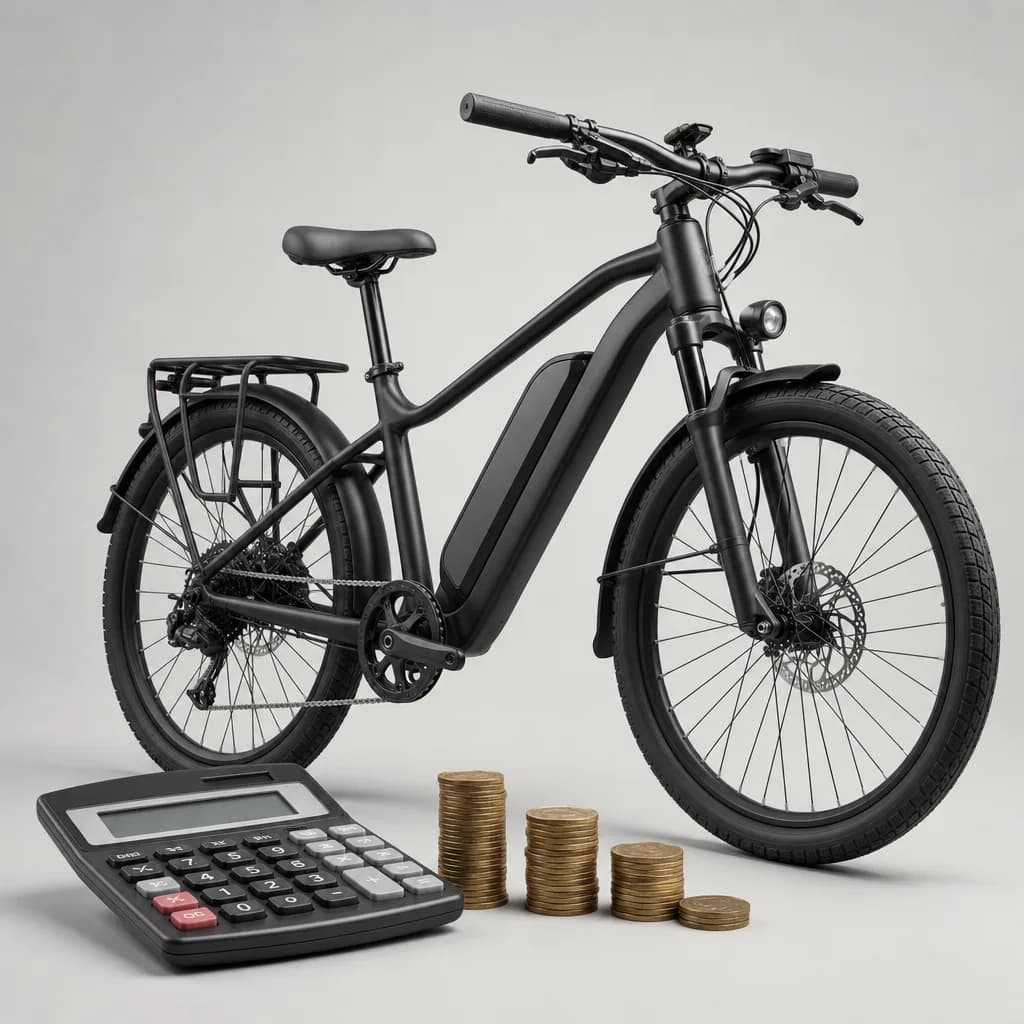
Financing an e-bike costs more than buying outright, unless you get a 0 percent APR deal and you would otherwise invest the cash. On a 1295 EUR bike over 24 months, 0 percent APR means 54 EUR a month and zero interest. At 9.9 percent APR, the payment is 60 EUR a month and you pay 138 EUR in interest. That 138 EUR is more than the bike's charging cost for five years. Buying outright saves that interest, but it ties up your cash. The real question is what that cash would earn elsewhere.
The Real Cost of Financing
Financing has a simple appeal: you get the bike now and pay over time. But the total cost depends on the APR and the term. The APR is the annual percentage rate, and it includes the interest and most fees. A lower APR always costs less, but the term matters too. A longer term spreads the payment out but adds more interest.
Consider a 1295 EUR bike. At 0 percent APR over 24 months, you pay 54 EUR a month and no interest. At 9.9 percent APR, the monthly payment is 60 EUR and the total interest is 138 EUR. That 138 EUR is a real cost. It could cover more than a year of charging for a typical rider. If you finance at a higher rate, say 15 percent or more, the interest can be several hundred euros.
Some lenders advertise a low monthly payment without emphasizing the APR. A 36-month term at 9.9 percent APR on a 1295 EUR bike would have a lower monthly payment than 24 months, but the total interest would be higher. Always compare the total cost of credit, not just the monthly figure. The finance calculator on this site shows both.
The Hidden Costs of Financing
Beyond the interest, financing can carry fees that are easy to miss. Origination fees are charged upfront and are often folded into the loan, so you pay interest on them. Late fees add up if you miss a payment. Prepayment penalties punish you for paying off the loan early. These fees are not always in the APR, so read the loan agreement.
Another hidden cost is the opportunity cost of the down payment. If you put money down, that cash is tied up in the bike. If you finance 100 percent, you might pay a higher APR. Some lenders require a down payment to get a lower rate. Compare the total cost of different down payment scenarios.
There is also the cost of credit insurance or add-ons that dealers push. These can add hundreds to the loan. You do not need them. If a dealer insists, walk away. The best financing is a simple loan with no extras.
| Financing Option | What You Pay |
|---|---|
| 0% APR, 24 months | 54 EUR per month, 0 EUR interest |
| 9.9% APR, 24 months | 60 EUR per month, 138 EUR interest |
| Higher APR, longer term | Lower monthly payment, more total interest |
Total Cost of Ownership: The Five-Year View
Financing is just one part of the cost. The bike itself has running costs that dwarf the interest for most riders. Over five years, a median-priced bike costs 1642 EUR total, including 63 EUR for charging and 600 EUR for servicing. The bike is worth 316 EUR at the end. That works out to 0.11 EUR per km. The interest on a 9.9 percent loan adds 138 EUR, which is about 8 percent of the total cost.
Charging is cheap. Charging a median battery once costs 0.20 EUR at 0.28 EUR per kWh. Riding 1000 km in a year costs 4 EUR in electricity and 124 EUR including servicing on a hub motor. At 3000 km a year, it is 13 EUR for electricity and 133 EUR including servicing. Even at 5000 km a year, electricity is only 21 EUR and 141 EUR with servicing. These are small compared to the bike's price.
Servicing is a bigger cost. Hub motors cost 120 EUR a year to service, mid-drives 180 EUR. Over five years, that is 600 EUR for a hub motor. Battery replacement is another potential cost. A 720 Wh pack costs 864 EUR to replace at 1.2 EUR per Wh. But a pack lasts 800 full cycles, which is 38400 km on a median battery. Most riders will not need a new pack within five years.
When Financing Makes Sense
Financing makes sense when the APR is 0 percent or very low, and you would otherwise use that cash for something else. If you have the full price in savings, paying upfront saves the interest. But if that cash is earning more than the APR, financing can be rational. For example, if you can invest at 5 percent and the loan is 0 percent, you come out ahead by financing.
Financing also makes sense if you need the bike now and do not have the cash. An e-bike can replace a car for commuting. The savings from riding instead of driving can pay for the bike. Riding 50 km a week instead of driving saves 486 EUR a year, and a 1295 EUR bike pays for itself in 32 months. At 100 km a week, the saving is 1072 EUR a year, and the payback is 14 months. At 200 km a week, it is 2245 EUR a year and 7 months.
But financing at a high APR can eat into those savings. If you pay 138 EUR in interest on a 1295 EUR bike, that is more than a quarter of the annual saving from riding 50 km a week. The lower your mileage, the less sense financing makes. For occasional riders, buying outright is almost always better.
When Buying Outright Is Better
Buying outright is better when you have the cash and the APR is not 0 percent. You avoid interest and any financing fees. You also own the bike free and clear, which simplifies selling it later. If you change your mind, you can sell without paying off a loan.
Buying outright also protects you from overborrowing. It is easy to finance a more expensive bike than you need. The median price is 1399 USD, but you can get a capable bike for less. The Fiido D3 Pro costs 399 USD and has a 374 Wh battery. The HITWAY BK15M costs 700 USD and has a 720 Wh battery. If you pay cash, you are more likely to choose a bike that fits your budget.
The downside of buying outright is the opportunity cost. That cash could be earning interest or invested. But for most people, the amount is small relative to their savings. And the peace of mind of owning the bike outright is worth something.
How Your Credit Score Affects Your Options
Your credit score determines the APR you are offered. A score above 700 often qualifies for the best rates, including 0 percent promotions. A score below 600 might mean double-digit APRs or rejection. Before you apply, check your credit report and correct any errors.
If your credit is poor, you might not qualify for financing at all. In that case, buying outright is your only option. Or you could wait and improve your credit. A higher score could save you hundreds in interest.
Some lenders offer secured loans, where the bike is collateral. These may have lower APRs but risk repossession if you default. Unsecured personal loans have higher rates but no collateral. Compare offers from multiple lenders, not just the dealer's financing.
Finance Terms to Watch Out For
- APR (Annual Percentage Rate): the true cost of borrowing, including most fees. Compare this, not the monthly payment.
- Origination fee: an upfront charge, often 1 to 5 percent of the loan. It is added to the principal, so you pay interest on it.
- Prepayment penalty: a fee for paying off the loan early. Avoid loans with this.
- Balloon payment: a large final payment. Some loans have low monthly payments but a big lump sum at the end.
- Deferred interest: interest that accrues during a promo period and is charged if you do not pay in full by the end. This can be a trap.
Always read the loan agreement. If a term is unclear, ask. A reputable lender will explain everything. If they pressure you, walk away. The bike will still be there tomorrow.
Alternatives to Traditional Financing
If you do not want a loan, consider other ways to spread the cost. A 0 percent APR credit card can work if you pay it off within the promo period. But the rate after that is often high. A buy-now-pay-later service might offer installment payments, but watch for fees.
Some employers offer bike-to-work schemes that let you buy a bike tax-free. This is not financing in the traditional sense, but it reduces the upfront cost. Check if your employer participates.
Another option is to buy a used e-bike. The price is lower, so financing is less necessary. But used bikes may have battery degradation. The median battery lasts 800 cycles, which is 38400 km. Ask about the battery's age and condition.
How to Calculate the Real Cost
To compare financing and buying outright, you need the total cost of each. For financing, that is the monthly payment times the number of months, plus any fees. For buying outright, it is the purchase price. But you also need to consider the opportunity cost of your cash. If you invest the money instead of paying cash, what would it earn? A simple comparison is to look at the interest you would pay versus the interest you would earn.
The finance calculator on this site shows the monthly payment and total interest for any loan amount, APR, and term. The cost of ownership calculator totals five years of price, charging, servicing, battery, and resale. Use both to see the full picture.
Remember that the bike's running costs are the same whether you finance or buy. Charging is negligible. Servicing is 120 to 180 EUR a year. Depreciation is the biggest cost. Financing only adds interest on top.
Our Recommendation
If you can get 0 percent APR and you would otherwise invest the cash, financing is a reasonable choice. If the APR is above 5 percent, buying outright is almost always cheaper. The interest you pay is money that could go toward servicing or accessories.
For most people, the best move is to save up and pay cash. The median bike costs 1399 USD. That is a lot, but you can find good bikes for less. The Fiido D3 Pro is 399 USD, and the HITWAY BK15M is 700 USD. If you ride enough, the bike pays for itself in savings from not driving.
Before you buy, use the range calculator to see how far you can go on a charge. Use the savings calculator to see how much you save by riding instead of driving. Then use the cost of ownership calculator to see the five-year total. That will tell you what you can afford.
The decision is yours. Just do not let a low monthly payment hide a high total cost. Know the APR, the term, and the total interest. Then choose the option that leaves the most money in your pocket.
Frequently asked questions
Is financing an e-bike ever cheaper than buying outright?
Financing is cheaper only if you get a 0 percent APR offer and you would otherwise invest the cash. At 0 percent APR on a 1295 EUR bike over 24 months, you pay 54 EUR a month and zero interest. At 9.9 percent APR, you pay 60 EUR a month and 138 EUR in interest, which is more than the bike's charging cost for five years.
What hidden fees come with e-bike financing?
Lenders may charge origination fees, late fees, or prepayment penalties. The APR you are quoted already includes most fees, but read the fine print. A low monthly payment can hide a longer term that costs more in total interest.
How does my credit score affect financing an e-bike?
Your credit score determines the APR you qualify for. A higher score gets you a lower rate, possibly 0 percent. A lower score might mean double-digit APR, which adds hundreds to the cost. Check your score before applying, and compare offers.
What is the total cost of owning an e-bike over five years?
For a median-priced bike, five years of ownership costs 1642 EUR total, including 63 EUR for charging and 600 EUR for servicing. The bike is worth 316 EUR at the end. That works out to 0.11 EUR per km. Your actual cost depends on how far you ride and your electricity price.
Should I use a credit card or a personal loan to buy an e-bike?
A credit card with a 0 percent introductory APR can be a form of financing, but the rate after the intro period is often high. A personal loan may have a lower fixed rate. Always compare the APR and total cost over the term. Our finance calculator shows the monthly payment and total interest.