
The short answer: choose a mid-drive motor if you ride steep hills, want the longest range from a battery, and are willing to pay more upfront and in servicing. Choose a hub motor if you ride mostly flat terrain, want the lowest price and simplest maintenance, and don't need maximum efficiency. Your terrain, budget, and how much you value efficiency decide it.
How Mid-Drive Motors Work
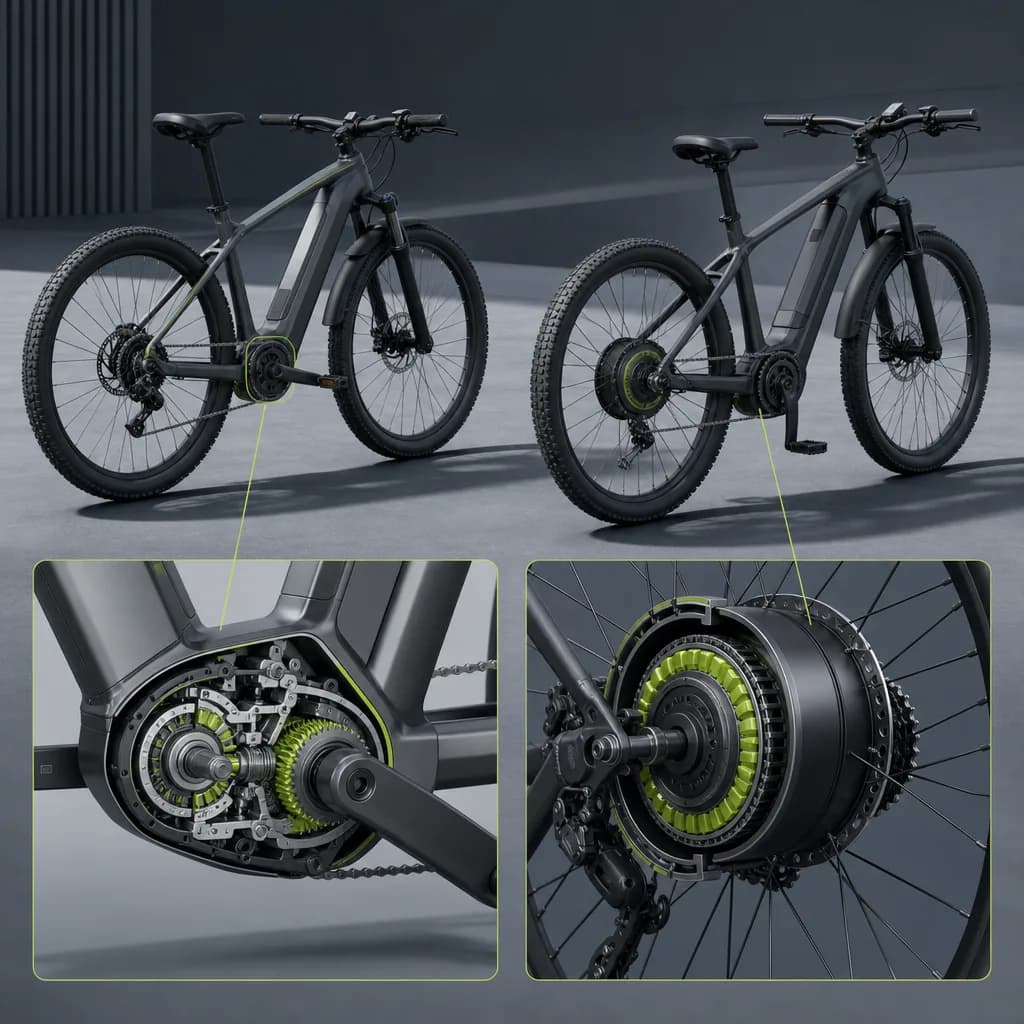
A mid-drive motor sits at the bike's bottom bracket, between the pedals. It drives the cranks, so it works through the bike's gear system. That means the motor can spin at an efficient rate while the gears adjust the wheel speed. On a hill, you shift to a low gear and the motor turns easily. On flat ground, you shift up and the motor cruises.
Because the motor uses the gears, it can stay in its efficient power band more often. That efficiency translates into longer range for the same battery. For example, a 720 Wh battery on a mid-drive bike in ordinary riding (Tour mode, rolling terrain) gives about 48 km, with a range band of 42 to 53 km. In easy riding (Eco, flat), it gives about 94 km, band 82 to 105 km.
Mid-drive motors also add weight low and central on the frame, which helps handling. But they put more stress on the chain and cassette because the motor drives through them. That means more frequent drivetrain wear and higher servicing costs. Servicing a mid-drive motor runs about 180 EUR per year, compared to 120 EUR for a hub motor.
How Hub Motors Work
A hub motor is built into the center of the front or rear wheel. It drives the wheel directly, without going through the bike's gears. There are two types: geared and direct-drive. Geared hub motors are smaller and lighter, with internal gears for torque. Direct-drive hub motors are heavier but have no gears to wear out.
Hub motors are simpler. They don't stress the chain or cassette, so those parts last longer. They also have fewer moving parts overall. That simplicity makes them cheaper to maintain: about 120 EUR per year for servicing, compared to 180 EUR for mid-drive. And because the motor is in the wheel, it doesn't affect the bike's drivetrain at all.
The trade-off is efficiency on hills. A hub motor has a single gear ratio, so it can't keep the motor in its efficient range when climbing. On steep hills, it draws more current and drains the battery faster. On flat ground, the difference is smaller. For example, a 720 Wh battery on a hub motor in ordinary riding might give less than the 48 km a mid-drive gives, but the exact figure depends on the motor and riding style.
Hub motors also add unsprung weight to the wheel, which can affect ride quality over bumps. But for city commuting and flat terrain, that's often not a problem. Many commuter and folding bikes use hub motors because they are simple and cost-effective.
Real-World Range: Mid-Drive vs Hub Motor
Range is where mid-drive motors shine. Because they use the gears, they convert battery energy into motion more efficiently. That means you can go further on the same battery. But range depends heavily on how you ride and the terrain.
Our range calculator uses assist consumption rates: Eco 7 Wh per km, Tour 11, Sport 15, Turbo 20. It also applies multipliers for terrain (flat 1, rolling 1.25, steep 1.6), tyres (road 1, hybrid 1.1, knobby 1.25), temperature (mild 1, cold 1.2), pace (relaxed 0.9, brisk 1, fast 1.3), and rider weight (1 percent per 5 kg either side of 80 kg). The result is a range band of plus or minus 12 percent.
For a 720 Wh battery, the median size in our catalogue, the estimated ranges are: easy riding (Eco, flat) gives 94 km, band 82 to 105 km. Ordinary riding (Tour, rolling) gives 48 km, band 42 to 53 km. Hard riding (Turbo, steep) gives 20 km, band 18 to 23 km. In the cold, that ordinary range drops to 40 km.
Mid-drive bikes tend to achieve the higher end of these estimates because of their efficiency. Hub motors often fall short, especially on hills. But if you ride on flat ground and use Eco mode, a hub motor can still give you a decent range. The key is to match the motor to your terrain.
Cost of Ownership: Upfront and Long-Term
Upfront, hub motors are generally cheaper. The median price of an e-bike in our catalogue is 1399 USD, but you can find hub-motor bikes for as little as 399 USD, like the Fiido D3 Pro. Mid-drive bikes tend to cost more because the motor is more complex. For example, the Cyrusher Trident, a mid-drive mountain bike, is the most expensive in our catalogue at 4499 USD.
Long-term, hub motors are cheaper to service. Servicing a hub motor costs about 120 EUR per year, while a mid-drive costs 180 EUR per year. Over five years, that's a difference of 300 EUR. But mid-drive bikes may have lower running costs if they are more efficient, because you use less electricity. However, electricity is cheap: charging a median battery costs about 0.20 EUR per charge, and riding 100 km costs about 0.42 EUR in electricity.
Battery replacement is a big cost for any e-bike. A replacement pack costs about 1.2 EUR per Wh, so a 720 Wh pack costs 864 EUR. Battery life is about 800 full cycles, which on a median battery is about 38400 km. If you ride 3000 km a year, that's about 13 years, but batteries degrade even if you don't use them.
| Cost factor | Hub motor | Mid-drive motor |
|---|---|---|
| Typical upfront price | From 399 USD | From 1000 USD |
| Annual servicing | 120 EUR | 180 EUR |
| Drivetrain wear | Lower | Higher |
| Battery replacement (720 Wh) | 864 EUR | 864 EUR |
To see the full five-year cost of a specific bike, use our cost-of-ownership calculator. It totals the purchase price, charging, servicing, battery replacement, and resale value. For example, five years of a median bike costs 1642 EUR total, or 0.11 EUR per km. That includes 63 EUR for charging and 600 EUR for servicing.
Which Motor Type Is Best for You?
Start with your terrain. If you live in a hilly area or plan to ride off-road, a mid-drive motor is the better choice. It uses the gears to climb efficiently, so you won't drain the battery as fast. If your rides are mostly flat, a hub motor is perfectly adequate and will save you money.
Next, consider your budget. Hub motors are cheaper upfront. The cheapest bike in our catalogue, the Fiido D3 Pro at 399 USD, has a hub motor. Mid-drive bikes typically start around 1000 USD. If you can afford the higher upfront cost, a mid-drive may save you money in the long run through efficiency, but the higher servicing cost offsets some of that.
Think about maintenance. If you want a bike that requires less attention, a hub motor is simpler. You won't need to replace the chain and cassette as often. If you enjoy tinkering and don't mind drivetrain maintenance, a mid-drive is fine.
Finally, test ride both if you can. But since you're reading this, you might not have that option. Use our find-my-ebike tool to narrow down bikes based on your needs.
Financing Your E-Bike
If the upfront cost is a barrier, many e-bikes can be financed. Our finance calculator helps you understand monthly payments. For example, a 1295 EUR bike over 24 months at 0 percent APR costs 54 EUR per month, with 0 EUR total interest. At 9.9 percent APR, the monthly payment is 60 EUR, and the total interest is 138 EUR.
Financing can make a more expensive mid-drive bike affordable. But remember, the longer the loan term, the more interest you pay if the APR is not zero. Always check the APR and total cost of credit.
Also consider the payback period if you're switching from driving. Riding 50 km a week instead of driving saves 486 EUR per year, so a 1295 EUR bike pays for itself in 32 months. Riding 100 km a week saves 1072 EUR per year, paying back in 14 months. Riding 200 km a week saves 2245 EUR per year, paying back in just 7 months.
Maintenance Tips for Both Motor Types
Regardless of motor type, keep your battery healthy. Charge it regularly, avoid extreme temperatures, and store it at partial charge if you won't ride for a while. Battery life is about 800 full cycles, so treat it well to maximize its lifespan.
For hub motors, check the axle nuts and spokes periodically. The motor adds weight to the wheel, so spokes can loosen over time. Also, keep the motor connectors clean and dry. Hub motors are sealed, but water can still get in through the wiring.
For mid-drive motors, keep the chain clean and lubricated. Because the motor drives through the drivetrain, a dirty chain wears out faster. Also, check the motor mount bolts for tightness. The motor is heavy and can vibrate loose.
Servicing costs are higher for mid-drive (180 EUR per year) than hub (120 EUR per year). That difference is due to more complex parts and labor. Budget for that in your ownership costs.
Real Bikes Compared
To see how motor type plays out in practice, look at specific models. The HITWAY BK15M is a mid-drive mountain bike at 700 USD. Over five years at 3000 km a year, it costs 1153 EUR total, or 0.08 EUR per km. That's cheaper than many hub-motor bikes because of its low price and efficiency.
On the other hand, the HAOQI Leopard Pro, a mid-drive mountain bike at 1899 USD, costs 1802 EUR over five years at 3000 km a year, or 0.12 EUR per km. The Velowave Rover, a hub-motor bike at 1799 USD, costs 2012 EUR over five years, or 0.13 EUR per km. The Velotric Summit 1, a mid-drive at 2899 USD, costs 2362 EUR over five years, or 0.16 EUR per km.
| Bike | Motor type | Price (USD) | 5-year cost (EUR) | Cost per km (EUR) |
|---|---|---|---|---|
| HITWAY BK15M | Mid-drive | 700 | 1153 | 0.08 |
| HAOQI Leopard Pro | Mid-drive | 1899 | 1802 | 0.12 |
| Velowave Rover | Hub | 1799 | 2012 | 0.13 |
| Velotric Summit 1 | Mid-drive | 2899 | 2362 | 0.16 |
Notice that the cheapest bike, the HITWAY BK15M, has the lowest five-year cost. That's because the purchase price dominates the total. A more expensive bike can still be economical if you ride a lot, but the upfront cost matters.
What to Do Next
Now that you know the trade-offs, narrow down your options. Use our find-my-ebike tool to answer a few questions and get a shortlist of bikes that match your needs. Then, for each bike, run the range and cost-of-ownership calculators to see the real numbers.
If you're still unsure, consider your typical ride. If it's a flat commute under 20 km each way, a hub motor will save you money. If you plan to tackle hills or want to go on longer rides, invest in a mid-drive. The extra upfront cost may be worth it for the efficiency and climbing ability.
Finally, remember that the best e-bike is the one you'll ride. Don't overthink the motor type. Both will get you where you need to go. Choose the one that fits your budget and terrain, and enjoy the ride.
Frequently asked questions
Which motor type is better for hills?
Mid-drive motors are better for hills because they use the bike's gears to keep the motor in its efficient range. Hub motors have a single gear ratio, so they strain on steep climbs. If you ride steep hills regularly, choose mid-drive.
Are hub motors cheaper to maintain?
Yes, hub motors are cheaper to maintain. Servicing a hub motor costs about 120 EUR per year, while a mid-drive costs about 180 EUR per year. Hub motors also have fewer drivetrain parts to wear out.
Why do mid-drive motors have a longer range?
Mid-drive motors are more efficient because they leverage the bike's gears, so they use less battery for the same distance. For example, a 720 Wh battery on a mid-drive might give you 48 km in ordinary riding, while a hub motor might give less. However, the difference depends on riding style and terrain.
Can I replace the battery on an e-bike?
Yes, most e-bikes have removable batteries. A replacement pack costs about 1.2 EUR per Wh, so a 720 Wh pack costs 864 EUR. Battery life is about 800 full cycles, which is roughly 38400 km on a median battery.
What is the best motor for commuting?
For commuting, consider your route. If it's flat and you want low maintenance, a hub motor is fine. If you have hills or want longer range, a mid-drive is better. Also factor in cost: hub motors are generally cheaper upfront.