
Choosing your first e-bike comes down to matching the bike to your real riding. That means knowing where you will ride, how far, and what you can spend. This guide gives you the questions to ask and the numbers that matter, without the marketing fluff.
Start With Your Ride, Not the Bike
Before you look at motors or batteries, picture your typical week. Will you ride on flat city streets, rolling hills, or steep climbs? Is your commute 10 km or 40 km round trip? Do you plan to carry groceries or a child? These answers decide the motor and battery you need.
Terrain matters because it directly affects range. Our range calculator uses a terrain multiplier: flat is 1, rolling is 1.25, and steep is 1.6. That means the same battery will take you much further on flat ground than on steep hills. If you live in a hilly area, you need a bigger battery or a more efficient motor.
Distance matters because it sets the minimum range you need. A good rule is to look for an estimated range that is at least double your longest expected ride. That gives you a buffer for wind, cold, and battery degradation over time.
Cargo matters because weight affects range and motor strain. Our range formula includes a rider weight adjustment of 1 percent per 5 kg either side of 80 kg. Heavier loads, including the bike itself, reduce range. If you plan to haul gear, factor that into your battery choice.
Motor Type: Hub or Mid-Drive
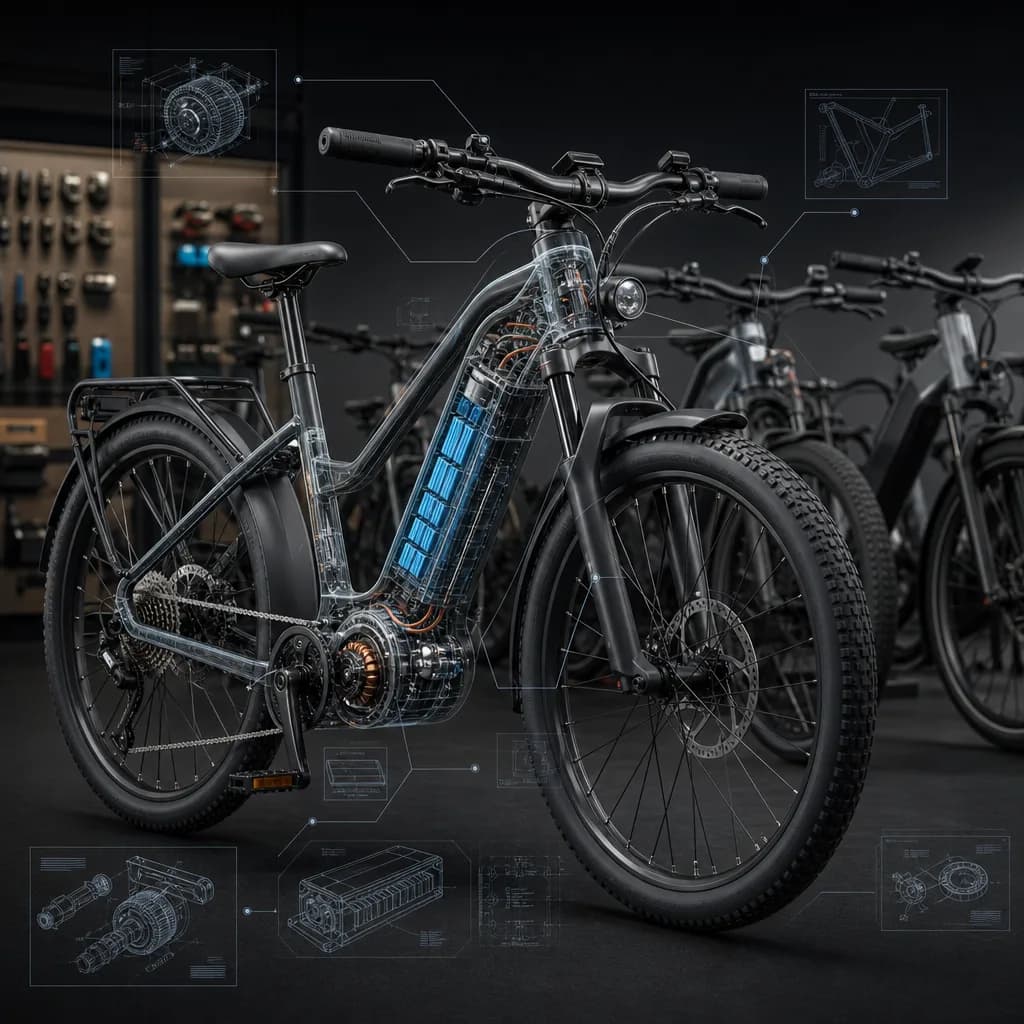
The motor is the heart of an e-bike. There are two main types: hub motors and mid-drive motors. Hub motors sit in the center of the rear wheel. Mid-drive motors sit at the bottom bracket, where the pedals attach. Each has strengths.
Hub motors are simpler and cheaper. They are common on commuter and folding bikes. They require less maintenance, with servicing costs around 120 EUR a year. Hub motors are fine for flat terrain and moderate hills. They are also easier to replace if they fail.
Mid-drive motors are more efficient on hills and provide a more natural riding feel. They use the bike's gears, so they can climb steep grades more easily. However, they are more complex and cost more to service, around 180 EUR a year. We count a motor as a mid-drive from 60 Nm of torque.
For your first e-bike, consider your terrain. If you live in a flat area and want a simple, low-cost bike, a hub motor is a solid choice. If you have steep hills or plan to ride off-road, a mid-drive motor is worth the extra cost.
| Motor Type | Best For |
|---|---|
| Hub motor | Flat city riding, budget buyers, low maintenance |
| Mid-drive motor | Hilly terrain, off-road, efficiency, natural feel |
Battery Size and Realistic Range
Battery size is measured in watt hours (Wh). The median battery in our catalogue is 720 Wh. Larger batteries give more range but add weight and cost. Smaller batteries are lighter and cheaper but may not meet your needs.
Our range estimates are based on a formula that accounts for assist level, terrain, tyre type, temperature, pace, and rider weight. For example, a 720 Wh battery gives an estimated range of 94 km under easy riding (Eco mode, flat terrain), but only 20 km under hard riding (Turbo mode, steep terrain). In ordinary riding (Tour mode, rolling terrain), it gives 48 km.
Cold weather also reduces range. The same 720 Wh battery that gives 48 km in ordinary riding gives 40 km in cold conditions. Tyres matter too: knobby tyres reduce range compared to road tyres. Pace matters: a fast pace uses more energy than a relaxed pace.
When comparing bikes, look at the estimated range, not the claimed range. Our database shows that the median claimed range is 97 km, but the median estimated range is 48 km. That is a 50 percent overclaim. Use our range calculator to get a number you can trust.
Set a Realistic Budget
E-bike prices range from 399 USD to 4499 USD in our catalogue. The median price is 1399 USD. A quarter of bikes cost under 999 USD, half under 1399 USD, three quarters under 1899 USD, and a tenth above 2299 USD. Your budget should reflect how often you will ride and what you expect from the bike.
Cheaper bikes, like the Fiido D3 Pro at 399 USD, may be tempting, but they often have smaller batteries and less durable components. The Fiido D3 Pro has a 374 Wh battery and an estimated range of 28 km. That may be fine for short trips, but not for long commutes.
More expensive bikes, like the Cyrusher Trident at 4499 USD, offer larger batteries and better components. The Cyrusher Trident has a 1040 Wh battery and an estimated range of 60 km. But you do not need to spend that much to get a good bike.
Consider the total cost of ownership, not just the purchase price. Over five years, a median bike costs about 1642 EUR in total, including charging, servicing, and depreciation. That works out to 0.11 EUR per km. Use our cost of ownership calculator to see the full picture.
| Price Range (USD) | What You Typically Get |
|---|---|
| Under 1000 | Smaller batteries (around 400 Wh), basic components, shorter range |
| 1000 to 1500 | Median battery size (around 700 Wh), better components, good value |
| 1500 to 2000 | Larger batteries, more features, better motors |
| Above 2000 | Premium components, large batteries, specialized designs |
Test Ride and Fit
You would not buy a car without sitting in it. The same goes for an e-bike. A test ride tells you if the bike fits your body and feels stable. Pay attention to the standover height, reach to the handlebars, and comfort of the saddle. A good fit prevents pain and improves control.
If you cannot test ride in person, check the bike's geometry and compare it to a bike you have ridden. Look at the step-through height and the adjustable components. Some bikes, like the Velotric Nomad 1, have a step-through frame that makes mounting easier.
Weight matters, especially if you need to carry the bike up stairs or onto a train. The median bike weight is 28.1 kg. The lightest bike in our catalogue is the Fiido Air Carbon at 13.6 kg, while the heaviest is the Hiboy C1 at 56.7 kg. A lighter bike is easier to handle but may have a smaller battery.
During a test ride, try different assist levels. Feel how the motor responds when you start from a stop and when you climb a hill. Listen for unusual noises. Check the brakes and gears. A test ride is your chance to spot issues before you buy.
Consider Maintenance and Warranty
An e-bike is a machine that needs care. Budget for regular servicing and occasional repairs. Hub motors cost about 120 EUR a year to service, while mid-drive motors cost about 180 EUR a year. Tyres, brake pads, and chains wear out and need replacement.
Check the warranty. Most bikes come with a warranty on the frame, motor, and battery. Understand what is covered and for how long. A good warranty can save you money if something fails.
Battery life is a key part of ownership. Most batteries last about 800 full cycles. If you ride 3000 km a year, a median battery will last about 38400 km, which is over 10 years. But if you ride in extreme conditions or drain the battery fully every time, it may wear out sooner.
Consider the cost of a replacement battery. For a 720 Wh pack, that is 864 EUR. Some bikes have proprietary batteries that are hard to find later. Look for bikes with standard battery mounts or a brand that will support the bike for years.
Make Your Choice Confident
By now you know where you will ride, what motor type suits you, how much battery you need, and what you can spend. You have checked the fit and considered maintenance. The final step is to compare specific models side by side.
Use our bike catalogue to filter by price, motor type, battery size, and style. Look at the estimated range for each bike, not the claimed range. For example, the Hidoes C1 has a claimed range that is closest to our estimate, but many bikes overclaim by 50 percent or more.
Think about the bike's style. Do you want a city bike, a mountain bike, a folding bike, or a cargo bike? Each has trade-offs. A folding bike like the Fiido D3 Pro is great for commuting and storage, but it may have a smaller battery. A cargo bike like the Fiido M1 Pro can carry heavy loads but is heavier and less nimble.
Finally, trust the numbers. Use our calculators to estimate range, savings, and total cost. A bike that seems cheap may cost more over five years. A bike that seems expensive may be worth it if you ride often.
Your first e-bike should make you want to ride more. Choose one that fits your body, your routes, and your budget. With the right bike, you will save money compared to driving, reduce your carbon footprint, and have fun. A car emits 170 g of CO2 per km, while an e-bike emits 5 g. Over a year of riding 1000 km, that is a big difference.
Start with our range calculator to see what battery size you need. Then use the cost of ownership calculator to compare bikes over five years. Finally, browse the catalogue and test ride your top choices. You have the tools. Now go find your ride.
Frequently asked questions
What is the most important thing to consider when buying my first e-bike?
Start with where you'll ride. That decides the motor type and battery size you need. If you ride mostly flat city streets, a hub motor with a smaller battery may be fine. If you have steep hills or long commutes, you'll want a mid-drive motor and a larger battery.
How much should I spend on my first e-bike?
Set a realistic budget based on how often you'll ride. The median price in our catalogue is 1399 USD. You can find bikes for less, but expect to pay more for quality components and support. Use our cost of ownership calculator to see the total five-year cost, not just the sticker price.
How far can an e-bike really go on a single charge?
Manufacturer range claims are often optimistic. In our catalogue, 271 out of 275 bikes have claimed ranges that exceed our estimates. For a typical 720 Wh battery, our range calculator estimates 48 km under ordinary riding conditions (Tour mode, rolling terrain). Use our range calculator to get a realistic figure for your specific bike and riding style.
What is the difference between a hub motor and a mid-drive motor?
Hub motors are in the center of the rear wheel. They are simpler and cheaper to service. Mid-drive motors are at the bottom bracket, where the pedals attach. They provide better weight distribution and efficiency on hills. We count a motor as a mid-drive from 60 Nm of torque.
How much does it cost to run an e-bike compared to a car?
Running an e-bike is much cheaper. For example, riding 50 km a week instead of driving saves about 486 EUR a year. Over five years, a median e-bike costs about 0.11 EUR per km, including charging, servicing, and depreciation. Use our savings calculator to see your potential savings.