
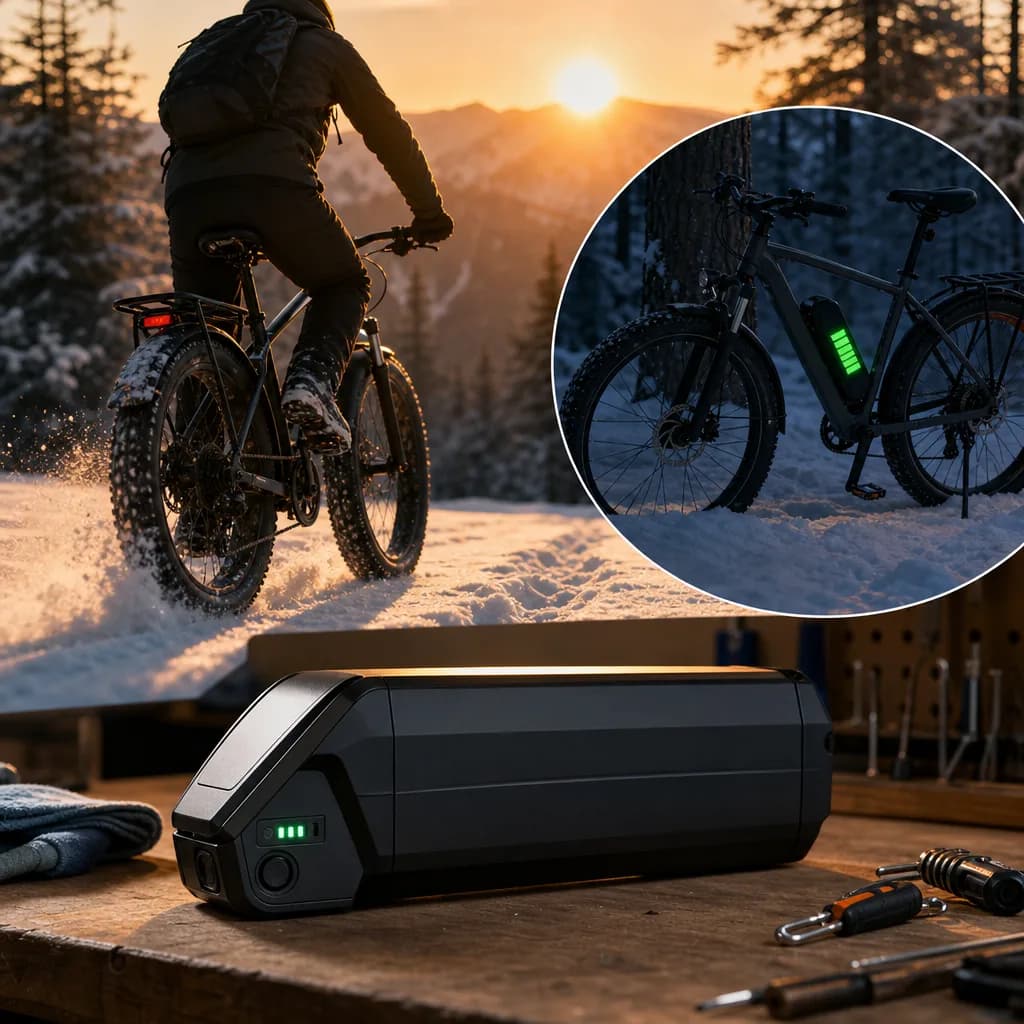
Cold weather drains your e-bike battery faster because low temperatures slow the chemical reactions inside lithium-ion cells, reducing the energy they can deliver. On top of that, cold air increases aerodynamic drag, and cold tires increase rolling resistance, so the motor has to work harder. The result is a noticeable drop in range, often by 20 percent or more, and in severe cold, you might see closer to 40 percent loss. But you can fight back with smart riding habits and battery care.
Why Cold Weather Hurts Battery Range
Lithium-ion batteries work by moving lithium ions between electrodes. Cold slows that movement. The electrolyte becomes more viscous, and the chemical reactions that release electrons happen more slowly. The battery's internal resistance rises, so when you ask for power, the voltage drops more than it would in warm weather. The motor controller compensates by drawing more current to maintain the same assist level, which drains the battery faster.
The effect is worse under heavy load. If you ride in Turbo mode up a steep hill, the battery has to deliver high current, and the cold makes that even harder. You might notice the battery percentage dropping faster than usual, and in extreme cold, the battery management system may limit power to protect the cells. That's why a bike that feels fine in summer can feel sluggish in January.
Cold also affects the bike itself. Tire pressure drops in cold weather, increasing rolling resistance. Lubricants thicken, adding friction to the drivetrain. And cold air is denser, so aerodynamic drag goes up. All of these make the motor work harder, compounding the battery's own loss. Our formula accounts for this with a temperature multiplier of 1.2, meaning you use 20 percent more energy per kilometer in cold conditions.
How Much Range Do You Actually Lose?
Let's put numbers on it. Our range calculator uses a formula that starts with battery capacity in watt-hours, then divides by energy consumption per kilometer. Consumption depends on assist mode, terrain, tires, temperature, and pace. For a median 720 Wh battery, easy riding (Eco, flat) gives about 94 km. Ordinary riding (Tour, rolling) gives about 48 km. Hard riding (Turbo, steep) gives about 20 km.
Now apply the cold multiplier of 1.2. That same 720 Wh battery in ordinary riding drops from 48 km to about 40 km. That's a 17 percent reduction. In easy riding, it drops from 94 km to about 78 km. But remember, these are estimates. Real-world conditions like wind, rider weight, and battery age can push the loss higher. Our range band of plus or minus 12 percent shows the uncertainty.
| Riding style | Mild range (km) | Cold range (km) |
|---|---|---|
| Eco, flat | 94 | 78 |
| Tour, rolling | 48 | 40 |
| Turbo, steep | 20 | 17 |
To see your own bike's range, use the range calculator. It lets you input battery size, assist mode, terrain, and temperature to get a personalized estimate.
How to Minimize Cold-Weather Range Loss
You can't change the weather, but you can change how you ride and how you care for your battery. Start with the battery itself. Keep it warm before you head out. If you store your bike in a cold garage, bring the battery inside overnight. A warm battery delivers more usable energy. But don't charge it immediately after coming in from the cold; let it warm to room temperature first.
On the bike, use a lower assist mode when you can. Eco mode uses about 7 Wh per km, while Turbo uses 20 Wh per km. That's nearly three times the energy. In cold weather, the difference is even more critical. Plan your route to avoid steep hills if possible, and keep your tires inflated to the recommended pressure. Cold reduces tire pressure, so check it regularly.
Dress warmly and ride at a steady pace. A brisk but steady effort is more efficient than stop-and-go. Also, consider using regenerative braking if your bike has it, though not all e-bikes do. Finally, reduce wind resistance by tucking in or using a windshield if you have one. Every bit of drag saved is energy saved.
- Bring the battery inside when not riding.
- Charge at room temperature.
- Use Eco or Tour mode instead of Turbo.
- Check tire pressure weekly.
- Keep the battery warm during the ride if possible, like in an insulated bag.
Charging Tips for Cold Weather
Charging a cold battery is harmful. Lithium-ion cells can be damaged if charged below freezing, leading to reduced capacity and even safety risks. Always bring the battery inside and let it warm to room temperature before plugging in. If the battery is very cold, wait a few hours. Also, avoid charging immediately after a ride when the battery is warm; let it cool down a bit, but not to freezing.
Use the charger that came with your bike. Third-party chargers may not have the correct voltage or current, and they might not handle temperature compensation properly. Charge in a dry place, away from flammable materials. Never leave a charging battery unattended overnight, though modern chargers are safe, it's a good habit.
If you store your bike for weeks, charge the battery to about 50 percent. A full charge stresses the cells, and a full discharge can damage them. Check the charge every month or two and top it up to 50 percent if it drops. This keeps the battery in good health for spring.
Long-Term Battery Storage in Winter
If you're not riding for weeks or months, store the battery properly. Remove it from the bike and keep it in a cool, dry place. The ideal temperature is between 32 and 68 degrees Fahrenheit. Avoid extreme heat or cold. A basement or closet is often better than an unheated garage.
Charge to about 50 percent before storing. This is the optimal state for lithium-ion longevity. A full charge accelerates capacity loss, and a full discharge can lead to over-discharge, which damages the battery permanently. If you have a smart charger, it may have a storage mode that sets the right charge level.
Check the battery every month. If the charge drops below 20 percent, charge it back to 50 percent. This prevents the battery from sitting at a very low state of charge, which can cause the voltage to drop too low and trigger the battery management system to shut off. A battery that sits at 0 percent for months may become unusable.
When to Replace Your Battery
Batteries degrade over time, and cold weather can accelerate that if you don't care for them. Our formula assumes a battery lasts about 800 full charge cycles. On a median 720 Wh battery, that's roughly 38,400 km. But if you ride in cold often and charge improperly, you might need a replacement sooner.
Signs that your battery needs replacing include a noticeable drop in range, longer charging times, or the battery not holding a charge. If your bike's range in mild weather has dropped by more than 20 percent from when it was new, it might be time. Also, if the battery swells or gets hot during charging, stop using it and replace it immediately.
Replacement cost is about 1.2 EUR per Wh. For a 720 Wh pack, that's around 864 EUR. That's a significant expense, so it's worth protecting your battery. Use the cost of ownership calculator to see how battery replacement fits into your total cost over five years.
Real-World Example: Winter Commute
Let's look at a typical commuter bike. The Lectric XPress has a 672 Wh battery and an estimated range of 48 km in ordinary riding. In cold weather, that drops to about 40 km. If your commute is 20 km round trip, you'll still make it, but with less margin. If your commute is 30 km, you might need to charge at work or use a lower assist mode.
For a longer commute, consider a bike with a larger battery. The Troxus Trax Plus has a 1440 Wh battery, the largest in our catalogue, with an estimated range of 103 km. In cold, that's still about 86 km, enough for most commutes. But it's also heavier and more expensive.
If you're on a budget, the Fiido D3 Pro is the cheapest in our catalogue at 399 USD, but it has a small 374 Wh battery and only 28 km estimated range. In cold, that might be 23 km, which is fine for short trips but not for a long commute. Choose a bike that matches your winter needs.
Final Tips for Cold Weather Riding
Plan ahead. Know your bike's range in cold and don't push it to the limit. Carry a charger if you can, and know where you can charge along your route. Use the savings calculator to see how much you save by riding instead of driving, even in winter. The savings might motivate you to bundle up.
Keep your battery clean and dry. Moisture can cause corrosion. After a ride in snow or rain, wipe down the battery contacts and let the battery dry before charging. Also, check your bike's firmware for updates; some manufacturers improve battery management in cold weather.
Finally, consider your riding style. In winter, it's better to ride at a steady pace and avoid sudden accelerations. Use lower assist levels and shift gears early to keep the motor from straining. Every bit of efficiency helps extend your range.
Related MathBikes Tools
Our calculators can help you make informed decisions. The range calculator estimates range based on your battery and conditions. The savings calculator shows the financial benefit of riding. The cost of ownership calculator totals five years of expenses. The battery calculator converts amp hours and volts to watt hours. And the finance calculator helps you understand loan payments.
Browse the full catalogue to compare bikes, or use find my e-bike to narrow down options based on your needs. Our methodology page explains every formula we use, so you can trust the numbers.
Frequently asked questions
Why does cold weather reduce e-bike battery range?
Cold slows the chemical reactions inside lithium-ion cells, so they deliver less usable energy. The battery's internal resistance rises, and voltage sags under load, making the motor draw more current for the same assist. Our temperature multiplier applies a 1.2 factor to energy consumption in cold conditions, which can cut range by about 20 percent or more.
How much range do I lose in freezing temperatures?
Our formula applies a cold multiplier of 1.2, meaning you use 20 percent more energy per kilometer. But real-world losses can be larger because cold also affects tire pressure and rolling resistance. The 40 percent figure in the standfirst is a common rule of thumb, but your actual loss depends on temperature, battery chemistry, and riding style.
Should I charge my e-bike battery indoors in winter?
Yes. Charging a cold battery can damage it, so bring it inside and let it warm to room temperature before plugging in. Never charge below freezing. Also, avoid charging immediately after a cold ride; let the battery warm up first to prevent condensation and stress.
How should I store my e-bike battery in winter if I'm not riding?
Store the battery at about 50 percent charge in a cool, dry place, ideally between 32 and 68 degrees Fahrenheit. Avoid full charge or full discharge for long periods. Check the charge every month or two and top it up to 50 percent if it drops. This preserves battery health and capacity.
When should I replace my e-bike battery?
Replace it when its range no longer meets your needs or when it shows signs of failure, like swelling or sudden shutdowns. Our formula assumes a battery lasts about 800 full charge cycles. On a median 720 Wh battery, that's roughly 38,400 km. Replacement cost is about 1.2 EUR per Wh, so a 720 Wh pack costs around 864 EUR.