
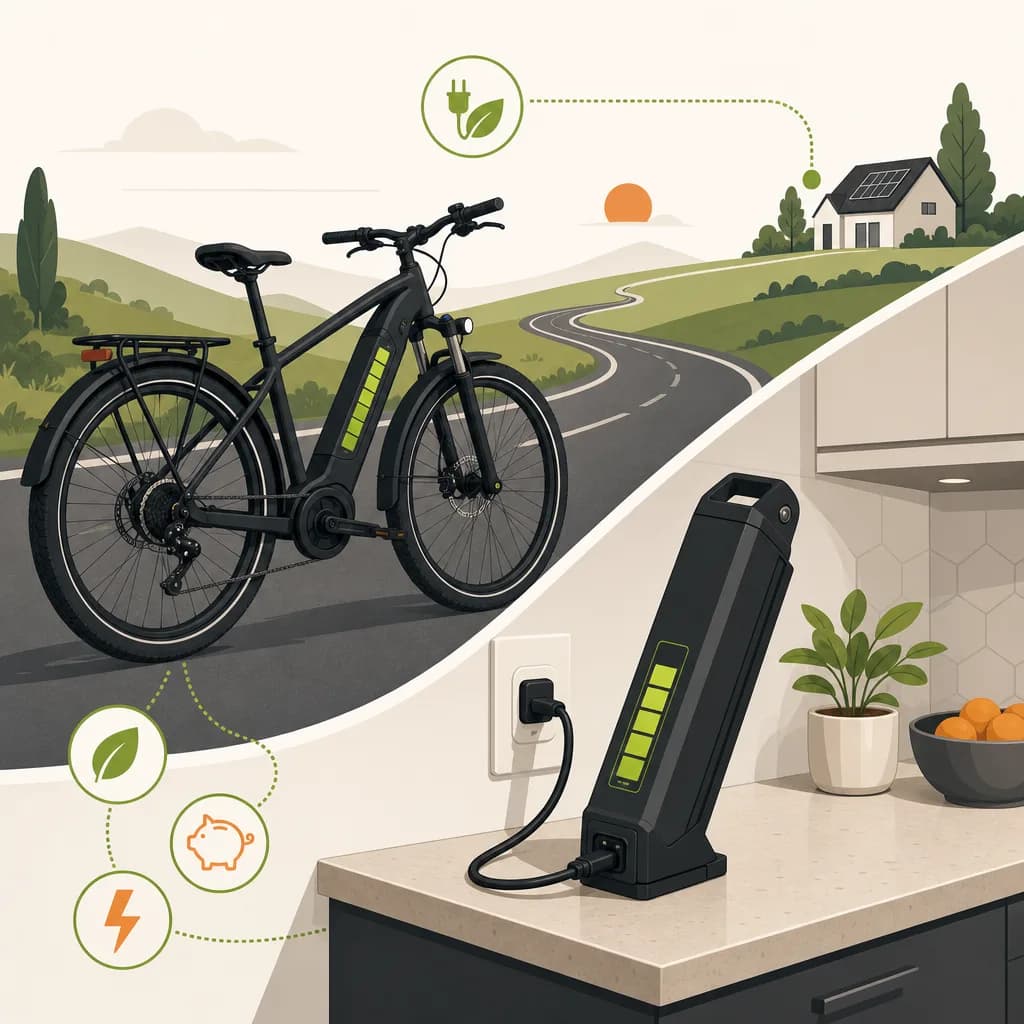
Charging an e-bike at home costs about 20 cents for a full charge. That's the simple answer. The exact figure depends on two numbers: your battery's capacity in watt-hours and your electricity rate in dollars per kilowatt-hour. This guide shows you how to find your cost, why it's so low, and how it compares to other costs of owning an e-bike.
What Determines Charging Cost?
Two factors set the cost of a full charge: battery size and electricity price. Battery size is measured in watt-hours (Wh). Most e-bike batteries fall between 192 Wh and 1440 Wh. The median battery in our catalogue is 720 Wh. Electricity price varies by location and plan, but the US average is around 16 cents per kWh. At that rate, a 720 Wh battery costs about 12 cents to charge. At 28 cents per kWh, it's about 20 cents, which is the figure we often quote.
Your battery's capacity is printed on the pack itself, often as a number like "48V 15Ah". Multiply volts by amp-hours to get watt-hours. For example, a 48V 15Ah battery is 720 Wh. If you don't want to do the multiplication, our battery calculator does it for you.
Electricity price is the other variable. Check your latest utility bill for the rate per kWh. Some utilities charge more during peak hours. If you have time-of-use pricing, charging overnight can cut the cost significantly. The difference between 10 cents and 30 cents per kWh changes a 720 Wh charge from 7 cents to 22 cents.
How to Calculate Charging Cost
The formula is simple: cost per charge = (battery Wh / 1000) × electricity rate per kWh. For a 720 Wh battery at 28 cents per kWh, that's 0.72 × 0.28 = 0.20 dollars, or 20 cents. At the US average of 16 cents, it's about 12 cents.
If you don't know your battery's Wh, look for the voltage and amp-hours. Multiply them: volts × amp-hours = watt-hours. For example, a 48V 15Ah battery gives 720 Wh. A 52V 20Ah battery gives 1040 Wh. The battery calculator can do this conversion for you.
Your electricity rate is on your utility bill. It's usually shown as cents per kWh. If you have a variable rate, use the average over the year. If you're on a time-of-use plan, use the rate for the times you'll charge, often at night.
Charging Efficiency and Losses
Charging is not 100% efficient. The charger converts AC from your wall to DC for the battery, and some energy is lost as heat. Typical losses are 10% to 20%. That means a 720 Wh battery might draw 0.8 to 0.9 kWh from the wall. Our figures already account for this: the 20 cents per charge at 28 cents per kWh is based on realistic losses.
The battery also loses some energy during discharge, especially in cold weather. Our range estimates include a cold weather multiplier of 1.2, meaning range drops by 20% in cold conditions. But the charging cost is based on what you draw from the wall, not what the battery delivers to the motor.
Don't worry about these losses. They add a few cents per charge. Over a year, they might amount to a dollar or two. The bigger cost is battery replacement, which we cover later.
Annual Cost of Charging
Your annual charging cost depends on how far you ride. The more you ride, the more you charge. But even heavy riders spend little on electricity. For example, riding 5000 km in a year uses about 21 euros of electricity at typical European rates. In the US, that's roughly 25 dollars. That's less than a tank of gas for a car.
To estimate your annual cost, multiply your cost per full charge by the number of charges per year. If you ride 3000 km a year and your bike gets 48 km per charge (the median estimated range), that's about 63 charges. At 20 cents each, that's about 13 dollars a year.
The savings calculator can show you the annual cost of electricity for your specific riding distance. It also compares that to the cost of driving the same distance, which is typically hundreds of dollars more.
| Distance per year | Electricity cost (EUR) | Electricity + servicing (hub motor) |
|---|---|---|
| 1000 km | 4 | 124 |
| 3000 km | 13 | 133 |
| 5000 km | 21 | 141 |
Tips to Save Money on Charging
Charging is already cheap, but you can trim it further. First, charge during off-peak hours if your utility offers lower rates. Many plans have cheaper electricity at night. Set a timer or use the charger's schedule feature if available.
Second, don't overcharge. Most chargers stop when the battery is full, but leaving it plugged in for days can cause slight losses and stress the battery. Unplug when done.
Third, keep your battery healthy. A battery that lasts 800 full cycles instead of 400 effectively halves the cost per km of the battery itself. Avoid extreme temperatures and don't store it fully discharged. Replacing a 720 Wh pack costs around 864 EUR, which dwarfs the electricity cost.
Cost to Charge in Different Countries
Electricity prices vary widely around the world. In the US, the average is about 16 cents per kWh, so a 720 Wh charge costs about 12 cents. In Europe, prices are often higher, around 28 cents per kWh, making the same charge about 20 euro cents. In some countries, prices exceed 40 cents per kWh.
The table below shows the cost to charge a 720 Wh battery at different electricity rates. These are examples, not specific countries. Your actual rate is on your bill.
| Electricity rate (per kWh) | Cost per full charge (720 Wh) |
|---|---|
| 10 cents | 7 cents |
| 16 cents | 12 cents |
| 28 cents | 20 cents |
| 40 cents | 29 cents |
Even at high rates, charging remains cheap. A 40 cent per kWh rate still costs under 30 cents per charge. Compare that to a gallon of gas or a bus fare.
Charging at Public Stations vs. Home
Public charging stations for e-bikes are less common than for cars, but they exist. Some are free, some charge per session, and some charge per kWh. Home charging is almost always cheaper. Public stations may charge 1 to 2 dollars per hour, which can exceed the cost of a full home charge in 30 minutes.
Convenience matters too. Charging at home means you start every ride with a full battery. Public stations require you to wait or plan around them. If you commute and can charge at work for free, that's a bonus, but don't rely on it.
For most riders, home charging is the primary method. The cost difference is small in absolute terms, but home charging is simpler and more reliable. If you're considering an e-bike for commuting, the savings calculator can show you how much you save compared to driving, which far outweighs any charging cost.
Does Charging Affect Your Electric Bill?
Yes, but only slightly. If you ride 100 km a week, that's about 1.5 kWh per week at 15 Wh/km, or about 78 kWh per year. At 16 cents per kWh, that's about 12 dollars a year. Your monthly bill might increase by a dollar or two. That's less than the cost of a single movie ticket.
To put it in perspective, a typical US household uses about 900 kWh per month. An e-bike adds less than 1% to that. Even if you ride 5000 km a year, the electricity is about 21 euros, which is less than 2% of an average household's annual electricity use.
So you don't need to worry about your electric bill. The bigger financial impact of an e-bike is the upfront cost and maintenance, not the electricity.
Should You Care About Charging Cost?
Charging cost is the smallest expense of owning an e-bike. Over five years, the median bike's charging cost is 63 EUR, while servicing is 600 EUR and the bike itself costs over 1000 EUR. The battery replacement, if needed, is 864 EUR. So don't choose a bike based on charging cost. Choose it based on range, weight, and price.
What matters more is the savings from riding instead of driving. If you ride 50 km a week, you save about 486 EUR a year. That's more than the cost of the electricity and servicing combined. The savings calculator shows you the payback time for a bike.
So, should you care? Only to the extent that you understand it's negligible. Focus on the bike that fits your needs and budget. The charging cost will be a rounding error in your annual budget.
What to Do Next
Now that you know the cost, the next step is to calculate your own numbers. Use the battery calculator to find your exact cost per charge. Then use the savings calculator to see how much you save by riding instead of driving. Finally, if you're comparing bikes, use the cost of ownership calculator to see the total five-year cost, including charging, servicing, and battery replacement.
Frequently asked questions
How much does it cost to charge an e-bike at home?
Charging a typical e-bike battery costs about 20 cents per full charge at the average US electricity rate. The exact cost depends on your battery size and your electricity price per kilowatt-hour. Use the battery calculator to find your precise figure.
Does charging an e-bike use a lot of electricity?
No. A typical 720 Wh battery uses less than 1 kWh for a full charge, which is less than a typical household uses in a few hours. Even if you ride every day, the annual electricity cost is usually under 30 dollars.
Is it cheaper to charge at home or at a public station?
Home charging is almost always cheaper. Public stations often charge per session or per kWh at rates higher than residential electricity. Some public stations are free, but they are less convenient and may require membership.
Does charging an e-bike affect my electric bill noticeably?
For most riders, the increase is small. If you ride 100 miles a week, the added cost is about a dollar per month. It's far less than the cost of running a refrigerator or air conditioner.
Can I reduce the cost of charging my e-bike?
Yes. Charge during off-peak hours if your utility offers time-of-use rates. Also, keep your battery healthy to avoid premature replacement, which is a much bigger cost than electricity. Use the savings calculator to see how much you save by riding instead of driving.