
The short answer: an e-bike saves you money if you ride it enough to offset the purchase price. The math is simple: compare the cost of your current transport per km against the cost of an e-bike per km, then multiply by your weekly distance. The result tells you your annual savings and how many months to break even. This guide walks you through each step, using real figures from our catalogue and open formulas.
Understanding the Costs of Your Current Transport
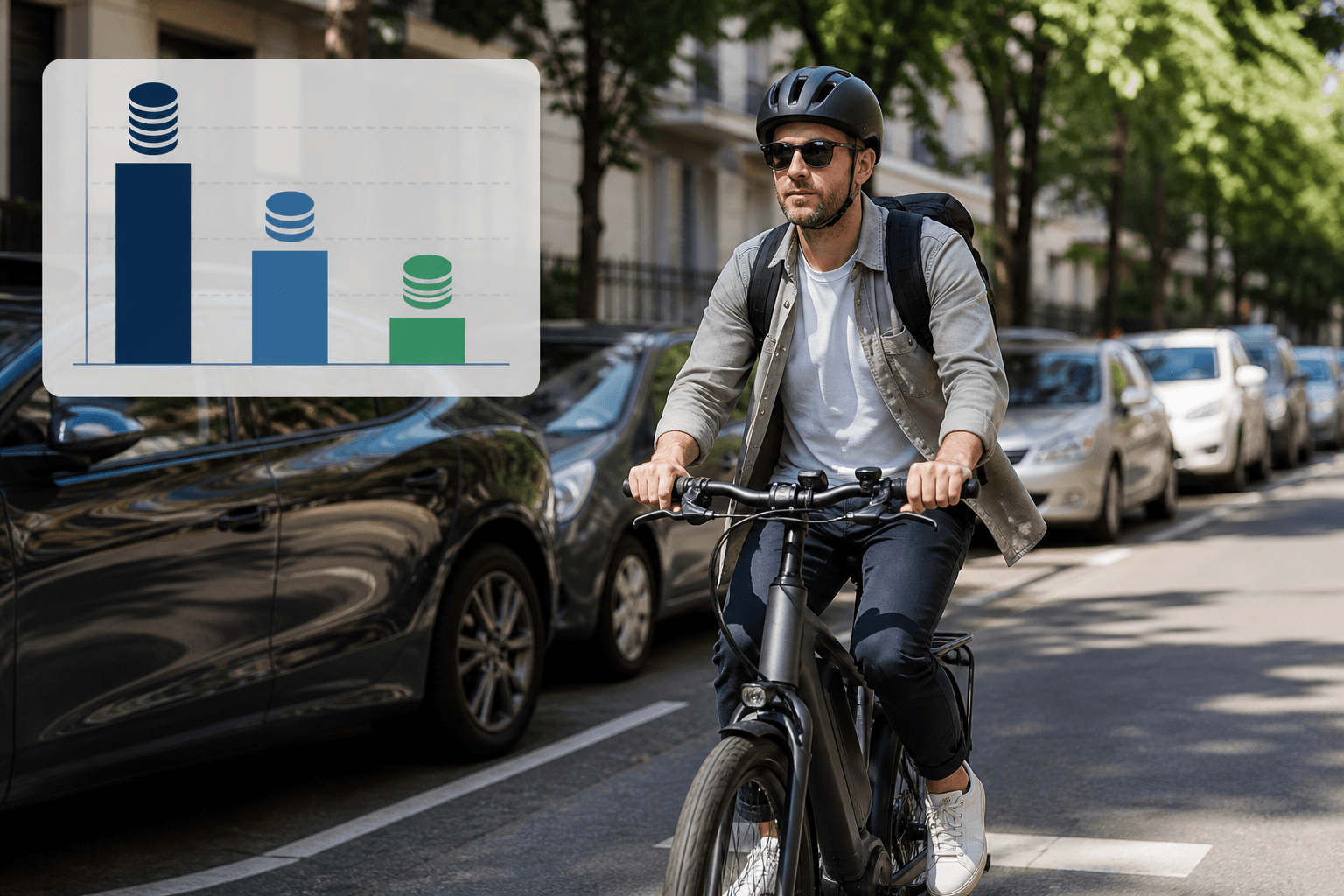
Start with what you pay to drive today. The biggest cost is depreciation, the loss in your car's value as you rack up miles. We count 0.12 EUR per km for depreciation. Maintenance adds 0.06 EUR per km, and parking 0.02 EUR per km. That totals 0.20 EUR per km before fuel, insurance, and taxes.
Fuel is separate because it varies with your car's efficiency and local prices. You know your own fuel cost per km. Add it to the 0.20 EUR base. If your car gets 8 liters per 100 km and fuel costs 1.50 EUR per liter, that's 0.12 EUR per km, bringing the total to 0.32 EUR per km. That is the number to beat.
Public transport is simpler: your fare per trip divided by distance. If a bus ride costs 2.50 EUR for 5 km, that's 0.50 EUR per km. A carpool or ride-share has its own rate. Write down your current cost per km. It is the baseline for every comparison that follows.
The Upfront Cost of an E-Bike
E-bikes range from 399 USD to 4499 USD in our catalogue of 275 bikes. The median price is 1399 USD. A quarter cost under 999 USD, half under 1399 USD, three quarters under 1899 USD, and a tenth above 2299 USD. That spread means your purchase price depends heavily on the type and quality you choose.
Cheap bikes exist. The Fiido D3 Pro costs 399 USD, the cheapest in our catalogue. It has a 374 Wh battery and an estimated range of 28 km. At the other end, the Cyrusher Trident costs 4499 USD with a 1040 Wh battery and 60 km estimated range. Most riders don't need the most expensive bike; the median price gets you a solid commuter.
If you finance, the interest adds to the upfront cost. A 1295 EUR bike over 24 months at 0 percent APR costs 54 EUR per month with no interest. At 9.9 percent APR, the payment rises to 60 EUR per month and you pay 138 EUR in total interest. That interest is part of your investment, so include it in your payback calculation.
Recurring Costs of an E-Bike
Once you own the bike, the ongoing costs are small but not zero. Electricity to charge the battery is the most obvious. Charging a median 720 Wh battery once costs about 0.20 EUR at 0.28 EUR per kWh. Riding 100 km costs about 0.42 EUR in electricity, and 1000 km in a year costs about 4 EUR. That is negligible compared to fuel.
Maintenance and servicing are the real recurring costs. We estimate 0.04 EUR per km for maintenance, covering tires, brake pads, and chain. Annual servicing runs 120 EUR for a hub motor and 180 EUR for a mid-drive. A mid-drive motor costs more to service because it works through the drivetrain. Most bikes with 60 Nm or more torque are mid-drives.
Battery replacement is a future cost. A typical battery lasts 800 full charge cycles. For a median 720 Wh battery, that's about 38400 km. Replacing a 720 Wh pack costs about 864 EUR at 1.2 EUR per Wh. That cost is spread over many years, but it's real. The cost of ownership calculator includes it.
| Annual riding (km) | Electricity cost (EUR) | Electricity + servicing (hub motor) (EUR) |
|---|---|---|
| 1000 | 4 | 124 |
| 3000 | 13 | 133 |
| 5000 | 21 | 141 |
How Much Money Can an E-Bike Save You?
The savings come from replacing car trips with e-bike rides. Each km you ride instead of drive avoids the car's variable cost, about 0.20 EUR per km in maintenance, depreciation, and parking, plus fuel. The e-bike's own cost is tiny: about 0.00 EUR per km in electricity and 0.04 EUR in maintenance, plus a share of servicing and battery.
Our worked examples show the scale. Riding 50 km a week instead of driving saves 486 EUR per year. Riding 100 km a week saves 1072 EUR. Riding 200 km a week saves 2245 EUR. These figures assume you replace car trips and use the car cost constants above. Your actual savings depend on your car's fuel economy and your local fuel price.
To estimate your own savings, multiply your weekly km by the car cost per km, subtract the e-bike cost per km, and multiply by 52. The savings calculator does this for you, letting you adjust for your car's efficiency and fuel price. It also shows the CO2 you save: a car emits 170 g per km, an e-bike just 5 g.
Payback Period: When Will You Break Even?
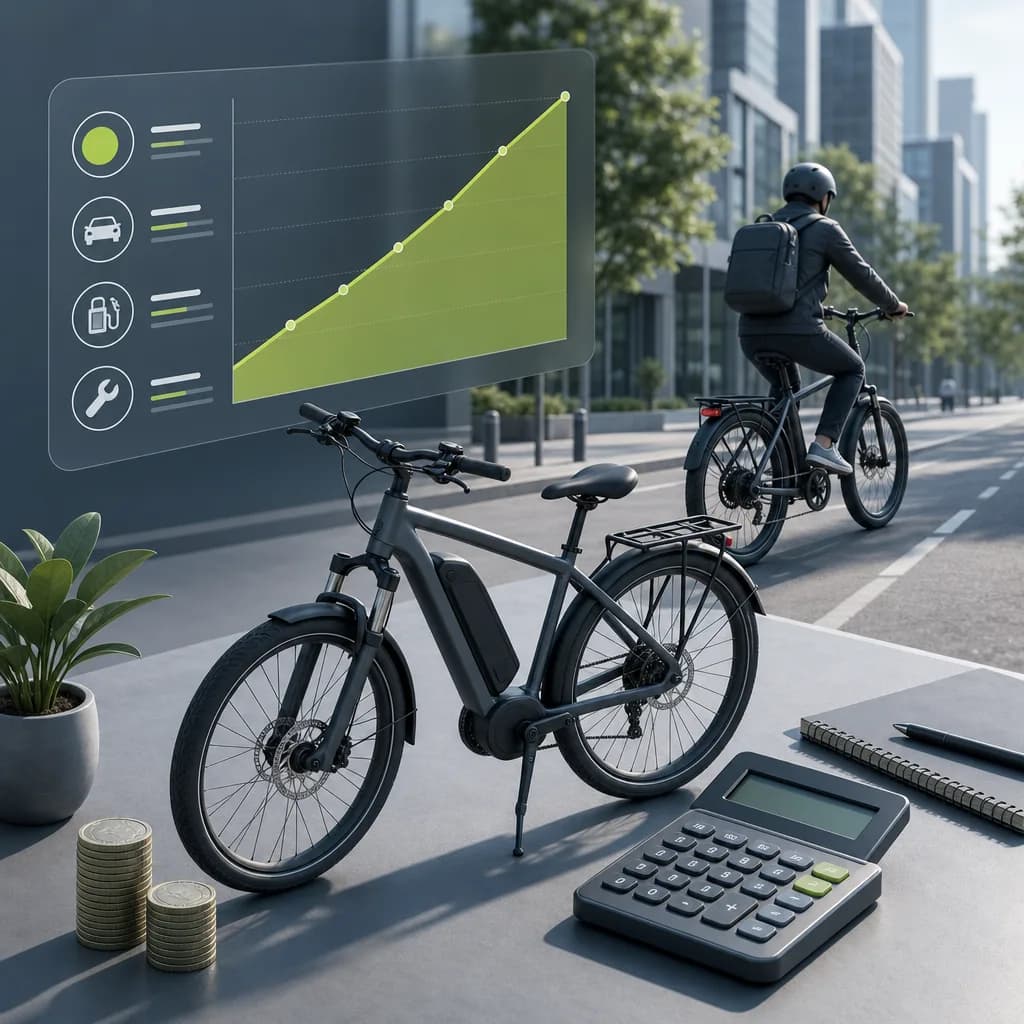
The payback period is the purchase price divided by your annual savings. It tells you how many months of riding it takes to recover your investment. The shorter the payback, the better the deal. For a 1295 EUR bike, riding 50 km a week gives an annual saving of 486 EUR, so payback takes 32 months. Riding 100 km a week cuts that to 14 months. Riding 200 km a week brings it down to 7 months.
These examples use a specific bike price and assume you keep the bike for the full period. If you buy a cheaper bike, payback is faster. If you finance at a high APR, the interest adds to the price and lengthens payback. The finance calculator helps you compare monthly payments and total interest.
Payback also depends on how long you keep the bike. After five years, a median bike is worth about 24 percent of its price, so you recover some of your investment when you sell. The cost of ownership calculator includes resale value and gives a total five-year cost per km.
Hidden Savings to Consider
Beyond the direct comparison, e-bikes bring savings that don't show up in a simple per-km calculation. Health is one. Riding an e-bike is physical activity, and regular exercise can reduce healthcare costs over time. We don't put a number on that, but it's real.
Time is another. In congested cities, an e-bike can be faster than a car for short trips. If your commute is 10 km through traffic, the e-bike might save you 20 minutes a day. That time has value, even if you don't monetize it.
Parking is a direct saving. Many cities charge for car parking, but bikes park free or cheaply. Our car cost includes 0.02 EUR per km for parking, but if you pay a daily rate, your saving is higher. Also, e-bikes don't need oil changes, smog checks, or insurance, though some riders add theft insurance.
Finally, consider the environmental benefit. An e-bike emits 5 g of CO2 per km versus 170 g for a car. Over 1000 km, that's 165 kg less CO2. A tree absorbs about 22 kg per year, so that's like planting 7.5 trees. Some riders value that enough to justify the purchase.
Calculating Your Personal Savings
To get your personal number, you need three inputs: your weekly riding distance, your car's cost per km, and the e-bike's price. The savings calculator lets you enter these and adjusts for your car's fuel efficiency and fuel price. It also accounts for the e-bike's electricity and maintenance costs.
If you don't know your car's cost per km, use our default of 0.20 EUR per km plus fuel. For a typical car, that's about 0.32 EUR per km. The calculator also lets you include or exclude fixed costs like insurance, which you'll still pay if you keep the car.
For the e-bike side, the calculator uses the median bike's consumption of 15 Wh per km and maintenance of 0.04 EUR per km. It adds annual servicing of 120 EUR for a hub motor or 180 EUR for a mid-drive. You can adjust the bike price to match the model you're considering.
Factors That Can Change the Equation
Several factors can make an e-bike more or less economical. The biggest is your riding distance. The more km you replace, the faster the payback. If you only ride 20 km a week, savings are small and payback may exceed the bike's life. If you ride 200 km a week, the bike pays for itself in months.
Your car's cost per km matters too. If you drive a gas-guzzler with high maintenance, the e-bike saves more. If your car is electric and cheap to run, the gap narrows. The calculator lets you set your own car cost.
The e-bike's efficiency affects running costs. A bike with a larger battery doesn't necessarily cost more per km; it depends on how you ride. Using Eco mode on flat terrain, a 720 Wh battery gives about 94 km of range. In Tour mode on rolling hills, it's about 48 km. In Turbo on steep hills, it's about 20 km. The more assist you use, the more electricity you consume, but even Turbo costs only a few cents per km.
Battery size also determines replacement cost. A larger battery costs more to replace but lasts longer in km. For example, a 1056 Wh battery costs 1267 EUR to replace, but a 374 Wh battery costs 230 EUR. The cost of ownership calculator helps you compare different battery sizes.
| Battery size (Wh) | Estimated range (km, ordinary riding) | Replacement cost (EUR) |
|---|---|---|
| 374 | 23 | 230 |
| 518 | 34 | 622 |
| 720 | 48 | 864 |
| 1056 | 61 | 1267 |
Comparing Real Bikes: Cost of Ownership
To see how the math works on actual bikes, we ran five-year cost of ownership for four models at 3000 km per year. The HITWAY BK15M, a 700 USD mountain bike, totals 1153 EUR over five years, or 0.08 EUR per km. The HAOQI Leopard Pro, at 1899 USD, totals 1802 EUR, or 0.12 EUR per km. The Velowave Rover, at 1899 USD, totals 2012 EUR, or 0.13 EUR per km. The Velotric Summit 1, at 2899 USD, totals 2362 EUR, or 0.16 EUR per km.
These totals include purchase price, charging, servicing, battery replacement, and resale value. The more expensive bikes cost more per km, but they may offer better components or longer life. The cost of ownership calculator lets you input any bike's price and battery size to get your own five-year estimate.
When comparing bikes, don't just look at the sticker price. A cheap bike with a small battery might need replacement sooner, raising its long-term cost. Conversely, a pricier bike with a large battery and efficient motor could be cheaper over time if you ride a lot. Use the cost of ownership calculator to compare apples to apples.
What to Do Next
Start with your own numbers. Estimate your weekly km that could be done on an e-bike. Check your car's fuel cost and maintenance. Then use the savings calculator to see your annual savings and payback period. If the payback is under three years, an e-bike is likely a smart financial move.
If you're still choosing a bike, use the range calculator to see how far a given battery will take you in your terrain. The find-my-ebike tool narrows the catalogue based on your needs. And the finance calculator helps you decide whether to pay upfront or finance.
Remember, the best e-bike for saving money is one you'll actually ride. Choose a model that fits your commute and riding style. With the right bike and enough miles, the savings are real.
Frequently asked questions
How much money can an e-bike save per year?
It depends on how much you ride instead of driving. Riding 50 km a week saves 486 EUR a year, 100 km saves 1072 EUR, and 200 km saves 2245 EUR. These figures assume you replace car trips and include car costs like maintenance, depreciation, and parking.
What is the payback period for an e-bike?
Payback is the bike's price divided by your annual savings. For a 1295 EUR bike, riding 50 km a week pays back in 32 months, 100 km in 14 months, and 200 km in 7 months. Your payback depends on your purchase price and weekly mileage.
What are the recurring costs of an e-bike?
Recurring costs include electricity for charging, maintenance, and servicing. Electricity costs about 0.20 EUR per full charge for a median 720 Wh battery. Servicing runs 120 EUR a year for a hub motor and 180 EUR for a mid-drive. Maintenance is about 0.04 EUR per km.
How long does an e-bike battery last?
A typical battery lasts about 800 full charge cycles. For a median 720 Wh battery, that's about 38400 km. Replacing a 720 Wh pack costs about 864 EUR. Battery life varies with usage and care.
Are e-bikes cheaper than cars per km?
Yes, over five years a median e-bike costs about 0.11 EUR per km, while a car costs about 0.20 EUR per km in maintenance, depreciation, and parking alone. The e-bike figure includes purchase, charging, servicing, and resale value.