
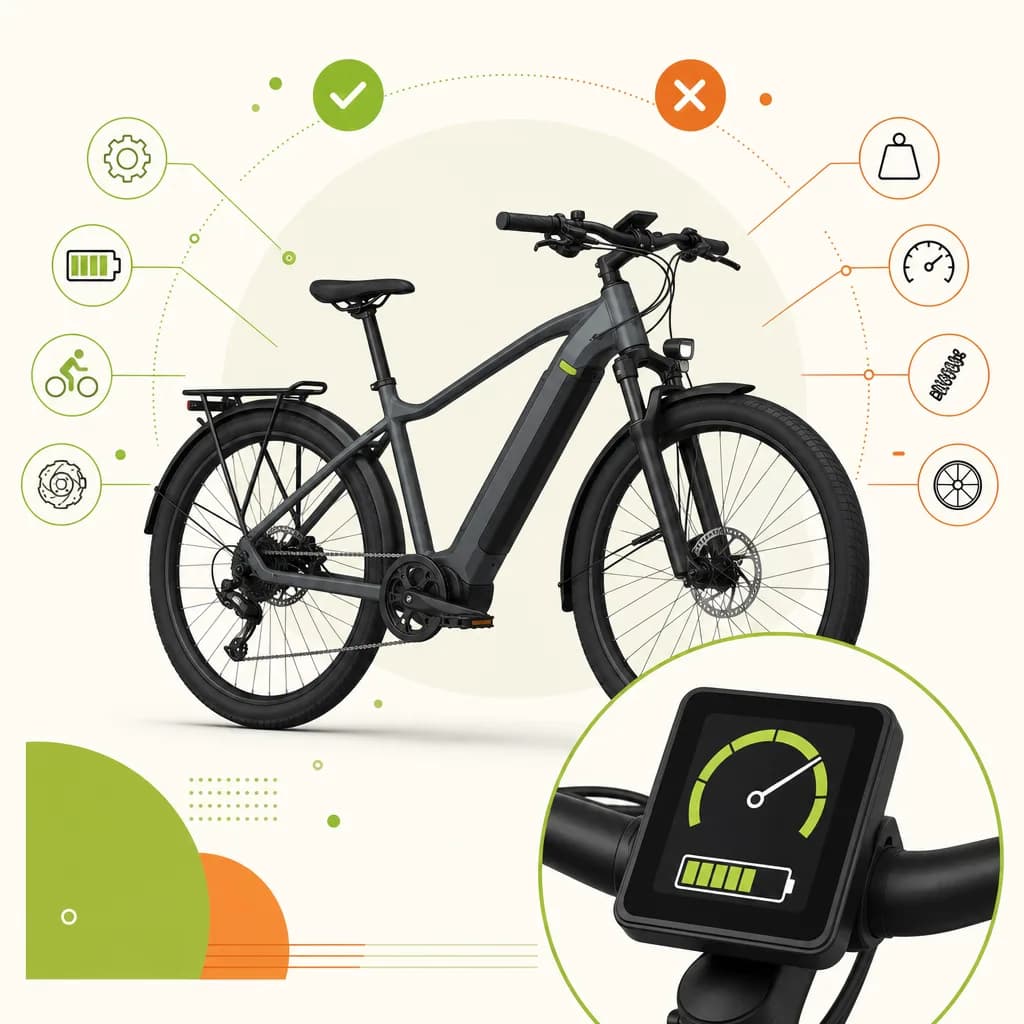
When you shop for an e-bike, you see a wall of numbers: watts, newton-meters, amp-hours, watt-hours, kilograms, gears. Some of those numbers tell you how far you will ride and how much you will enjoy the ride. Others are marketing fluff. This guide sorts the specs that matter from the ones you can ignore, using data from 275 bikes across 37 brands.
Motor Power: Watts and Newton-Meters
Motor power is quoted in watts and torque in newton-meters (Nm). Watts describe how much electrical power the motor can draw, but they do not tell you how strong the motor feels. Torque is the force at the wheel, and it determines how well the bike accelerates and climbs. In our catalogue, the median motor torque is not listed, but we know that 60 Nm is the threshold for a mid-drive motor in our formulas.
A motor with more torque will help you up steep hills and from a standstill. For most riders, a motor with at least 60 Nm is a good target. Motors below that, often hub motors, are fine for flat commutes but struggle on hills. The type of motor also affects servicing costs: hub motors cost 120 EUR a year to service, mid-drives 180 EUR.
Do not chase the highest watt number. A 750 W motor with low torque will feel weaker than a 500 W motor with high torque. Look for the torque figure, and if it is not listed, ask the seller. If they cannot tell you, treat it as a red flag.
Battery Specs: Watt-Hours, Not Amp-Hours
Battery capacity is the single most important spec for range. It is measured in watt-hours (Wh), which is the product of volts and amp-hours. Some sellers quote amp-hours (Ah) alone, but that is meaningless without voltage. Always convert to watt-hours using our battery calculator. For example, a 48 V battery with 15 Ah is 720 Wh.
In our catalogue, the median battery is 720 Wh. The smallest is 192 Wh on the Ridel Cruzzer, and the largest is 1440 Wh on the Troxus Trax Plus. Battery size directly affects range: a 720 Wh battery gives an estimated range of 48 km under ordinary riding (Tour mode, rolling terrain), while a 1440 Wh battery gives 95 km under the same conditions.
Battery capacity also affects replacement cost. A 720 Wh pack costs 864 EUR to replace at 1.2 EUR per Wh. Larger batteries cost more, so consider whether you need the extra range or if a smaller pack will do. A 192 Wh battery gives only 13 km of ordinary range, which is fine for short trips but not for commuting.
| Battery (Wh) | Ordinary Range (km) | Replacement Cost (EUR) |
|---|---|---|
| 192 | 13 | 230 |
| 346 | 23 | 415 |
| 450 | 30 | 540 |
| 518 | 34 | 622 |
| 600 | 40 | 720 |
| 720 | 48 | 864 |
| 1056 | 70 | 1267 |
| 1440 | 95 | 1728 |
Range Claims: Take Them With a Grain of Salt
Every e-bike comes with a claimed range, but those numbers are often optimistic. In our catalogue, the median claimed range is 97 km, while the median estimated range is 48 km. That is a 50 percent overclaim. Of the 275 bikes with a claim, 271 have a claimed range that exceeds our estimate. Only a handful come close to their claim, like the Hidoes C1.
Why the gap? Manufacturers test under ideal conditions: lowest assist, flat ground, light rider, no wind. Real riding uses more power. Our range calculator uses a formula that accounts for assist mode, terrain, tyre type, temperature, and rider weight. For example, a 720 Wh battery gives 94 km in Eco mode on flat terrain, but only 20 km in Turbo mode on steep hills.
Cold weather also cuts range. The same 720 Wh battery that gives 48 km in mild conditions gives 40 km in cold. So when you compare bikes, use the estimated range, not the claimed range. Look for the estimated range in our catalogue, or use the range calculator with your own riding conditions.
Weight: Bike and Battery
Weight affects handling, portability, and range. A heavier bike is harder to pedal without assist, harder to lift onto a rack, and uses more energy to accelerate. The median weight in our catalogue is 28.1 kg. The lightest bike is the Fiido Air Carbon at 13.6 kg, and the heaviest is the Hiboy C1 at 56.7 kg.
Weight also affects range because the motor has to move more mass. Our range formula includes a rider weight factor, but the bike weight is part of the total. A heavy bike like the Hiboy C1, with a 522 Wh battery, has an estimated range of only 36 km. A lighter bike with the same battery would go further.
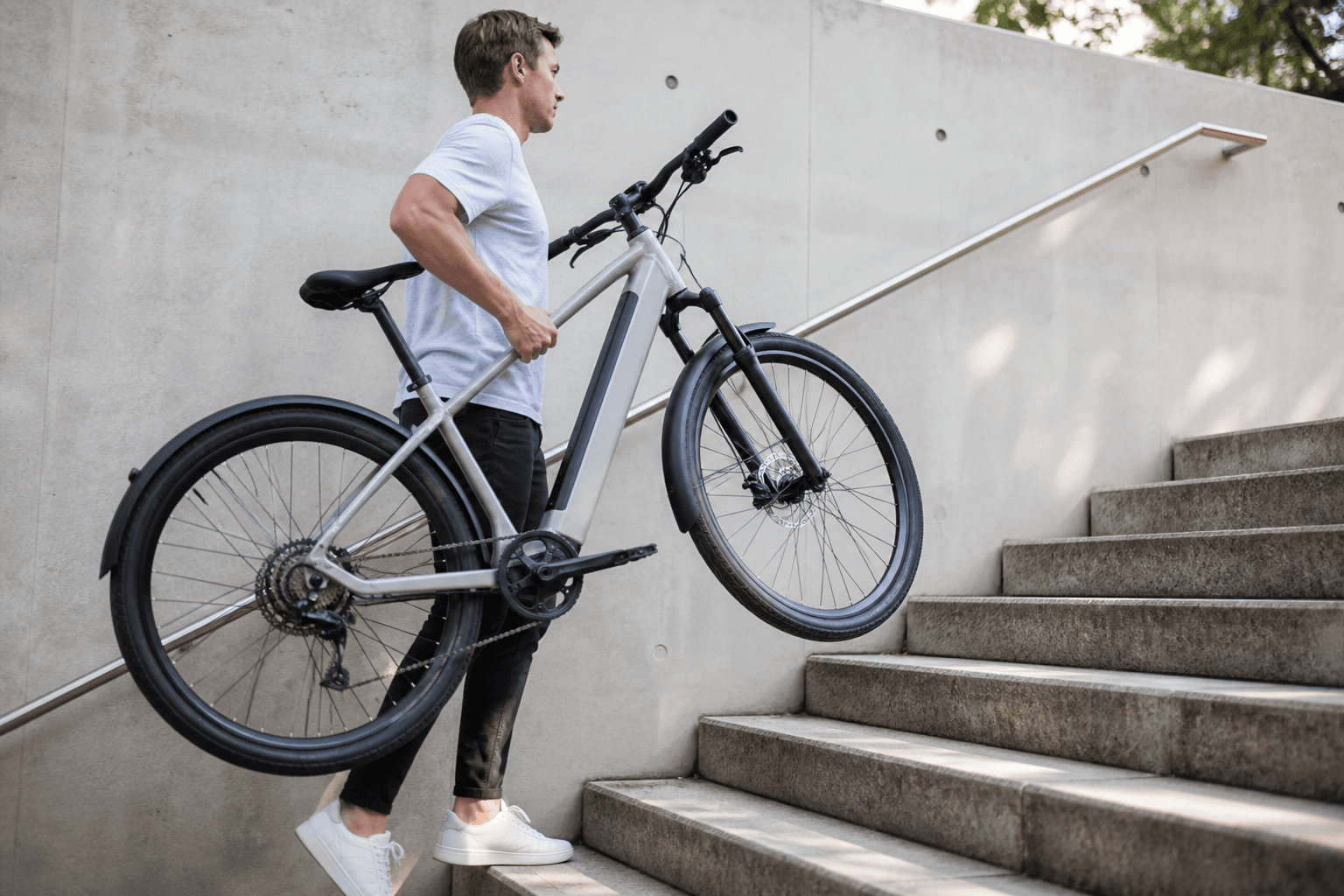
Consider where you will store and transport the bike. If you have to carry it up stairs or onto a train, weight matters a lot. If you ride on flat ground and never lift it, you can accept a heavier bike. But remember that a heavier bike also feels less nimble.
Suspension: How Much Do You Need?
Suspension smooths out bumps, but it adds weight and cost. There are two types: front suspension (a fork) and full suspension (front and rear). For commuting on pavement, front suspension is often enough. For off-road trails, full suspension helps control and comfort.
In our catalogue, suspension varies widely. Some city bikes have no suspension, while mountain bikes have full suspension. The type of bike you choose should match your terrain. If you ride on smooth bike paths, you can skip suspension and save money and weight. If you ride on gravel or trails, front suspension is a good compromise.
Suspension also requires maintenance, which adds to the cost of ownership. A suspension fork needs periodic service, and cheap suspension can be more trouble than it is worth. Look for a fork with adjustable preload or lockout, which lets you stiffen it for smooth roads.
Brakes: Disc Brakes Are a Must
Brakes are a safety-critical component. Disc brakes, either mechanical or hydraulic, provide consistent stopping power in wet conditions. Rim brakes, which grip the wheel rim, are less effective when wet and wear out the rim. On an e-bike, which is heavier and faster than a regular bike, disc brakes are essential.
Hydraulic disc brakes are more expensive but require less effort to squeeze and modulate better. Mechanical disc brakes are cheaper and easier to adjust. Either is better than rim brakes. Check that the bike has disc brakes, and if you ride in hilly areas, consider hydraulic.
Brake maintenance is part of the annual servicing cost. Our cost of ownership calculator includes servicing, but the type of brake can affect that. Hydraulic brakes need bleeding occasionally, while mechanical brakes need cable adjustments. Both are manageable, but budget for it.
Gears: How Many Do You Need?
E-bikes have a motor to help you pedal, so you do not need as many gears as on a regular bike. Many e-bikes have a single speed or a hub gear with 3 to 8 speeds. The number of gears is not a measure of quality. What matters is the range of gears, especially a low gear for starting from a stop and a high gear for pedaling at speed.
In practice, most riders use a few gears. A 7-speed or 8-speed drivetrain is plenty for most conditions. Internal hub gears are low-maintenance and good for commuting. Derailleur gears are lighter and more efficient but require more adjustment.
Do not pay extra for a 21-speed or 24-speed bike. You will not use all those gears, and they add weight and complexity. Focus on the quality of the shifting and the gear range, not the count.
Frame Material: Aluminum is King
Frame material affects weight, ride quality, and price. Aluminum is the most common and offers a good balance of weight, strength, and cost. Steel is heavier but absorbs vibration well. Carbon fiber is light and stiff but expensive. For most e-bike buyers, aluminum is the right choice.
In our catalogue, the vast majority of bikes use aluminum frames. It is durable and corrosion-resistant. Carbon fiber frames are rare at the median price of 1399 USD. Steel frames are found on some budget bikes, but they add significant weight.
Do not be swayed by marketing about frame material. Aluminum is fine for almost everyone. If you want a lighter bike, look at the total weight, not just the frame. A bike with a carbon frame but a heavy battery and motor may still weigh more than an aluminum bike with a smaller battery.
Smart Features: Gimmicks vs. Useful
Many e-bikes come with smart features: app connectivity, GPS tracking, integrated lights, and displays. Some are useful, but many are gimmicks that add cost and complexity. A basic display that shows speed, battery, and assist level is enough for most riders.
App connectivity can be useful for tracking rides and adjusting motor settings, but it is not essential. If the app is poorly designed or the bike requires it for basic functions, that is a red flag. GPS tracking is valuable for theft recovery, but only if the service is reliable and has a subscription fee.
Integrated lights are a plus because they are always charged and hard to forget. But you can add good lights for less than the price difference. Smart features should not be the reason you choose a bike. Focus on the core specs: battery, motor, brakes, and weight.
Price: What Are You Really Paying For?
E-bike prices range from 399 USD to 4499 USD in our catalogue, with a median of 1399 USD. What does more money buy? Generally, better components, larger batteries, more torque, and better support. But there are good bikes at every price point.
In the under 1000 USD range, you can find bikes like the SAMEBIKE SY26 at 799 USD, which has a 480 Wh battery and a 35 km estimated range. In the 1000 to 1500 USD range, the Lectric XPress at 1299 USD offers 672 Wh and 48 km. Above 2000 USD, you get better motors and suspension, but the gains are incremental.
The price spread in our catalogue shows that a quarter of bikes cost under 999 USD, half under 1399 USD, and three quarters under 1899 USD. Only a tenth are above 2299 USD. Set a budget based on what you need, not on the most expensive option.
Warranty and Support: Don't Overlook
An e-bike is a significant investment, and you want it to last. Warranty terms vary widely. Some brands offer a 1-year warranty, others 2 years or more. Check what is covered: frame, motor, battery, and electronics. Battery warranties are especially important because batteries degrade over time.
Support is also crucial. If you buy online, who will service the bike? Some brands have local dealers, others are direct-to-consumer. Look for a brand with a good reputation for customer service and available spare parts. In our catalogue, we cover 37 brands, and the level of support varies.
Consider the total cost of ownership, not just the purchase price. A cheap bike with poor support may cost more in the long run. Our cost of ownership calculator shows that a 1295 EUR bike over 5 years costs 1642 EUR total, including charging, servicing, and resale value. That is 0.11 EUR per km.
Specs That Don't Matter
Some specs are overhyped and do not affect your ride. The number of gears is one. Most riders use a few gears, and a 7-speed is enough. Another is the display size or color. A simple display works fine. Also, the brand of the motor or battery is less important than the actual specs. A generic motor with high torque is better than a name-brand motor with low torque.
Do not obsess over the top speed. Most e-bikes are limited to 25 km/h or 32 km/h depending on the class. You will not use the top speed often. Also, ignore the number of assist levels. Many bikes have 5 levels, but you will likely use only 2 or 3.
Finally, ignore the claimed range. Use the estimated range instead. And do not pay extra for a bike with a huge claimed range if the battery is small. The battery size is the real determinant.
How to Choose Your E-Bike
Start with your budget. Then decide what type of riding you will do: commuting, off-road, or cargo. Use our find-my-ebike tool to narrow down the catalogue. Then compare bikes on the specs that matter: battery capacity, torque, weight, and brakes.
Look at the estimated range for your typical ride. If you commute 20 km round trip, a bike with a 48 km estimated range gives you a comfortable margin. If you ride 50 km, you need a larger battery or a more efficient bike.
Consider the total cost of ownership. A bike that costs 1295 EUR and you ride 100 km a week will pay for itself in 14 months compared to driving, saving 1072 EUR a year. If you ride 200 km a week, it pays back in 7 months and saves 2245 EUR a year.
Real Cost of Ownership
The purchase price is just the beginning. You will pay for electricity, servicing, and eventually a new battery. Over five years, a median bike costs 1642 EUR total, including 63 EUR for charging, 600 EUR for servicing, and it is worth 316 EUR at the end. That works out to 0.11 EUR per km.
Charging is cheap. Charging a median battery once costs 0.20 EUR at 0.28 EUR per kWh. Riding 100 km costs 0.42 EUR in electricity. Servicing is the bigger cost: hub motors cost 120 EUR a year, mid-drives 180 EUR. Batteries eventually need replacing. A 720 Wh pack costs 864 EUR, and it lasts about 800 full cycles, which is 38400 km on a median bike.
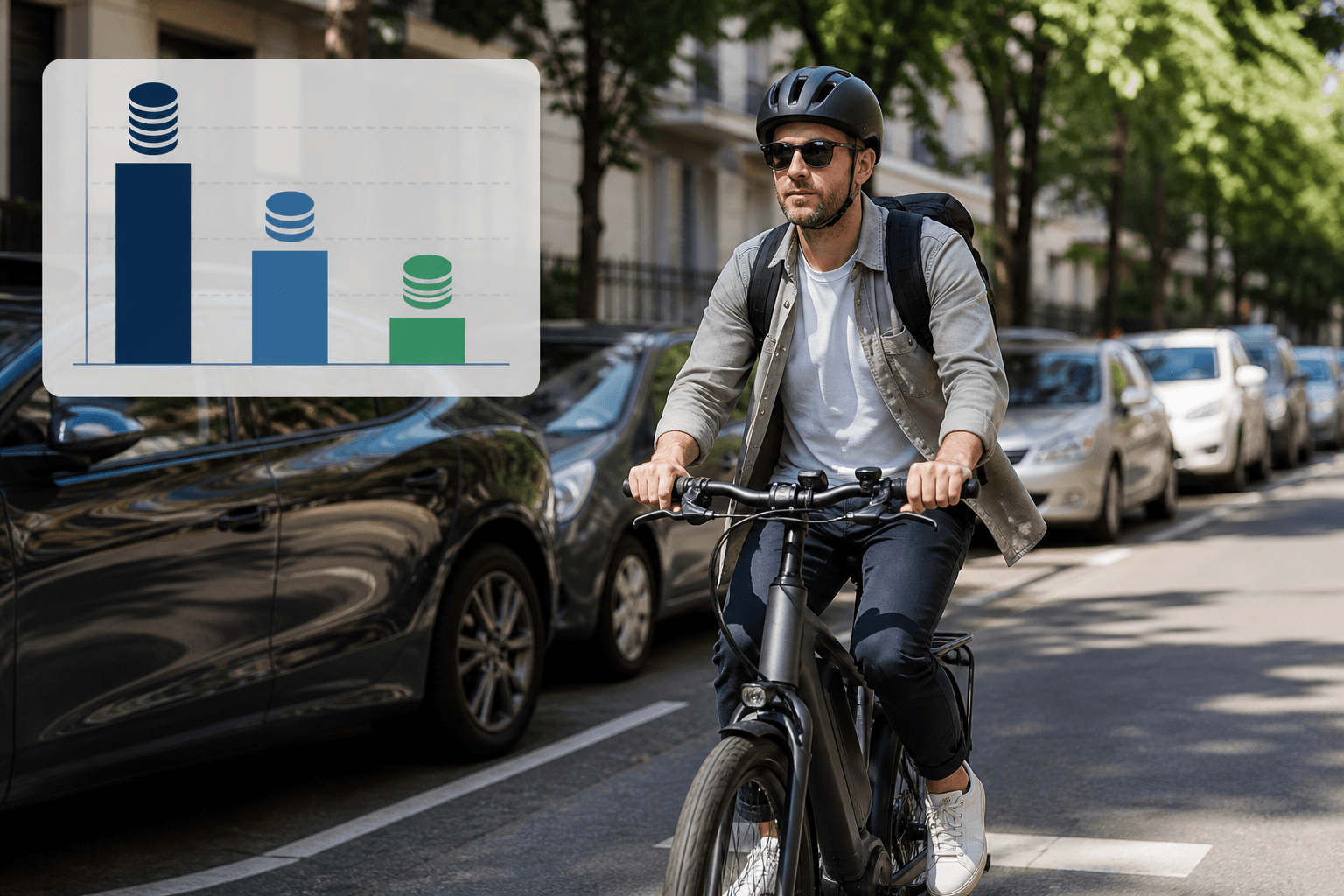
Compare that to driving. A car costs 0.06 EUR per km in maintenance, 0.12 EUR in depreciation, and 0.02 EUR in parking. That is 0.20 EUR per km before fuel. An e-bike costs a fraction of that. Even with servicing, riding 3000 km a year on a hub motor costs 133 EUR, while driving would cost much more.
| Bike | Price (USD) | 5-Year Total Cost (EUR) | Cost per km (EUR) |
|---|---|---|---|
| HITWAY BK15M | 700 | 1153 | 0.08 |
| HAOQI Leopard Pro | 1899 | 1802 | 0.12 |
| Velowave Rover | 1299 | 2012 | 0.13 |
| Velotric Summit 1 | 2299 | 2362 | 0.16 |
When you compare e-bikes, use the cost of ownership calculator to see the real difference. A more expensive bike with a larger battery and better motor may cost more upfront but could have lower servicing costs if it has a hub motor. But remember, mid-drive motors cost more to service.
Now that you know which specs matter, you can shop with confidence. Focus on battery capacity, torque, weight, and brakes. Use the calculators to estimate range and cost. And do not forget to check the warranty and support. Your next e-bike should be a joy to ride, not a source of regret.
Frequently asked questions
What is the most important e-bike spec?
Battery capacity in watt-hours is the most important spec because it determines how far you can go. Motor torque in newton-meters matters for hill climbing and acceleration. Weight also affects handling and range.
How much does motor power matter?
Motor power in watts is less important than torque. Torque (newton-meters) tells you how strong the motor is at the wheel. A motor with 60 Nm or more is considered a mid-drive class and offers better performance.
Why are claimed ranges so different from real ranges?
Manufacturers test under ideal conditions: low assist, flat terrain, light rider. Real riding uses more power. Our estimates show the median claimed range is 97 km, but the median estimated range is 48 km, so claims are often double reality.
What specs can I ignore?
Ignore the number of gears (most riders use only a few), smart features like app connectivity (often gimmicks), and frame material (aluminum is fine). Focus on battery capacity, torque, weight, and brake type.
How much should I spend on an e-bike?
The median price in our catalogue is 1399 USD. You can find decent bikes under 1000 USD, but expect better components and support above that. Consider your riding distance and total cost of ownership.