
Switching from a car to an e-bike can save you thousands of dollars a year, but the exact number depends on how much you ride and what you pay for your car. The savings come from fuel, parking, insurance, and maintenance. On the e-bike side, the costs are electricity, servicing, and the bike itself. This guide breaks down each cost and shows you how to calculate your own savings.
The Big Costs of Owning a Car
Owning a car costs more than the monthly payment. You pay for fuel, insurance, parking, maintenance, and depreciation. The MathBikes cost model uses published figures: maintenance runs 0.06 EUR per km, depreciation 0.12 EUR per km, and parking 0.02 EUR per km. That adds up to 0.20 EUR per km before you even count fuel.
Fuel is the biggest variable. A typical car emits 170 g of CO2 per km, and the cost of gasoline varies with your mileage and fuel efficiency. The savings calculator lets you input your car's fuel consumption and local fuel price to get a per-km cost. But even without fuel, the fixed costs of maintenance, depreciation, and parking are substantial.
Depreciation is often the largest single cost. A new car loses value every year, and that loss is a real cost even if you don't sell the car. The 0.12 EUR per km figure reflects average depreciation across car models. Parking adds another 0.02 EUR per km, which is easy to underestimate if you pay for parking at work or in the city.
E-Bike vs Car: Yearly Cost Comparison
The e-bike side is much cheaper. The MathBikes model assumes an e-bike uses 15 Wh per km, which is a typical average across riding styles. At an electricity price of 0.28 EUR per kWh, that works out to about 0.00 EUR per km in electricity. Maintenance is 0.04 EUR per km, and you should budget 100 EUR a year for servicing.
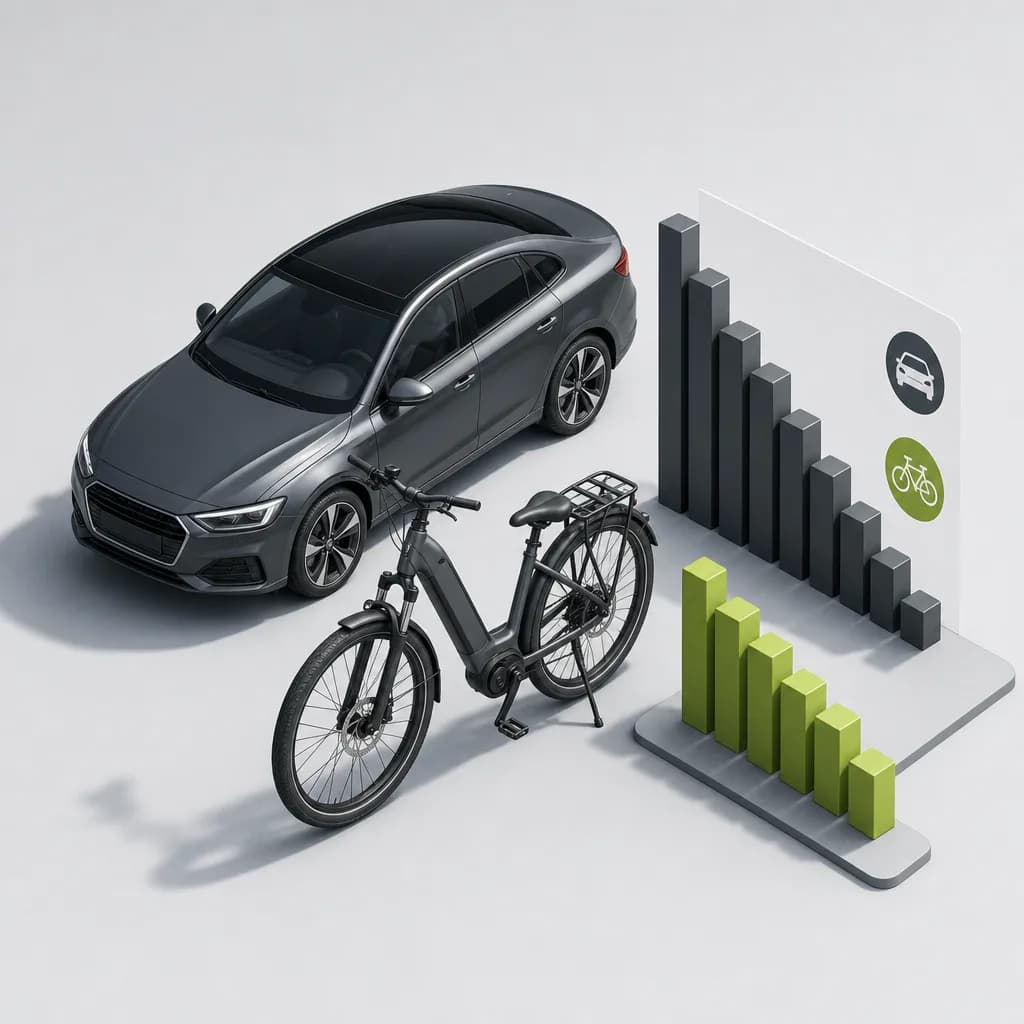
To compare yearly costs, you need to know how many km you ride. The savings calculator uses your weekly distance and the per-km costs above. For example, riding 50 km a week instead of driving saves 486 EUR a year. Riding 100 km a week saves 1072 EUR. Riding 200 km a week saves 2245 EUR. These savings already account for the e-bike's electricity and maintenance.
| Weekly distance | Annual saving (EUR) | Months to pay back a 1295 EUR bike |
|---|---|---|
| 50 km | 486 | 32 |
| 100 km | 1072 | 14 |
| 200 km | 2245 | 7 |
The payback period is short for most riders. A 1295 EUR bike pays for itself in 32 months at 50 km a week, 14 months at 100 km, and just 7 months at 200 km. If you commute 20 miles a day (about 32 km each way), you are likely in the 200 km a week category.
Hidden Savings You Might Miss
Beyond the obvious fuel and parking costs, e-bikes save you money in less visible ways. Car maintenance is a big one. The average car costs 0.06 EUR per km in maintenance, while an e-bike costs only 0.04 EUR per km. Over 5000 km a year, that is a saving of 100 EUR. Plus, e-bikes do not need oil changes, timing belts, or exhaust systems.
Depreciation is another hidden saving. Cars lose value quickly, but e-bikes hold their value better. After 5 years, a median e-bike is worth about 24% of its original price. That is a real cost, but it is much lower than a car's depreciation. For a 1295 EUR bike, that is about 316 EUR after 5 years.
Health benefits are harder to quantify but real. Riding an e-bike gives you exercise, which can reduce healthcare costs over time. Some employers offer incentives for cycling to work, such as tax breaks or subsidies. Check with your employer. Also, many cities offer free or discounted parking for bikes, and some regions have purchase incentives for e-bikes.
What You Give Up by Switching
An e-bike is not a car. You give up weather protection, cargo space, and the ability to carry passengers. If you regularly haul large items or drive in heavy rain, an e-bike may not replace every car trip. But for commuting and errands within 20 miles, an e-bike can handle most trips.
Range is a consideration. The median e-bike has a 720 Wh battery and an estimated range of 48 km under ordinary riding (Tour mode, rolling terrain). That is enough for a 15-mile commute each way, but not for a 100-mile road trip. If you need longer range, you can buy a bike with a larger battery, like the Troxus Trax Plus with a 1440 Wh battery, which gives an estimated 103 km range.
Charging time is another factor. A full charge takes a few hours, so you need to plan ahead. But you can charge at home or at work. And if you run out of battery, you can still pedal, though the bike is heavy. The median e-bike weighs 28.1 kg, so pedaling without assist is tough.
Real-World Scenarios: Who Saves the Most?
The biggest savers are people who drive a lot and have high car costs. If you have a long commute, pay for parking, and drive a gas guzzler, an e-bike can save you thousands. For example, riding 200 km a week saves 2245 EUR a year. That is more than the cost of many e-bikes, so you could pay off a bike in less than a year.
Urban dwellers save on parking and insurance. If you live in a city where parking costs 0.02 EUR per km, that adds up. Also, you might be able to drop a second car entirely, saving on insurance and registration. The savings calculator does not include insurance, but you can add it manually.
Occasional drivers save less. If you only drive 50 km a week, your saving is 486 EUR a year. That is still significant, but it takes longer to pay back a bike. A 1295 EUR bike would take 32 months to pay back. If you ride less than that, consider a cheaper bike, like the Fiido D3 Pro at 399 USD.
How to Maximize Your Savings
Choose a bike that fits your needs and budget. The median price is 1399 USD, but you can find good bikes for less. The Fiido D3 Pro costs 399 USD, while the most expensive is 4499 USD. A more expensive bike does not necessarily save you more money. Look at the total cost of ownership over 5 years, which includes purchase price, charging, servicing, and resale value.
Maintain your bike to keep costs low. Servicing costs 120 EUR per year for a hub motor and 180 EUR for a mid-drive. Regular maintenance prevents expensive repairs. Also, check your tire pressure and keep your battery healthy. A battery lasts about 800 full cycles, which is roughly 38400 km on a median battery. Replacing a 720 Wh pack costs 864 EUR, so treat it well.
Use the right assist mode. The range of a 720 Wh battery varies from 94 km in Eco mode on flat terrain to 20 km in Turbo mode on steep hills. Riding in Eco or Tour mode extends your range and reduces electricity costs. The range calculator can help you plan trips.
What a 5-Year Ownership Looks Like
To understand the true cost of an e-bike, look at 5 years of ownership. The MathBikes cost-of-ownership model includes the purchase price, charging, servicing, battery replacement if needed, and resale value. For a median bike (price 1399 USD, battery 720 Wh), the total cost over 5 years is 1642 EUR. That breaks down to 63 EUR for charging, 600 EUR for servicing, and the rest is depreciation and battery costs. The bike is worth 316 EUR at the end.
| Cost component | 5-year cost (EUR) |
|---|---|
| Charging | 63 |
| Servicing | 600 |
| Resale value at end | 316 |
| Total cost | 1642 |
The cost per km for a median bike is 0.11 EUR over 5 years. That is much less than the 0.20 EUR per km for a car (maintenance, depreciation, parking) before fuel. Even if you add electricity and servicing, the e-bike is cheaper.
But costs vary by bike. The HITWAY BK15M, a budget mountain bike at 700 USD, has a 5-year total cost of 1153 EUR at 3000 km per year, or 0.08 EUR per km. The Velotric Summit 1, a premium model at 2899 USD, costs 2362 EUR over 5 years, or 0.16 EUR per km. Choose a bike that fits your budget and riding style.
Check Your Own Numbers Before You Buy
Before you buy an e-bike, run your own numbers. The savings depend on your car's fuel efficiency, your local fuel price, your parking costs, and your annual mileage. The savings calculator does the math for you. You can also compare different bikes using the cost-of-ownership calculator.
Consider financing. If you need to borrow, compare interest rates. A 1295 EUR bike over 24 months at 0% APR costs 54 EUR per month with no interest. At 9.9% APR, the monthly payment is 60 EUR and you pay 138 EUR in interest. The finance calculator helps you see the total cost.
Finally, test ride a few bikes to find one that fits you. The right bike is one you will ride often. Use the find-my-ebike tool to narrow down the catalogue based on your needs, then visit a local dealer to try them out. The more you ride, the more you save.
Frequently asked questions
How much can I save per year by switching from a car to an e-bike?
The savings depend on how far you ride. If you ride 50 km a week instead of driving, you save 486 EUR a year. Ride 100 km a week and you save 1072 EUR. Ride 200 km a week and you save 2245 EUR. These figures come from our savings calculator.
What costs are included in the e-bike vs car comparison?
For cars, we include maintenance at 0.06 EUR per km, depreciation at 0.12 EUR per km, and parking at 0.02 EUR per km. For e-bikes, we include electricity at 15 Wh per km and maintenance at 0.04 EUR per km, plus 100 EUR a year servicing.
How much does it cost to charge an e-bike?
Charging a median battery (720 Wh) costs about 0.20 EUR per full charge at 0.28 EUR per kWh. Over a year, riding 5000 km costs about 21 EUR in electricity. That is less than a tank of gas.
How long does it take to pay back an e-bike?
If you ride 50 km a week, a 1295 EUR bike pays back in 32 months. At 100 km a week, it takes 14 months. At 200 km a week, only 7 months. The payback period depends on your weekly distance and the bike price.
What are the hidden costs of e-bike ownership?
The main hidden cost is battery replacement. A 720 Wh pack costs about 864 EUR to replace, and it lasts about 800 full cycles, which is roughly 38400 km. Servicing costs 120 EUR per year for a hub motor and 180 EUR for a mid-drive.