
If you are choosing between a folding and a full-size e-bike, the answer depends on how you will store it, carry it, and ride it. Folding e-bikes win on portability and storage. Full-size e-bikes win on ride comfort and often on battery capacity. But those are generalities. The right choice for you comes down to your specific situation, and the numbers show more overlap than you might expect.
Portability and Storage
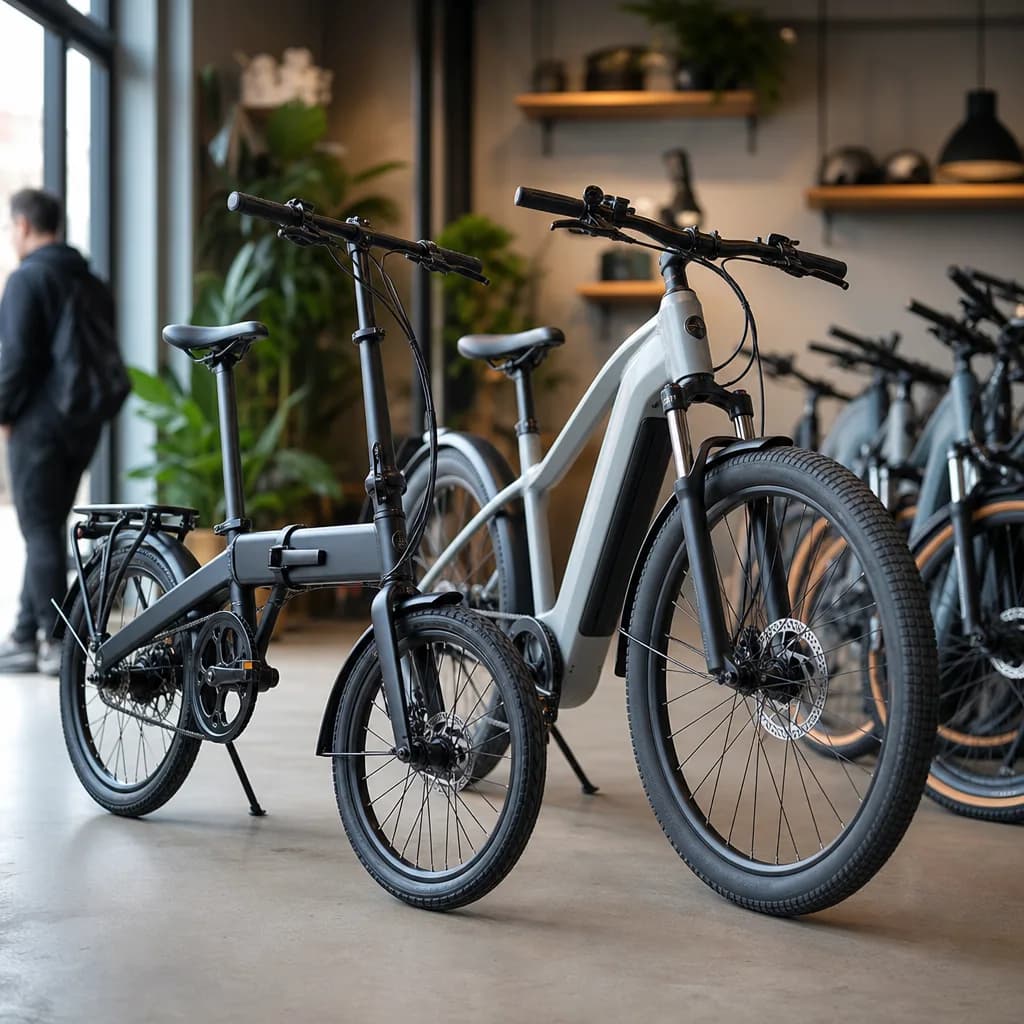
The main reason to buy a folding e-bike is that it folds. That makes it easier to store in a small apartment, take on a train, or put in a car trunk. Full-size e-bikes do not fold, so they need a garage, shed, or a sturdy bike rack. If you live on the third floor with no elevator, a folding bike might be your only option. But folding adds weight and complexity, and not every folding bike folds small enough to be truly convenient.
Weight matters when you carry a bike up stairs or onto a bus. The lightest e-bike in our catalogue is the Fiido Air Carbon, a full-size city bike at 13.6 kg. The heaviest is the Hiboy C1, a folding bike at 56.7 kg. So a full-size bike can be lighter than a folding one. The median weight across all bikes is 28.1 kg. If you must carry your bike regularly, look for a model under 20 kg, but expect to pay more for that lightness.
Folded dimensions are just as important as weight. Some folding bikes fold into a compact package that fits under a desk or in a closet. Others fold but still take up a lot of space. Check the folded size against your storage area. Also, consider how easy the folding mechanism is to use. A bike that takes five minutes to fold will not get folded often.
If you plan to combine cycling with public transport, a folding bike is often allowed where full-size bikes are not. But check the rules of your local transit. Some trains have designated bike areas that accept full-size bikes, while others require folding bikes during peak hours. A folding bike gives you flexibility, but it is not a guarantee.
Range and Battery
Range is a measure of how far you can ride on a single charge. It depends on battery capacity, motor efficiency, your weight, terrain, and assist level. The median battery in our catalogue is 720 Wh. With that battery, our range calculator estimates 94 km on flat terrain in Eco mode, 48 km on rolling terrain in Tour mode, and 20 km on steep hills in Turbo mode. In cold weather, that 48 km drops to 40 km.
Battery capacity varies widely. The largest battery in our catalogue is 1440 Wh on the Troxus Trax Plus, a full-size city bike. The smallest is 192 Wh on the Ridel Cruzzer, also a full-size bike. Folding bikes can have large batteries too: the VTUVIA SF20 has 720 Wh. So do not choose a frame style based on range alone. Instead, look at the battery size and use our range calculator to estimate what you will get in your riding conditions.
Manufacturers often claim ranges that are much higher than real-world estimates. In our catalogue, 271 out of 275 bikes have claimed ranges that exceed our estimates. The median overclaim is 50 percent. For example, the Aventon Ramblas eMTB has the widest gap between its claimed range and our estimate. Always take claimed range with a grain of salt and rely on estimates based on your riding style.
If you have a long commute, you need a battery that can handle it. A 720 Wh battery gives you about 48 km of ordinary riding. If your commute is longer, you might need a larger battery or a second charger. Consider how often you can charge. If you can charge at work, a smaller battery might be fine. If you cannot, aim for a battery that gives you at least your round-trip distance with some margin.
| Battery size | Ordinary range (est.) | Replacement pack cost |
|---|---|---|
| 192 Wh | 13 km | 230 EUR |
| 346 Wh | 23 km | 415 EUR |
| 450 Wh | 30 km | 540 EUR |
| 518 Wh | 34 km | 622 EUR |
| 600 Wh | 40 km | 720 EUR |
| 672 Wh | 44 km | 806 EUR |
| 720 Wh | 48 km | 864 EUR |
| 768 Wh | 51 km | 922 EUR |
| 816 Wh | 54 km | 979 EUR |
| 884 Wh | 58 km | 1061 EUR |
| 1056 Wh | 70 km | 1267 EUR |
| 1200 Wh | 79 km | 1440 EUR |
| 1440 Wh | 95 km | 1728 EUR |
Ride Quality and Comfort
Full-size e-bikes generally offer a more comfortable ride. They have larger wheels, which roll over bumps more smoothly, and longer wheelbases, which provide stability at speed. Folding bikes often have smaller wheels (20 inches or less) and a shorter wheelbase, making them feel more nimble but also more twitchy. If you plan to ride on rough roads or at higher speeds, a full-size bike is usually the better choice.
Suspension is another factor. Many full-size e-bikes come with front suspension forks, and some have full suspension. Folding bikes rarely have suspension, though some have a suspension seatpost. If you have a bumpy commute, look for a bike with at least front suspension. The type of tyres also matters: wider tyres with knobby tread absorb more vibration but increase rolling resistance.
Rider fit is crucial. Full-size bikes come in different frame sizes, so you can find one that fits your height. Folding bikes often have a one-size-fits-all approach, with an adjustable seatpost and handlebar stem. This can work for many riders, but if you are very tall or very short, a full-size bike with the right frame size will be more comfortable. A proper fit reduces strain on your back, neck, and knees.
Test ride if you can. Even if you cannot test ride, compare the geometry. Look at the reach, stack, and standover height. A bike that is too small or too large will be uncomfortable on long rides. If you are between sizes, consider how you will use the bike. For commuting, a more upright position may be more comfortable. For longer rides, a more sporty position might be better.
Performance and Power
Performance includes motor power, torque, and top speed. Both folding and full-size e-bikes can have powerful motors. The motor's torque determines how well it climbs hills. Our database counts a motor as a mid-drive from 60 Nm. Mid-drive motors are generally more efficient and provide better hill-climbing than hub motors, but they cost more to service. Hub motors are simpler and cheaper to maintain.
The type of motor matters more than the frame style. You can find folding bikes with mid-drive motors and full-size bikes with hub motors. If you live in a hilly area, choose a motor with high torque, regardless of whether the bike folds. Also, consider the top speed. Most e-bikes are limited to 25 km/h or 32 km/h depending on the class. Check local laws.
Battery capacity also affects performance. A larger battery can deliver more power over a longer period, which is important if you ride in Turbo mode often. However, a larger battery adds weight. The median battery is 720 Wh, but you can find bikes with batteries from 192 Wh to 1440 Wh. Think about how much assist you use. If you rely on Eco mode, a smaller battery might suffice.
Handling is part of performance. Full-size bikes with larger wheels are more stable at speed and in corners. Folding bikes with smaller wheels accelerate quickly but can feel less stable on descents. If you plan to ride at higher speeds or on winding roads, a full-size bike gives you more confidence. If you only ride in urban areas at moderate speeds, a folding bike's agility is an advantage.
Cost and Value
Price is a major factor. The median price in our catalogue is 1399 USD. The cheapest bike is the Fiido D3 Pro at 399 USD, a folding model. The most expensive is the Cyrusher Trident at 4499 USD, a full-size mountain bike. Price depends more on brand, components, and battery size than on frame style. You can find affordable and expensive options in both categories.
Beyond the purchase price, consider the total cost of ownership. Our cost of ownership calculator shows that a median bike costs about 1642 EUR over five years, including charging, servicing, and depreciation. That is 0.11 EUR per km. Servicing is a big part: about 600 EUR over five years. Hub motors cost 120 EUR per year to service, while mid-drives cost 180 EUR per year. So a cheaper bike with a hub motor might cost less in the long run.
Battery replacement is another cost. A 720 Wh pack costs about 864 EUR to replace. Batteries last about 800 full cycles, which is roughly 38400 km on a median bike. If you ride 3000 km a year, the battery will last over 12 years. But if you ride 5000 km a year, it will last about 7 years. Factor in battery replacement when budgeting.
Resale value is often overlooked. After five years, a median bike is worth about 24 percent of its original price. That means a 1399 USD bike would be worth about 316 EUR. Depreciation is a real cost. Some brands hold value better than others, but it is hard to predict. Buying a used e-bike can save money, but you take on the risk of battery wear.
Which One Should You Buy?
Start with your storage and transport situation. If you have no secure place to park a full-size bike, or if you need to carry it on public transport, a folding bike is the practical choice. If you have a garage or a secure bike room, a full-size bike offers better ride quality and often more battery options.
Consider your typical ride. If you commute a short distance on flat roads and need to fold it at the office, a folding bike like the Fiido D3 Pro at 399 USD might be enough. If you ride longer distances, tackle hills, or want a smooth ride on rough pavement, a full-size bike with a larger battery and suspension is worth the extra money. The median price is 1399 USD, which buys a decent full-size commuter like the Lectric XPress.
Think about the future. A folding bike is easier to take with you on a road trip or store in a small apartment. A full-size bike is more versatile for recreational rides and can handle more varied terrain. If you might want to ride off-road, a full-size mountain bike like the HAOQI Cheetah Pro is a better choice than a folding bike.
Use our find-my-ebike tool to narrow down the catalogue based on your needs. It asks a few questions and suggests bikes that match. You can also filter the catalogue by frame style, price, and battery size.
What Should You Do Next?
Decide based on your priorities. If portability is non-negotiable, choose a folding bike and accept some trade-offs in ride comfort. If comfort and range are more important, choose a full-size bike and find a secure place to store it. Do not overpay for features you will not use. The median price is 1399 USD, and many good bikes are available for less.
Before you buy, run the numbers. Use our savings calculator to see how much you will save by riding instead of driving. If you ride 100 km a week instead of driving, you save 1072 EUR a year. That can pay back a 1295 EUR bike in 14 months. If you ride 200 km a week, you save 2245 EUR a year, paying back the bike in 7 months. The more you ride, the faster the payback.
Finally, check the battery. Use our battery calculator to understand the capacity and what it means for range and cost. A 720 Wh battery costs about 0.20 EUR to charge once. Over a year of riding 3000 km, electricity costs about 13 EUR. That is negligible compared to the cost of the bike itself.
Whatever you choose, buy from a reputable brand with a warranty and good customer support. Read reviews from other owners. And always follow local laws regarding e-bike classification and helmet use. The right e-bike is the one that fits your life and gets you riding more.
Frequently asked questions
Are folding e-bikes less comfortable than full-size e-bikes?
Often, yes. Folding e-bikes typically have smaller wheels and shorter wheelbases, which can make the ride feel more twitchy and less stable at speed. Full-size bikes generally offer a smoother, more planted ride. However, comfort depends on the specific model and your body size, so it's worth checking the geometry and test riding if possible.
Do folding e-bikes have less range than full-size e-bikes?
Not necessarily. Range depends on battery capacity and motor efficiency, not the frame style. Some folding e-bikes come with large batteries, and some full-size bikes have small ones. For example, the VTUVIA SF20 folding bike has a 720 Wh battery with an estimated range of 52 km, while the full-size Cyrusher Trident has a 1040 Wh battery and 60 km estimated range. Always check the battery size and use our range calculator for a realistic estimate.
Are folding e-bikes cheaper than full-size e-bikes?
On average, folding e-bikes tend to be cheaper, but there is overlap. The cheapest bike in our catalogue is the Fiido D3 Pro at 399 USD, which is a folding model. However, you can find full-size city bikes under 1000 USD, like the VIVI C26UL at 500 USD. The median price across all bikes is 1399 USD, so both styles span a wide price range.
Can I take a folding e-bike on public transport?
Many folding e-bikes are designed to be compact enough for buses, trains, and even airplanes, but rules vary by operator. Always check with the transit authority. Even a light folding e-bike like the Fiido Air Carbon at 13.6 kg can be cumbersome to carry for long distances, so consider the weight and folded dimensions before relying on public transport.
How much does it cost to own an e-bike over five years?
Using our cost of ownership calculator, a median bike (priced 1399 USD) costs about 1642 EUR over five years, including charging, servicing, and depreciation. That works out to 0.11 EUR per km. Servicing is a significant part, around 600 EUR over five years. The exact cost varies by bike price, usage, and motor type.