
Your e-bike's advertised range is a fantasy. It's measured on a flat road, with a light rider, pedaling steadily in the lowest assist mode, in mild weather. Real riding is hills, headwinds, stop-and-go traffic, heavier riders, and cold mornings. The result: the median e-bike in our catalogue claims 97 km, but our realistic estimate is 48 km. That's a 50 percent overclaim. Here's why, and what you can do about it.
How Manufacturers Test Range
Manufacturers usually test range on a rolling road, with a machine pedaling at a steady speed, on a flat surface, in a warm room. They use the lowest assist setting, or sometimes no assist at all. The rider weight is set to a light standard, often around 70 kg. The result is a number that no real rider will ever see.
The test standard varies by region, but the common thread is that it ignores the real world. Hills, wind, and acceleration all demand more power. A heavier rider moves more mass. Cold weather saps battery capacity. And most riders don't use Eco mode all the time; they want a bit of help, especially on hills.
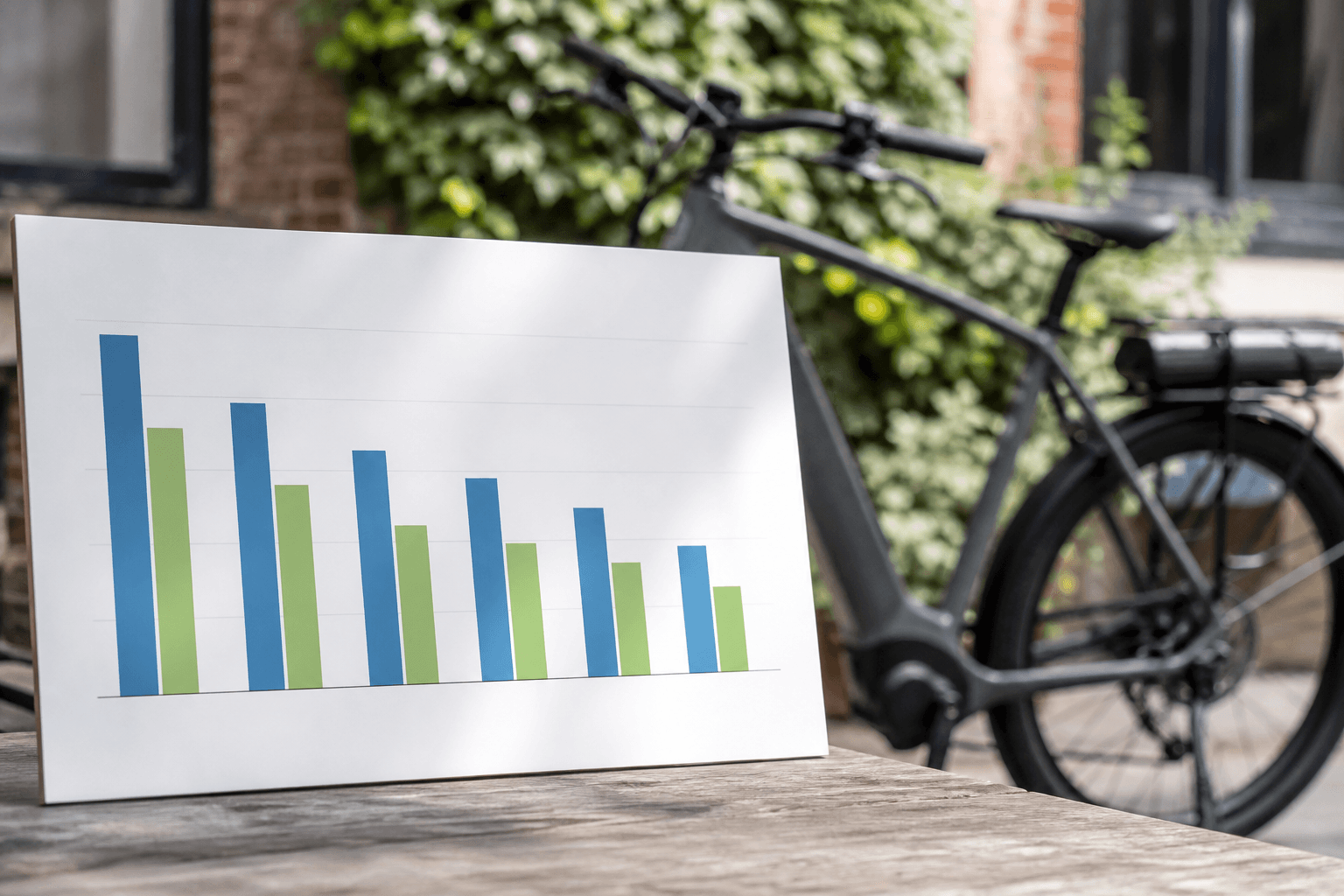
Our own catalogue shows the gap. We list 275 bikes from 37 brands. Of the 275 with a claimed range, 271 have a claimed range that exceeds our realistic estimate. The median overclaim is 50 percent. Some bikes are worse: the Aventon Ramblas eMTB has a claimed range that is more than double our estimate. Others are closer, like the Hidoes C1, but even that one doesn't match reality.
So when you see a range figure on a spec sheet, treat it as a best-case scenario. Your real range will be lower, often much lower. Understanding why will help you plan rides and choose the right bike.
Key Factors That Reduce Real-World Range
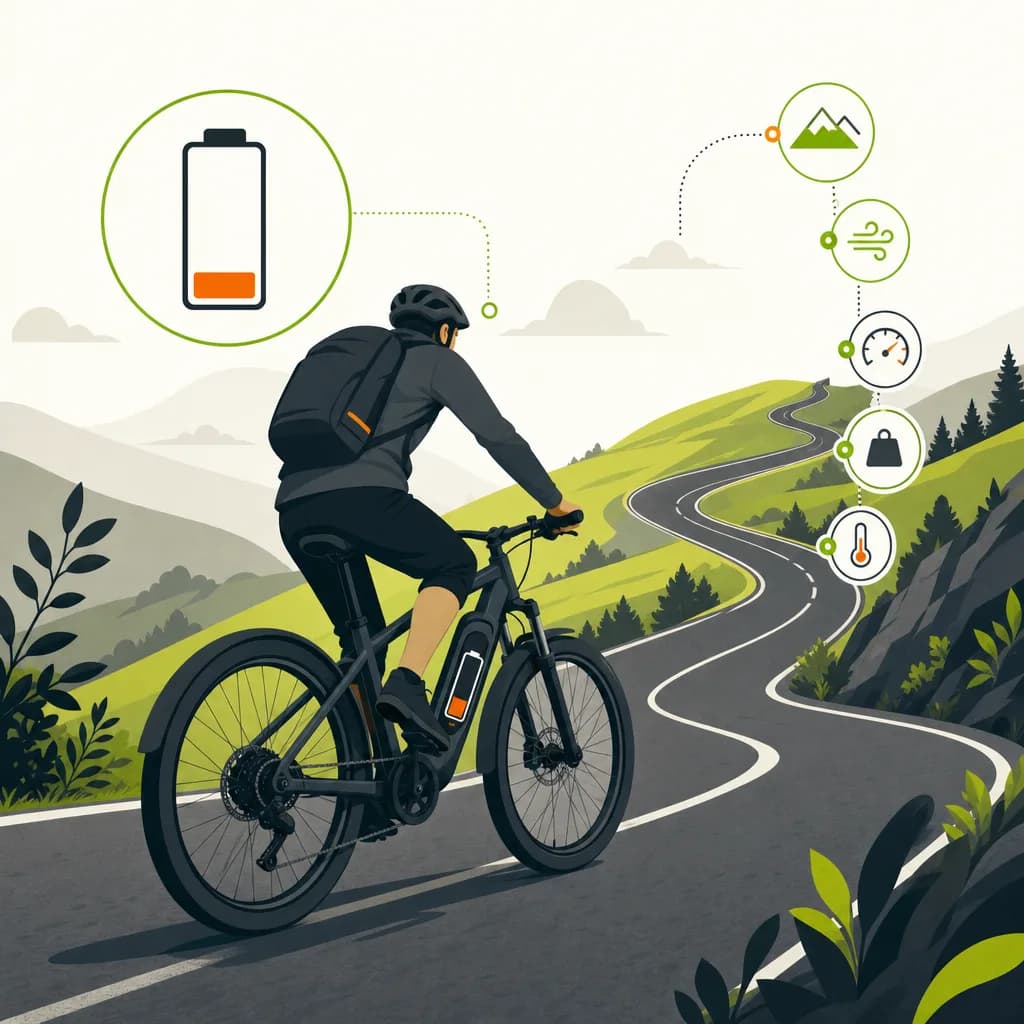
Several factors eat into your range. Some are about you, some about the environment, and some about how you ride. Here are the main ones, with the multipliers our formula uses.
Assist level
The more assist you use, the more power the motor draws. Our formula uses these consumption rates: Eco 7 Wh per km, Tour 11, Sport 15, Turbo 20. That's a huge difference. Riding in Turbo uses nearly three times the energy of Eco. On a 720 Wh battery, easy riding in Eco on flat ground gives you 94 km. Hard riding in Turbo on steep hills gives you just 20 km.
Most riders don't stay in Eco all the time. They use higher assist on hills, or when they're tired, or just because they want to go faster. Every bit of extra assist cuts your range.
Terrain
Hills are the enemy of range. Our terrain multiplier is 1 for flat, 1.25 for rolling, and 1.6 for steep. That means steep hills increase energy consumption by 60 percent compared to flat. A 720 Wh battery that gives you 94 km on flat ground in Eco will give you only 20 km on steep hills in Turbo.
Even rolling hills take a toll. You might not notice the extra effort, but the battery does. If your commute has any elevation gain, your range will be lower than the flat-ground claim.
Rider weight
Heavier riders need more power to move the bike. Our formula adds 1 percent energy consumption for every 5 kg above 80 kg rider weight. So a 100 kg rider uses about 4 percent more energy than an 80 kg rider. That might not sound like much, but it adds up over a ride.
Conversely, a lighter rider gets more range. If you weigh 60 kg, you'll use less energy and go further. The bike's own weight matters too, but rider weight is the bigger variable for most people.
Temperature
Cold weather reduces battery capacity and increases internal resistance. Our temperature multiplier is 1 for mild, 1.2 for cold. That means in cold weather, you lose about 20 percent of your range. For a 720 Wh battery in ordinary riding (Tour, rolling), range drops from 48 km to 40 km.
Batteries are chemical devices. They work best at moderate temperatures. If you ride in winter, expect a noticeable drop in range. Keep your battery indoors when not riding, and consider a battery warmer if you ride in extreme cold.
Tyre type and pressure
Knobby tyres have more rolling resistance than slick road tyres. Our tyre multiplier is 1 for road, 1.1 for hybrid, 1.25 for knobby. That means knobby tyres increase energy consumption by 25 percent compared to road tyres. If you have a mountain bike with aggressive tyres, your range will be lower than a city bike with slick tyres.
Tyre pressure also matters. Under-inflated tyres increase rolling resistance. Check your pressure regularly. It's a free way to improve range.
Pace
The faster you go, the more energy you use. Our pace multiplier is 0.9 for relaxed, 1 for brisk, 1.3 for fast. A fast pace increases energy consumption by 30 percent compared to a brisk pace. If you're in a hurry, you'll drain the battery faster.
Aerodynamics matter too. At higher speeds, wind resistance grows exponentially. So riding at 25 mph uses much more energy than riding at 15 mph.
Battery age and health
Batteries degrade over time. Our model assumes a battery life of 800 full cycles. After that, capacity drops significantly. A median battery (720 Wh) will last about 38,400 km before reaching 800 cycles. If you ride 5,000 km a year, that's over 7 years. But if you ride more or use higher assist, the battery will wear out faster.
A degraded battery holds less charge, so your range shrinks. If you notice a big drop in range, the battery might be nearing the end of its life. Replacing a 720 Wh pack costs about 864 EUR at 1.2 EUR per Wh.
How to Estimate Your Real Range
You can't just take the advertised range and subtract a fixed amount. The reduction depends on your specific conditions. The best way is to use our range calculator, which does the math for you. It applies multipliers for assist level, terrain, tyre type, temperature, pace, and rider weight.
The calculator gives you a range band, not a single number. That's because real-world conditions vary. Our formula shows a range band of plus or minus 12 percent. For example, a 720 Wh battery in ordinary riding gives a range of 48 km, with a band of 42 to 53 km. That's the range you can reasonably expect.
Here are some worked examples from our calculator, all for a 720 Wh battery:
| Riding style | Range (km) | Range band (km) |
|---|---|---|
| Easy (Eco, flat) | 94 | 82 to 105 |
| Ordinary (Tour, rolling) | 48 | 42 to 53 |
| Hard (Turbo, steep) | 20 | 18 to 23 |
Notice the huge difference. The same battery can take you 94 km in ideal conditions or just 20 km in demanding ones. Your real range will fall somewhere in between, depending on how you ride.
To get a personalized estimate, use the range calculator. It takes less than a minute and gives you a realistic number for your situation.
Tips to Maximize Your Range
You don't have to accept a short range. There are several things you can do to get more miles out of every charge. Some are about how you ride, others about how you maintain the bike.
Ride in a lower assist mode
This is the most effective tip. Use Eco or Tour instead of Sport or Turbo. You'll still get assistance, but you'll use less energy. On a 720 Wh battery, riding in Eco on flat ground gives you 94 km, while Turbo on the same terrain would give you much less. If you're on a long ride, start in Eco and save the higher modes for hills or when you're tired.
Pedal more, especially when starting off
The motor uses the most power when accelerating from a stop. If you pedal to get the bike moving, the motor doesn't have to work as hard. On hills, pedal along with the motor to reduce the strain. You'll extend your range and get a bit of exercise.
Keep your tyres inflated
Under-inflated tyres increase rolling resistance, which means the motor has to work harder. Check your tyre pressure regularly and inflate to the recommended level. This is a free and easy way to improve range.
Avoid carrying unnecessary weight
Every extra kilogram you carry costs energy. If you have a heavy lock, tools, or other cargo, consider leaving them at home if you don't need them. A lighter bike is more efficient.
Charge your battery properly
Batteries last longer if you keep them between 20 and 80 percent of charge for daily use. Avoid letting the battery fully discharge, and avoid charging to 100 percent every time if you don't need the full range. Store the battery in a cool, dry place, especially in summer. Heat degrades batteries.
Plan your route
If you have a choice, take a flatter route. Even if it's a bit longer, you might use less energy overall. Avoid steep hills if you can. Use our range calculator to see how terrain affects your range.
E-Bike Range vs. Other Transport
Even with a lower-than-advertised range, an e-bike is an incredibly efficient way to travel. Let's compare it to driving a car. Our savings calculator uses these figures: a car costs about 0.06 EUR per km in maintenance, 0.12 in depreciation, and 0.02 in parking, totaling 0.20 EUR per km. An e-bike uses about 15 Wh per km, with maintenance of 0.04 EUR per km and 100 EUR a year in servicing.
If you ride 50 km a week instead of driving, you save about 486 EUR a year. Riding 100 km a week saves 1072 EUR a year. Riding 200 km a week saves 2245 EUR a year. Those savings add up quickly.
The payback period for a 1295 EUR bike is short. If you ride 50 km a week, you'll pay it back in 32 months. At 100 km a week, it's 14 months. At 200 km a week, just 7 months. That's before you factor in the health benefits and the fun.
E-bikes are also far better for the environment. A car emits about 170 g of CO2 per km. An e-bike emits about 5 g per km, mostly from electricity generation. Over a year of riding 100 km a week, you'd save over 800 kg of CO2, equivalent to the absorption of about 37 trees per year.
Even the total cost of ownership is low. Over five years, a median e-bike costs about 1642 EUR in total, including purchase, charging, servicing, and accounting for resale value. That works out to about 0.11 EUR per km. A car costs much more per km.
Choosing the Right E-Bike for Your Needs
If you're shopping for an e-bike, don't just look at the advertised range. Consider your real needs. How far do you ride each day? What's the terrain like? How much do you weigh? What's the climate? These factors will determine the battery size you need.
Our catalogue has 275 bikes, with prices from 399 to 4499 USD. The median price is 1399 USD. The median battery is 720 Wh, and the median weight is 28.1 kg. But those are just medians. You can find bikes with much smaller or larger batteries.
For example, the Ridel Cruzzer has a tiny 192 Wh battery and an estimated range of just 14 km. That's fine for a short hop, but not for a commute. On the other end, the Troxus Trax Plus has a massive 1440 Wh battery and an estimated range of 103 km. That's enough for a long commute or even a day trip.
But battery size isn't the only factor. A heavy bike with knobby tyres will use more energy than a light bike with road tyres. The Fiido Air Carbon weighs just 13.6 kg, which is light for an e-bike. The Hiboy C1 weighs 56.7 kg, which is heavy. Weight affects range and handling.
| Battery size (Wh) | Estimated ordinary range (km) | Replacement pack cost (EUR) |
|---|---|---|
| 192 | 13 | 230 |
| 346 | 23 | 415 |
| 450 | 30 | 540 |
| 518 | 34 | 622 |
| 600 | 40 | 720 |
| 672 | 44 | 806 |
| 720 | 48 | 864 |
| 768 | 51 | 922 |
| 816 | 54 | 979 |
| 884 | 58 | 1061 |
| 1056 | 70 | 1267 |
| 1200 | 79 | 1440 |
| 1440 | 95 | 1728 |
As a rule of thumb, if you have a 20 km commute each way, you'll want a battery that gives you at least 50 km of real range, to account for hills and cold. That means a battery of at least 700 Wh, based on our estimates. If your commute is shorter, you can get away with a smaller battery.
Also consider the motor type. Hub motors are cheaper to service, at 120 EUR per year, while mid-drive motors cost 180 EUR per year. Mid-drive motors are generally more efficient on hills, but they cost more to maintain. Our cost of ownership calculator can help you compare total costs over five years.
For example, over five years, a HITWAY BK15M at 3000 km a year costs 1153 EUR total, or 0.08 EUR per km. A HAOQI Leopard Pro costs 1802 EUR total, or 0.12 EUR per km. A Velowave Rover costs 2012 EUR, or 0.13 EUR per km. A Velotric Summit 1 costs 2362 EUR, or 0.16 EUR per km. The cheapest bike isn't always the cheapest to own.
Related MathBikes Tools
We've built several calculators to help you make informed decisions. Here's a quick overview of what each one does.
- Range calculator: Estimates how far you can go on a single charge based on your battery, riding style, and conditions.
- Savings calculator: Compares the cost of riding an e-bike versus driving a car.
- Cost of ownership calculator: Totals five years of price, charging, servicing, battery replacement, and resale value.
- Battery calculator: Converts amp hours and volts into watt hours, and estimates range and charge cost.
- Finance calculator: Works out monthly payments and total cost of credit for a bike purchase.
You can also browse the entire catalogue of 275 bikes on our bikes page, or use the find-my-ebike tool to narrow down your options. If you're curious about the formulas behind our estimates, see our methodology.
Understanding why your e-bike range is lower than advertised is the first step to getting the most out of your bike. Use our tools to plan your rides, choose the right bike, and save money. Happy riding.
Frequently asked questions
Why is my e-bike range lower than advertised?
Manufacturers test on flat ground, at low assist, with a light rider, in mild weather. Real riding involves hills, wind, higher assist, heavier riders, and cold temperatures, all of which drain the battery faster. The median overclaim in our catalogue is 50 percent.
How much does rider weight affect e-bike range?
Our formula adds 1 percent energy consumption per 5 kg above 80 kg rider weight. A heavier rider will see proportionally less range. Conversely, a lighter rider gets more.
Does cold weather really reduce e-bike range?
Yes. Cold temperatures slow battery chemistry, increasing internal resistance. Our model applies a 1.2 multiplier for cold conditions, meaning range drops by about 20 percent. For a 720 Wh battery, ordinary riding range drops from 48 km to 40 km in the cold.
How can I estimate my real e-bike range?
Use our range calculator, which applies multipliers for assist level, terrain, tyre type, temperature, pace, and rider weight. It gives a realistic estimate, not the manufacturer's optimistic claim.
What is the single best way to extend my e-bike range?
Use a lower assist level. Eco mode uses about 7 Wh per km, while Turbo uses 20 Wh per km. Switching from Turbo to Eco can nearly triple your range, assuming the same terrain and conditions.