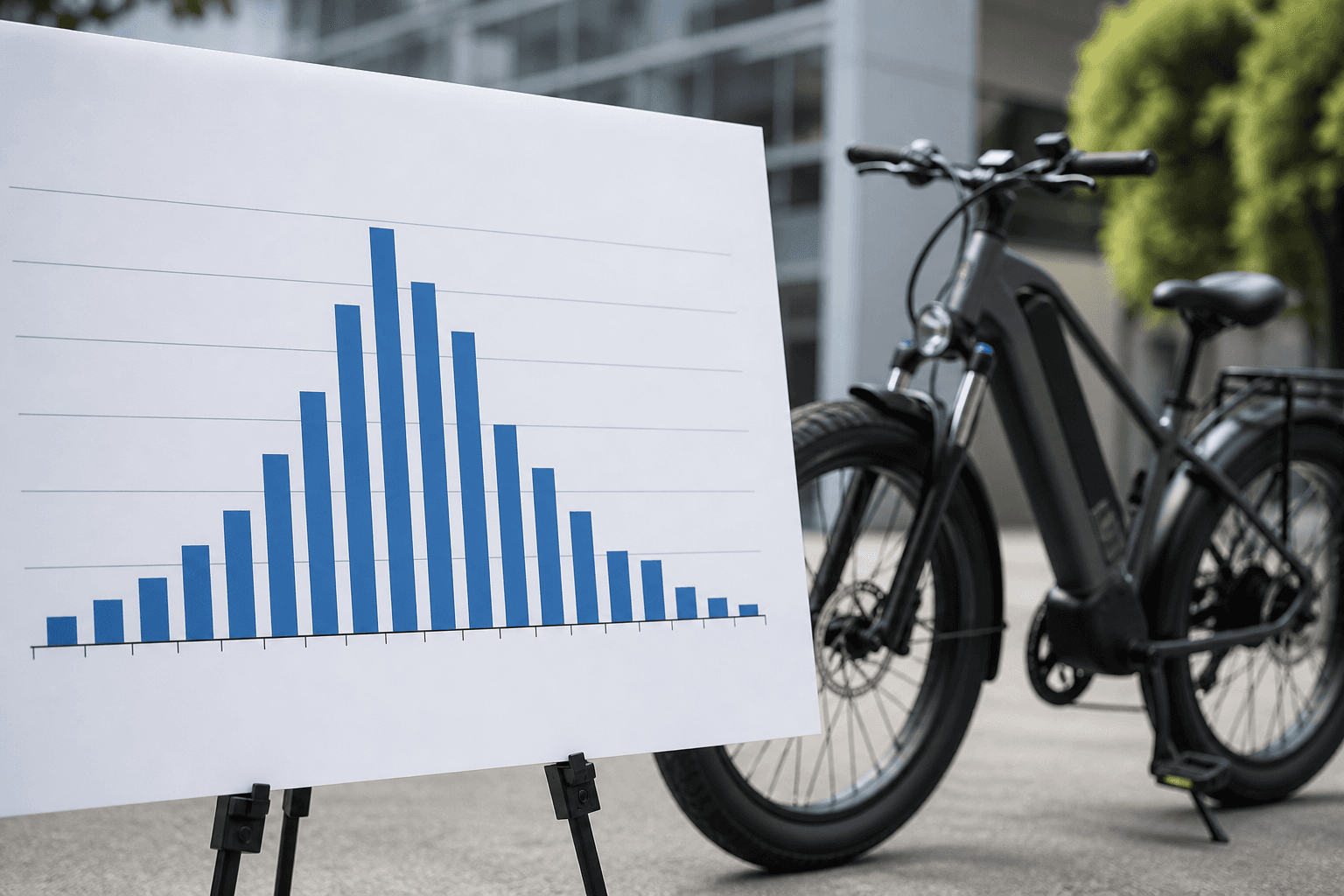

No. A $1,500 e-bike is not twice the bike a $750 one is. Doubling the price does not double any single figure. It does not double the battery, the range, or the weight saving. The catalogue holds 505 bikes. A quarter sit under 960 USD, half under 1299 USD, three quarters under 1781 USD. The median price is 1299 USD. The cheapest is 399 USD, the most expensive 5799 USD. Price spreads wide, but the specifications do not spread as wide.
What the Price Bands Actually Look Like
The catalogue splits into five bands. Under 800 USD holds 72 bikes. The 800 to 1200 USD band holds 143. The 1200 to 1600 USD band holds 131. The 1600 to 2200 USD band holds 106. Above 2200 USD holds 53. The middle is crowded. Most bikes cluster between 800 and 1600 USD. The extremes are thin.
Take the cheapest bike, the Fiido D3 Pro at 399 USD. It is a folding bike with a 374 Wh battery and an estimated range of 28 km. The most expensive, the Cyrusher Trident Full Suspension at 5799 USD, is a mountain bike with a 1040 Wh battery and an estimated range of 58 km. That is 14 times the price, but only 2 times the range. The median bike, the Heybike Ranger S at 1299 USD, has a 720 Wh battery and an estimated range of 53 km.
The price bands do not line up with type either. Mountain bikes are the most common at 190, but city bikes at 144, folding at 142, cargo at 26, touring at 2, and commuter at 1. A cheap mountain bike exists, the AAIRSK Q7 at 647 USD. An expensive folding bike exists, the ADO AIR Carbon at 4199 USD. Type does not set price.
Battery Size: The Biggest Single Difference
Battery size is the clearest thing price buys. The median battery is 720 Wh. The cheapest bikes often carry 374 Wh or less. The Fiido D3 Pro has 374 Wh. The Fafrees Hailong One, typical of the under 800 USD band, has 522 Wh. The Fiido E Gravel C22, typical of the 800 to 1200 USD band, has 614 Wh. The G-Force ZM, typical of the 1200 to 1600 USD band, has 960 Wh. The Vitilan H5 ALL Terrain, typical of the 1600 to 2200 USD band, has 1300 Wh. The Cyrusher Ranger, typical of the above 2200 USD band, has 1040 Wh.
But the pattern is not perfect. The most expensive bike, the Cyrusher Trident, has 1040 Wh. The Coswheel GT20 PRO at 2094 USD has 1920 Wh. The Onesport OT02 PRO at 755 USD has 187 Wh. The Hiboy C1 at 440 USD has 522 Wh. So a cheap bike can have a bigger battery than an expensive one.
A bigger battery does not automatically mean a longer range. Range depends on how you ride. A 720 Wh battery gives 94 km on easy riding, 48 km on ordinary riding, and 20 km on hard riding. The claimed range is 97 km for the median bike, but the estimated range is 47 km. The median overclaim is 50 percent. The widest overclaim is 84 percent on the Aventon Ramblas eMTB. The closest is the Hidoes C5, where the claim nearly matches the estimate.
| Battery (Wh) | Ordinary range (km) | Replacement pack (EUR) |
|---|---|---|
| 374 | 25 | 449 |
| 522 | 35 | 626 |
| 720 | 48 | 864 |
| 960 | 63 | 1152 |
| 1300 | 86 | 1560 |
Weight: Price Does Not Buy Lightness
The median bike weighs 29.5 kg. The lightest is 13.6 kg, the Fiido Air Carbon at 1799 USD. The heaviest is 56.7 kg, the Hiboy C1 at 440 USD. So the most expensive bike is not the lightest, and the cheapest is not the heaviest. The Cyrusher Trident at 5799 USD weighs 43.5 kg. The ADO AIR Carbon at 4199 USD weighs 15.9 kg. Price does not reliably buy lightness.
Weight matters if you carry the bike up stairs or lift it onto a rack. A 29.5 kg bike is heavy. A 13.6 kg bike is light. But a light bike often has a smaller battery. The Fiido Air Carbon has 614 Wh. The Hiboy C1 has 522 Wh. The lightest bike is not the one with the longest range.
The type also affects weight. Cargo bikes are heavy. The Mukkpet Breeze weighs 41.7 kg. The HIMIWAY Big Dog weighs 39.9 kg. Folding bikes vary. The Fiido D3 Pro weighs 17.7 kg. The Hiboy C1 weighs 56.7 kg. The lightest folding bike is the ADO AIR Carbon at 15.9 kg.
Torque and Motor: What You Feel on Hills
Torque is the twisting force from the motor. It helps you accelerate and climb. The catalogue lists a torque figure for 433 bikes. The highest torque is 180 Nm on the Coswheel R6000. The lowest is not stated, but many cheap bikes have modest motors. A mid-drive motor is counted from 60 Nm. Hub motors are common on cheap bikes, mid-drives on expensive ones.
Servicing costs differ. A hub motor costs 120 EUR a year to service. A mid-drive costs 180 EUR a year. So a bike with a mid-drive motor costs more to maintain. The Coswheel R6000 has 180 Nm and is a mid-drive. The Fiido D3 Pro has a hub motor.
Torque does not always rise with price. The Cyrusher Trident at 5799 USD has a torque figure, but the highest torque is on a 1770 USD bike. The cheapest mountain bike, the AAIRSK Q7, has a torque figure. The most expensive city bike, the ADO AIR 30 PRO, has a torque figure. Check the spec.
Range: The Claim vs The Reality
The median claimed range is 97 km. The median estimated range is 47 km. That is a 50 percent overclaim. Only 22 bikes have a claim that does not exceed the estimate. The Hidoes C5 is the closest. The Aventon Ramblas eMTB is the widest, claiming 84 percent more than the estimate.
Range depends on assist level, terrain, tyres, temperature, and pace. The formula uses constants: Eco 7 Wh per km, Tour 11, Sport 15, Turbo 20. Terrain multipliers: flat 1, rolling 1.25, steep 1.6. Tyre multipliers: road 1, hybrid 1.1, knobby 1.25. Temperature multiplier: mild 1, cold 1.2. Pace multiplier: relaxed 0.9, brisk 1, fast 1.3. Rider weight adjusts 1 percent per 5 kg from 80 kg.
A 720 Wh battery gives 94 km on easy riding, 48 km on ordinary, 20 km on hard. In the cold, it gives 40 km. On knobby tyres, 42 km. On road tyres, 52 km. So a cheap bike with a small battery might give 25 km, while an expensive one with a big battery gives 60 km. But the expensive one might claim 100 km.
| Riding style | Range (km) | Band (km) |
|---|---|---|
| Easy | 94 | 82 to 105 |
| Ordinary | 48 | 42 to 53 |
| Hard | 20 | 18 to 23 |
Cost of Ownership: The Price Tag Is Just the Start
The purchase price is only part of the cost. Over five years, a median bike costs 1573 EUR total. That includes the price, charging, servicing, and resale. Charging costs 63 EUR over five years. Servicing costs 600 EUR. Resale recovers 293 EUR. The cost per km is 0.10 EUR.
Charging is cheap. Charging a median battery once costs 0.20 EUR at 0.28 EUR per kWh. Electricity to ride 100 km costs 0.42 EUR. Riding 1000 km a year costs 4 EUR in electricity. Riding 3000 km costs 13 EUR. Riding 5000 km costs 21 EUR. So the electricity is negligible.
The battery is a big cost. A 720 Wh replacement pack costs 864 EUR. The battery lasts 800 full cycles. That is 38400 km on a median bike. If you ride 50 km a week, the battery lasts many years. If you ride 200 km a week, it lasts fewer.
Servicing depends on motor type. Hub motor: 120 EUR a year. Mid-drive: 180 EUR a year. Over five years, that is 600 EUR for a hub, 900 EUR for a mid-drive. The median bike's five-year servicing is 600 EUR, suggesting a hub motor.
How Much You Save vs Driving
Riding an e-bike instead of driving saves money. The savings calculator compares the two. If you ride 50 km a week instead of driving, you save 486 EUR a year. At that rate, a 1203 EUR bike pays for itself in 30 months. Ride 100 km a week, save 1072 EUR a year, payback in 13 months. Ride 200 km a week, save 2245 EUR a year, payback in 6 months.
The savings come from avoiding car costs. The formula uses car costs: maintenance 0.06 EUR per km, depreciation 0.12 EUR per km, parking 0.02 EUR per km. That totals 0.20 EUR per km. An e-bike costs 0.04 EUR per km in maintenance plus 100 EUR a year servicing. Electricity is extra but tiny.
A more expensive bike takes longer to pay back. A $1,500 bike costs more than a $750 one, so the payback period is longer. But if you ride a lot, the savings still add up. The calculator lets you enter your own mileage and car costs.
Financing: What the Monthly Payment Really Costs
Many bikes are bought on credit. A 1203 EUR bike over 24 months at 0 percent APR costs 50 EUR a month and 0 EUR interest. At 9.9 percent APR, it costs 55 EUR a month and 128 EUR in interest. That 128 EUR is a small price for spreading the cost, but it adds up.
The interest rate matters more than the bike price. A 0 percent deal makes an expensive bike affordable. A high rate can make a cheap bike cost more over time. Compare the total cost of credit, not just the monthly payment.
The finance calculator works out the monthly payment and total interest. Use it before you sign. A 0 percent offer is common but not universal. Check the APR and the term.
What to Look For in Your Price Band
Under 800 USD, you get a basic bike. The Fiido D3 Pro at 399 USD has a 374 Wh battery and 28 km range. The VIVI C26UL at 500 USD has 374 Wh and 27 km. The Fafrees Hailong One at 699 USD has 522 Wh and 38 km. These are fine for short, flat rides.
In the 800 to 1200 USD band, batteries grow. The Fiido E Gravel C22 at 999 USD has 614 Wh and 45 km. The Koolux RK10 at 1068 USD has 624 Wh and 45 km. The Cyrusher Voyage at 917 USD has 504 Wh and 33 km. You get more range and often better components.
In the 1200 to 1600 USD band, the median price sits. The Heybike Ranger S at 1299 USD has 720 Wh and 53 km. The G-Force ZM at 1399 USD has 960 Wh and 55 km. The Mukkpet Breeze at 1499 USD has 720 Wh and 46 km. This is the sweet spot for many riders.
Above 1600 USD, you pay for brand, weight, or special features. The Vitilan H5 at 1894 USD has 1300 Wh and 74 km. The Cyrusher Ranger at 2599 USD has 1040 Wh and 61 km. The ADO AIR 30 PRO at 3335 USD has only 370 Wh and 27 km. The ADO AIR Carbon at 4199 USD has 346 Wh and 26 km. Price does not guarantee range.
The Real Differences Between Cheap and Expensive
So what does doubling your money buy? It buys a bigger battery, often double the watt hours. It buys more torque, which helps on hills. It buys a lighter frame, sometimes. It buys better components, which may last longer. But it does not buy double the range, because range claims are inflated across all bands.
The median overclaim is 50 percent. A cheap bike that claims 50 km might do 25 km. An expensive bike that claims 100 km might do 50 km. The ratio stays the same. The expensive bike does go farther, but not twice as far for twice the price.
Weight is not a reliable differentiator. The lightest bike is 1799 USD, not the most expensive. The heaviest is 440 USD. If weight matters, check the spec, not the price.
Servicing costs can erase the price difference. A mid-drive bike costs 180 EUR a year to service, a hub motor 120 EUR. Over five years, that is 300 EUR more. If you buy a 1500 USD mid-drive, you might spend more on servicing than a 750 USD hub motor.
The best bike for you is the one that fits your riding. If you ride 5 km to work on flat roads, a 750 USD bike is enough. If you ride 30 km on hills, a 1500 USD bike with a bigger battery and more torque is worth it. Use the calculators to compare real costs.
What to Do Next
Start with the range calculator to see how far a bike will go for you. Then use the cost of ownership calculator to see the five-year total. Compare a few bikes in your price band. Do not rely on the claimed range. Do not assume price equals quality.
The catalogue has 505 bikes. Filter by type, price, and battery. The find-my-ebike tool can narrow it down. Read the methodology to understand every formula. Then make a decision based on numbers, not marketing.
Frequently asked questions
Is a more expensive e-bike always better?
Not always. Price often buys a larger battery, a stronger motor, and better components. But a cheap bike can suit a short flat commute, while an expensive one may be wasted on the same ride. Check the specifications that matter for your use.
What do I get for doubling my budget?
You typically get a larger battery, more torque, and a lighter frame. But range depends on your riding style and terrain. A bike with a 720 Wh battery can go 48 km in ordinary riding, not the 97 km claimed. Doubling price does not double range.
Are cheap e-bikes reliable?
Reliability depends on the brand and components, not just price. Some budget bikes have decent parts, but servicing costs can add up. A hub motor costs 120 EUR a year to service, a mid-drive 180 EUR. Factor that into your budget.
How much does it cost to run an e-bike?
Charging is cheap. Riding 100 km costs 0.42 EUR in electricity. Servicing and battery replacement are bigger costs. Over five years, a median bike costs 1573 EUR total, including price, charging, servicing, and resale. Use the cost of ownership calculator.
Should I finance an e-bike?
Financing can make a bike affordable, but interest adds up. A 1203 EUR bike over 24 months at 0 percent APR costs 50 EUR a month. At 9.9 percent APR, it costs 55 EUR a month and 128 EUR in interest. Compare offers before you commit.