
Should you buy last year's model? The answer is yes if the discount is bigger than the extra resale drop. That is the whole trade. A new model costs more now, but it holds value better. An old model costs less now, but it loses value faster. The rest is detail.
What Actually Changes Between Model Years
Look at the catalogue. It holds 505 bikes from 62 brands. The median price is 1299 USD. The median battery is 720 Wh. The median weight is 29.5 kg. Those numbers barely move from year to year. What changes is usually small.
A manufacturer might fit a bigger battery, a new motor, or a colour screen. Sometimes they change the frame geometry. Sometimes they only change the paint. The core components, the battery and motor, often stay the same across a generation. That means last year's model is often mechanically identical to this year's.
The real change is the price. When a new model arrives, shops discount the old one to clear stock. That discount is the reason to consider last year's bike. The question is whether the discount is enough.
How Resale Value Decays
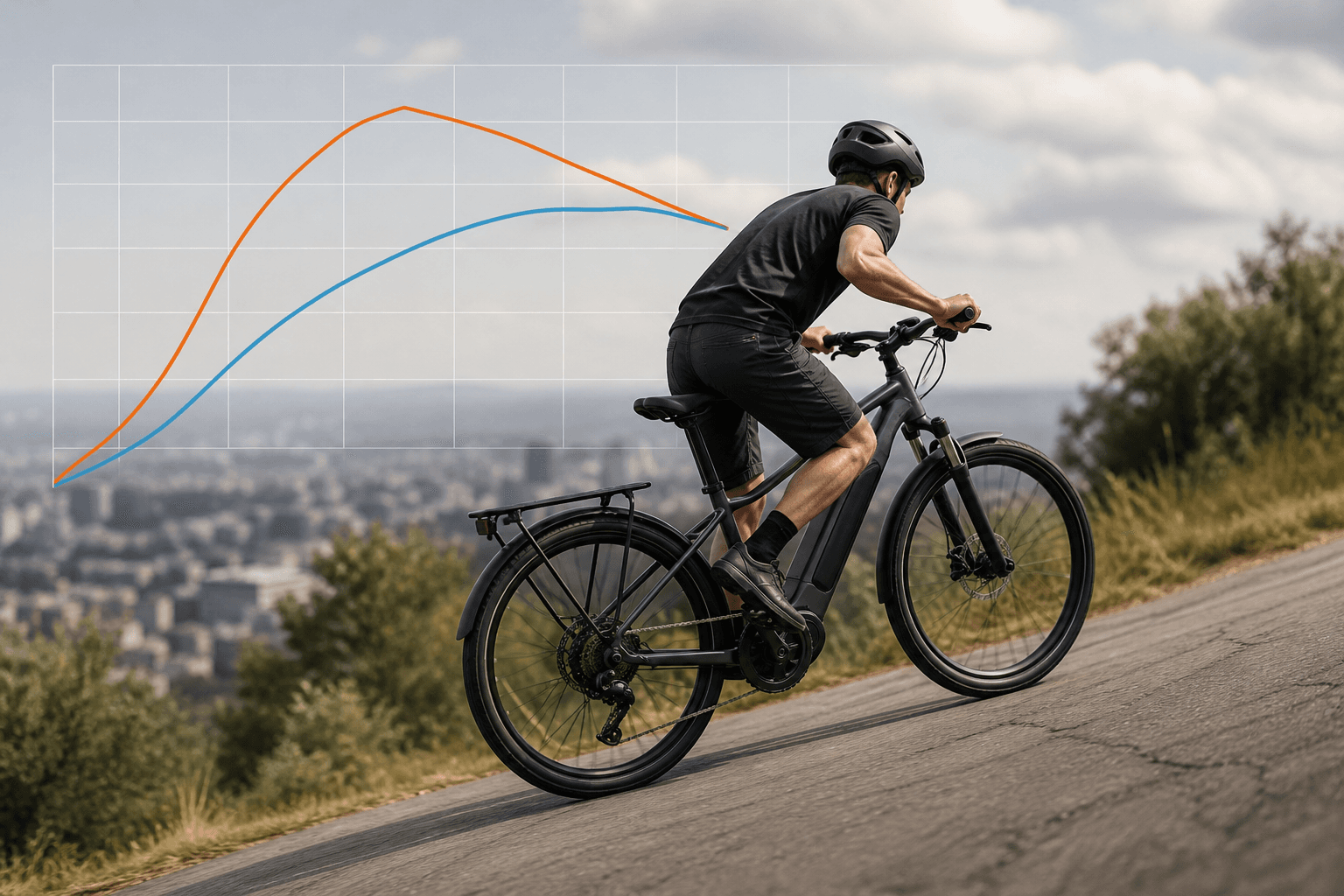
Our cost model uses a simple formula for resale after n years: 0.6 times e to the power of -0.18 times n, floored at 0.15. That means a bike retains 60 percent of its value at year zero, then loses value quickly at first. After 5 years, the value is low. After many years, it hits the floor of 15 percent.
For a median bike priced at 1299 USD, the resale after 5 years is 293 EUR. That is one figure from the worked examples. The exact amount in your currency depends on the exchange rate, but the shape is the same. Last year's model starts with a lower price, so its resale value is lower in absolute terms.
The key is the rate of decay. A bike that is one year old has already taken the biggest hit. If you buy it now and sell it in 3 years, the drop from your purchase price is smaller than if you bought new and sold after 3 years. That is the argument for buying last year's model.
Compare the Discount to the Extra Depreciation
Suppose a bike costs 1299 USD new. A year later, the same bike is discounted to 1000 USD. You save 299 USD upfront. But when you sell it after 5 years, the resale value is lower because the original price was lower. The question is whether the 299 USD saving covers that loss.
Our cost of ownership calculator does this comparison. It totals five years of price, charging, servicing, battery and resale. You enter the price you pay, your annual mileage, and your electricity tariff. The calculator shows the cost per km and the total over 5 years.
The worked example for a median bike shows five years total at 1573 EUR. That includes charging at 63 EUR, servicing at 600 EUR, and resale at 293 EUR. The price of the bike is part of that total. If you pay less upfront, the total drops, but the resale also drops.
What Does Not Change: The Ride and the Range
The riding experience depends on the battery, motor, and bike weight. Those do not change much between model years. The median battery is 720 Wh. The median weight is 29.5 kg. A bike from last year with the same battery and motor will ride the same as this year's model.
Range is a function of battery size and riding conditions. Our range calculator uses assist consumption of 7 Wh per km in Eco, 11 in Tour, 15 in Sport, and 20 in Turbo. It applies multipliers for terrain, tyres, temperature, and pace. A 720 Wh battery gives 48 km in ordinary riding, with a band of 42 to 53 km. That is the same whether the bike is last year's or this year's.
Manufacturers often overclaim range. In our catalogue, 483 bikes out of 505 have a claim that exceeds the estimate. The median overclaim is 50 percent. So ignore the marketing and use the estimate. Last year's model is not worse in this regard.
Battery Health: The Hidden Variable
Battery life is measured in full cycles. Our formula assumes 800 full cycles. A battery that has been through many cycles will hold less charge. Last year's model might have been a floor model, ridden by customers, or it might have sat in a warehouse. You cannot tell from the specification alone.
Ask the seller about the battery's history. How many cycles has it done? Was it stored at a reasonable temperature? A battery that has done 100 cycles is fine. A battery that has done 500 cycles is closer to replacement. The replacement cost is significant. For a 720 Wh pack, the replacement cost is 864 EUR at 1.2 EUR per Wh.
The cost of ownership calculator includes battery replacement. It assumes the battery lasts 800 cycles. If you buy a used bike with a degraded battery, you might need to replace it sooner. That cost can wipe out the discount.
Servicing and Maintenance: Same Costs
Servicing costs depend on the motor type, not the model year. Our model counts a motor as a mid-drive from 60 Nm. Servicing is 120 EUR per year for a hub motor and 180 EUR per year for a mid-drive. Last year's model with the same motor will cost the same to service.
The catalogue shows that 433 bikes have a stated torque figure. The highest torque is 180 Nm. Many bikes are above 60 Nm, so they count as mid-drives. That means higher servicing costs. But again, this is the same for new and old models.
One difference is warranty. A new bike comes with a full warranty. Last year's model might have a shorter warranty or none at all. If something breaks, you pay out of pocket. That risk is part of the cost. The cost of ownership calculator does not include warranty, so you must judge that yourself.
When Last Year's Model Is a Clear Win
There are cases where buying last year's model is clearly better. If the discount is large, say 30 percent or more, and you plan to keep the bike for many years, the savings are real. The resale value matters less if you never sell.
Consider the Fiido D3 Pro. It is the cheapest bike in the catalogue at 399 USD. A discount on last year's model would make it even cheaper. The battery is 374 Wh, and the estimated range is 28 km. That is enough for short commutes. If the bike fits your needs, the low price is hard to beat.
On the other end, the Cyrusher Trident Full Suspension is the most expensive at 5799 USD. A 20 percent discount saves over 1000 USD. That is a significant amount. But the resale value of a 5799 USD bike drops fast. Use the calculator to see if the discount covers the loss.
When to Buy This Year's Model
Buy this year's model if the changes matter to you. A bigger battery, a more powerful motor, or a better display can improve your ride. The catalogue shows a wide spread in battery sizes, from 187 Wh to 1920 Wh. If last year's model has a small battery and this year's has a larger one, the upgrade might be worth the extra cost.
Also buy new if you plan to sell in a few years. The resale value of a new bike is higher, and the faster depreciation happens in the first years. If you sell after 2 or 3 years, the new bike might cost less overall despite the higher upfront price.
Finally, buy new if you want the full warranty and the latest safety features. E-bike technology is improving, especially in battery management and motor efficiency. Last year's model might lack a feature that is standard this year.
| Scenario | Buy Last Year's | Buy This Year's |
|---|---|---|
| Discount is 20% or more | Yes | No |
| You keep the bike for 5+ years | Yes | No |
| You sell after 2 years | No | Yes |
| Battery size increased this year | No | Yes |
| You want the full warranty | No | Yes |
The Role of Financing
If you finance the bike, the interest adds to the cost. The cost of ownership calculator does not include financing, but our finance calculator does. For a 1203 EUR bike over 24 months at 0 percent APR, the monthly payment is 50 EUR and the interest is 0 EUR. At 9.9 percent APR, the monthly payment is 55 EUR and the interest is 128 EUR.
A discount on last year's model reduces the amount you finance. That reduces the interest you pay. So financing can make last year's model even more attractive. But be careful with long loan terms. A 24-month loan on a bike that lasts 5 years is fine. A 48-month loan on a bike that dies in 3 years is not.
How to Decide: A Simple Process
- Find the bike you want, both last year's and this year's model.
- Note the price difference and the specification changes.
- Estimate how many km you will ride per week.
- Run the cost of ownership calculator for both prices.
- Compare the 5-year totals. The lower total is the better deal, all else equal.
The cost of ownership calculator uses your mileage, electricity tariff, and the bike's price. It totals five years of price, charging, servicing, battery and resale. The worked example for a median bike shows a total of 1573 EUR over 5 years. That includes charging at 63 EUR, servicing at 600 EUR, and resale at 293 EUR. Your numbers will differ.
Remember that the resale value is an estimate. The actual resale depends on the market, the condition of the bike, and the brand. But the formula gives a consistent basis for comparison.
What to Do Next
Start by browsing the catalogue to see what is available. Use the filters to narrow by type, price, and battery size. Then pick a few bikes that interest you. For each, compare last year's model if you can find it.
Run the cost of ownership calculator for each option. The calculator is at /calculators/cost-of-ownership. It will show you the total cost over 5 years, including the resale value. That number is your decision tool.
If the discount on last year's model is large and you plan to keep the bike, buy it. If the changes are important to you or you plan to sell soon, buy this year's. The choice is yours, but the numbers will guide you.
Frequently asked questions
Is last year's model always a worse deal?
No. The deal depends on the discount and how long you keep the bike. If the discount is large and you plan to ride for years, the lower upfront price can outweigh the faster resale drop. Use the cost of ownership calculator with both prices to compare.
What usually changes between model years?
Manufacturers often update the battery, motor, display, or frame geometry. Sometimes they only change the paint. The catalogue shows that most bikes share similar components, so the changes are rarely dramatic.
How much does resale value drop each year?
Our formula for resale after n years is 0.6 times e to the power of -0.18 times n, floored at 0.15. That means a bike loses value quickly in the first years, then the drop slows. The exact dollar amount depends on the original price.
Should I worry about battery degradation on an older model?
Battery life is measured in full cycles, and our formula assumes 800 full cycles. A bike that sat in a warehouse may have few cycles, but a demo model could have many. Ask the seller about the battery's history and check the pack's condition.
Where can I see the total cost of ownership?
Use our cost of ownership calculator. It totals five years of price, charging, servicing, battery and resale. You enter the bike price, your mileage, and your electricity tariff. The calculator does the arithmetic.